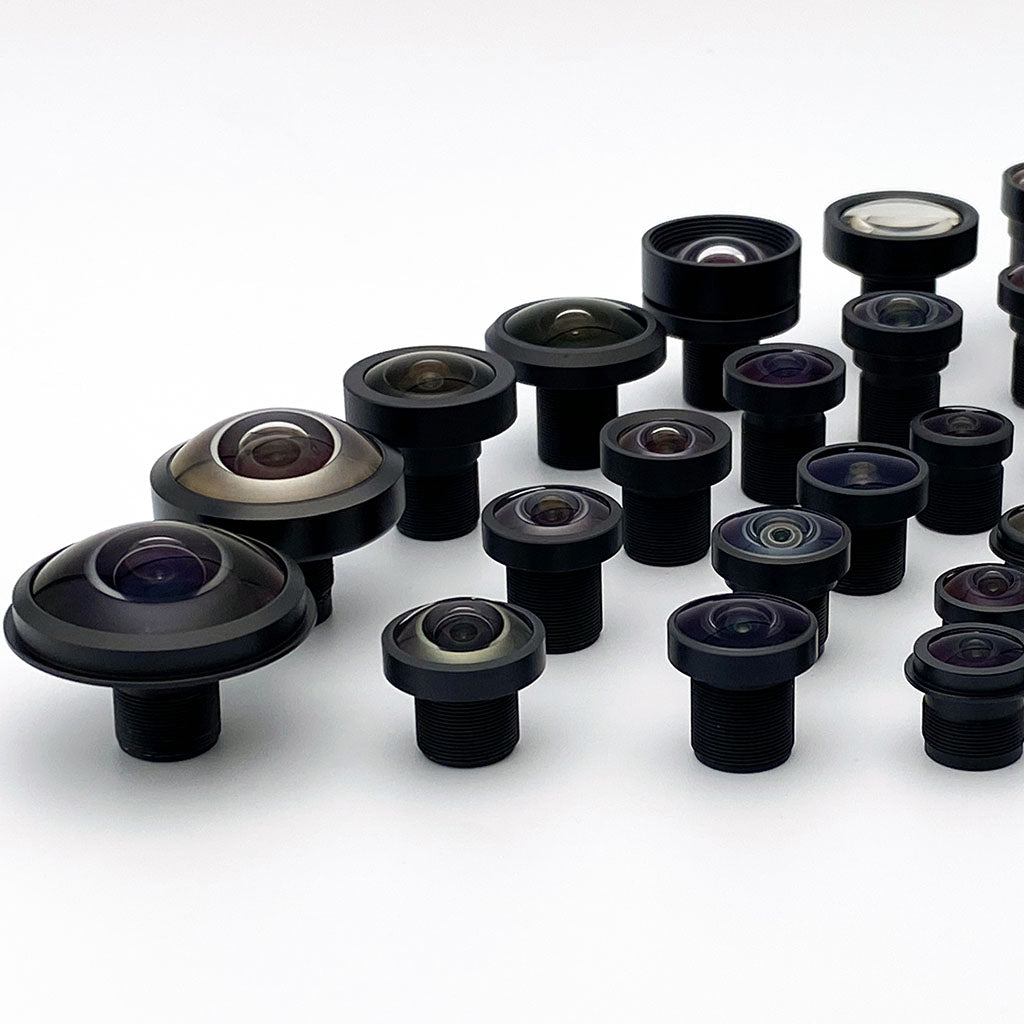

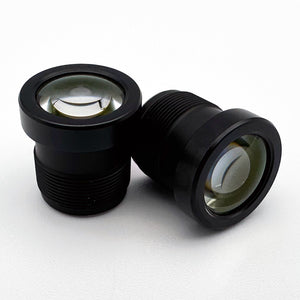
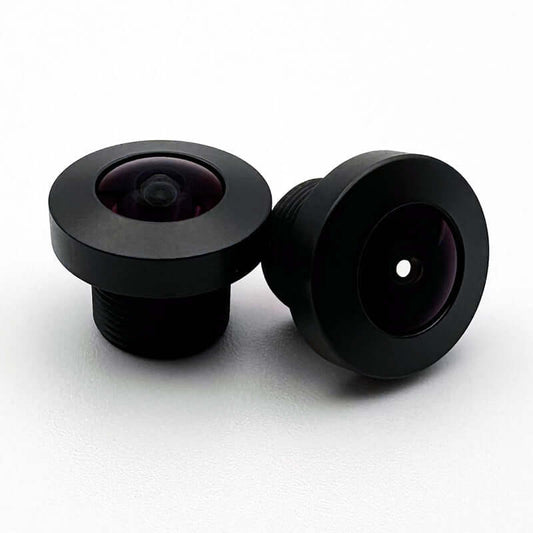
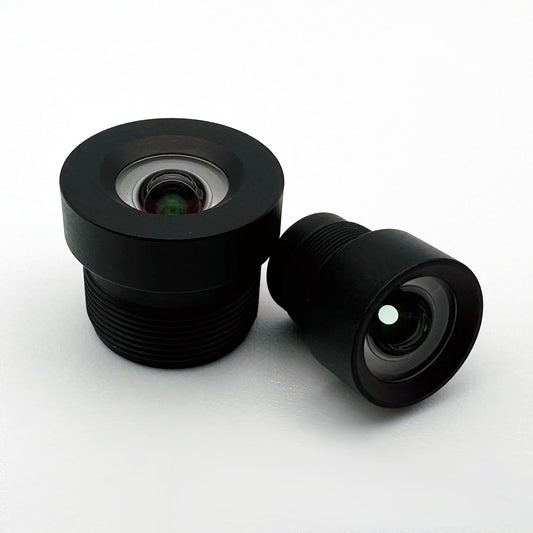
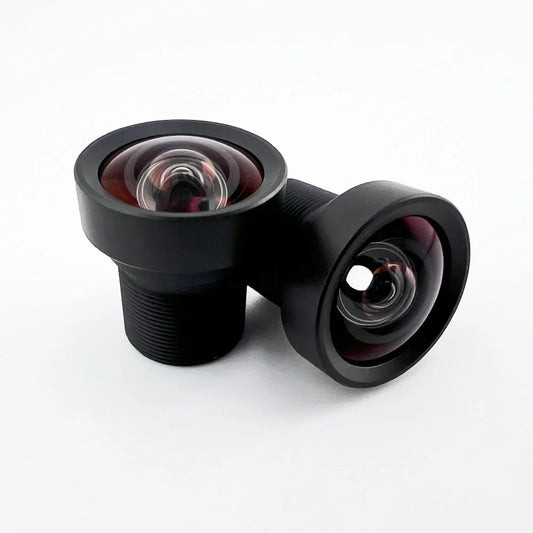
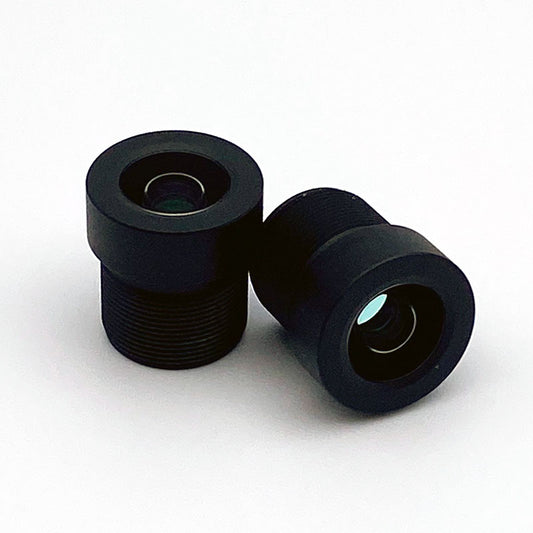
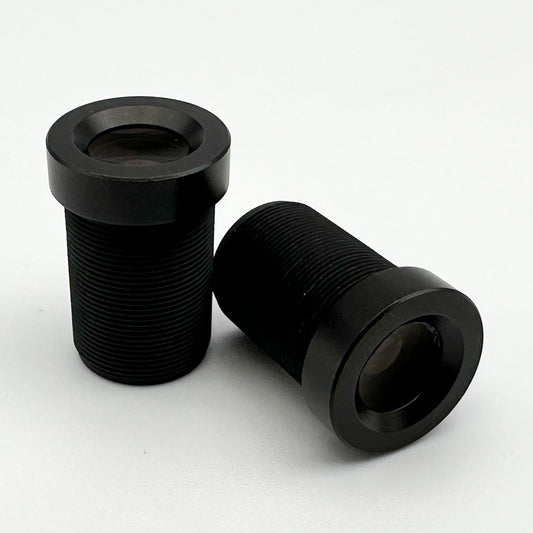
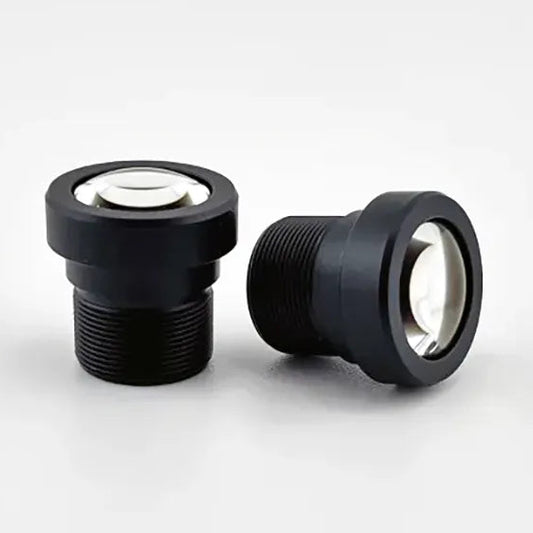
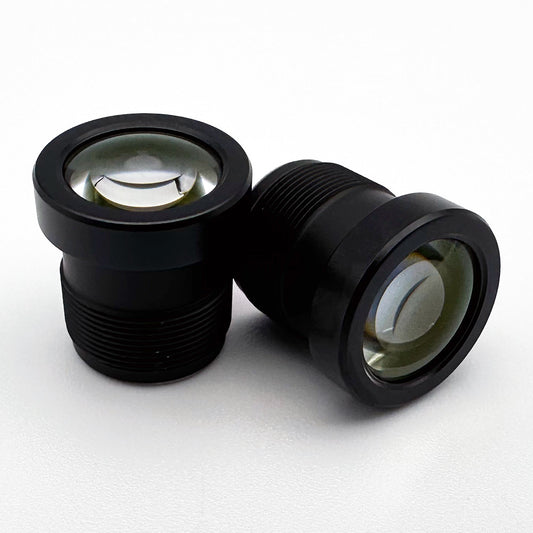
Kameraoptik auf Leiterplattenebene

Objektive für Embedded-Vision -Kameramodule auf Platinenebene

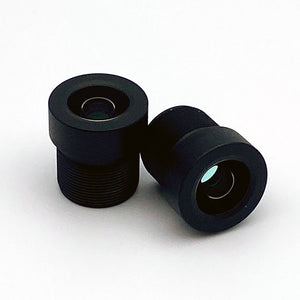
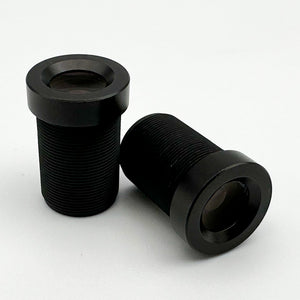
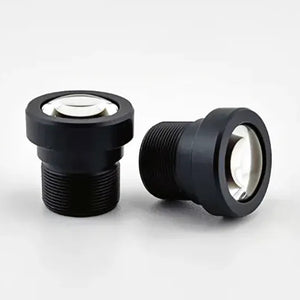
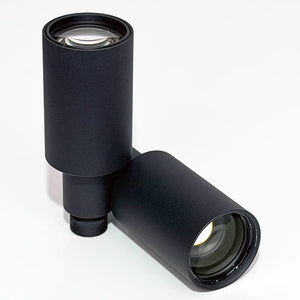
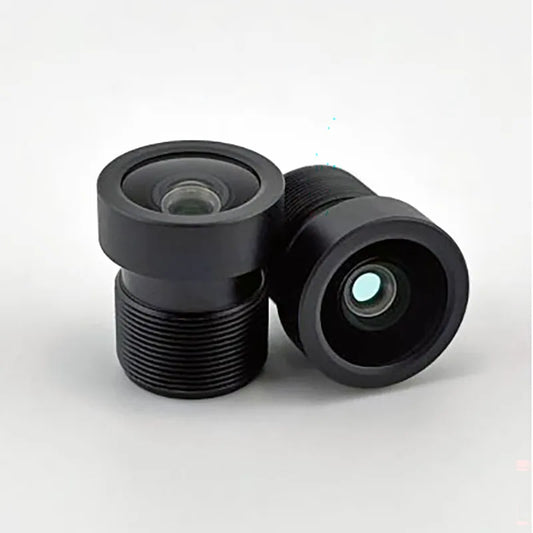
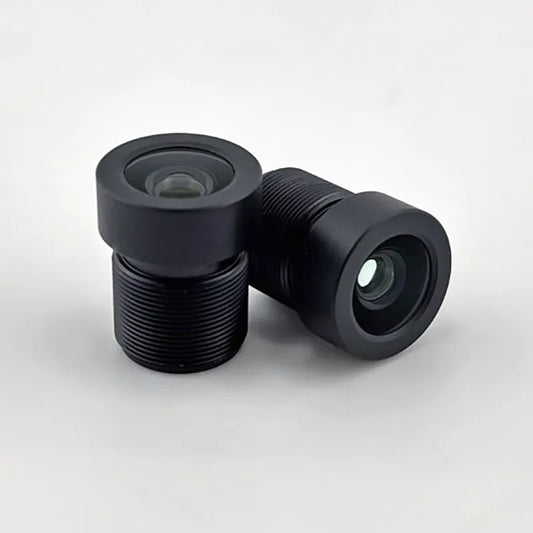
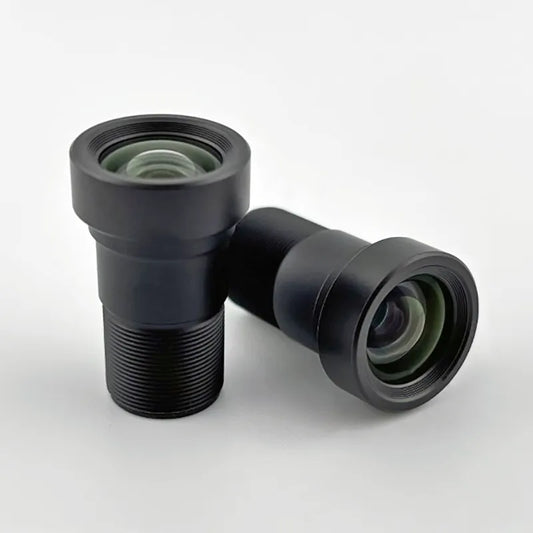
M12-Objektive (S-Mount), die direkt in eine auf einer Leiterplatte montierte Halterung an Jetson-, Raspberry Pi- und anderen MIPI-CSI2-Kameramodulen eingeschraubt werden können und hinsichtlich Sensorabdeckung, Übereinstimmung des Hauptstrahlwinkels und Halterungshöhe ausgewählt wurden.

The lenses below are the designs already used in board-camera integration work, chosen on image circle, chief ray angle match, and holder height rather than headline focal length. If you want the full catalog rather than the embedded subset, browse all M12 lenses.

0.8mm–7.8mm Featured focal lengths
F/1.45–F/2.3 Featured apertures
3 g–15 g Gewicht des M12-Objektivs
Ein Embedded-Vision-System, bestehend aus einer M12-Kamera auf Board-Ebene, die an einen Einplatinencomputer angeschlossen ist

M12 (S-mount) lenses are the default for embedded vision because they thread directly into a PCB-mounted holder at 3g-15g, cover sensors up to 1/1.8 inch typically with select designs to 2/3 inch, and cost a fraction of industrial C-mount optics. Use C-mount or CS-mount only when the application needs an adjustable iris, a larger sensor, or a level of aberration correction the chosen M12 design does not reach.

Die Anleitungen auf dieser Seite befassen sich mit der Anpassung von Sensoren und Hauptstrahlwinkeln, der Integration auf Platinenebene mit Jetson- und Raspberry-Pi-Kameramodulen sowie dem Kompromiss zwischen Leistungsaufnahme, Größe und Kosten, der die meisten Entscheidungen bei eingebetteten Objektiven bestimmt.

Objektivauswahl nach eingebetteter Anwendung

Je nachdem, welche Aufgabe die Kamera erfüllen muss, werden die Brennweite und die Blende festgelegt sowie entschieden, ob das Objektiv abgedichtet werden muss oder eine IR-Korrektur benötigt.

Edge-KI und NVIDIA Jetson-Plattformen

Die Module Jetson Nano, Xavier NX und Orin werden in der Regel mit MIPI-CSI2-Kameraplatinen kombiniert, die über M12-Halterungen verfügen. Für allgemeine Bildverarbeitungsanwendungen im Bereich von Armlänge bis hin zum Raummaß deckt eine Brennweite von 4 mm bis 8 mm die meisten Anwendungsfälle ab; 2 mm bis 3 mm eignen sich für Rundumsicht und Hinderniserkennung, bei denen eine breite Abdeckung wichtiger ist als feine Details.

Robotik und AMR-Navigation

Mobile robots typically run two different camera roles on two different lenses. Obstacle avoidance benefits from wide-angle or fisheye coverage where geometric accuracy does not matter. SLAM runs on either: calibrated fisheye and omnidirectional camera models are standard in current SLAM stacks, so what the front end needs is a camera model that fits the lens, a calibration that holds, well-localized features, and enough field of view. Low distortion keeps a plain pinhole model valid and skips the undistort step, which is why it stays the simpler starting point.

Überwachung und Sicherheit

Für den Tag-/Nachtbetrieb ist sowohl eine Möglichkeit zum Einlassen von Nahinfrarotlicht als auch ein IR-korrigiertes Objektiv erforderlich, um den Fokus über beide Wellenlängenbereiche hinweg aufrechtzuerhalten. Ein Standardobjektiv mit einem festen IR-Sperrfilter blockiert Nahinfrarotlicht, sodass die Kamera praktisch blind wird, sobald nachts eine 850-nm-Beleuchtung eingeschaltet wird. Für die Leistung bei schlechten Lichtverhältnissen ist die Blende wichtiger als die meisten anderen Spezifikationen: Ein Objektiv mit einer Blende von F/1,4 lässt etwa viermal so viel Licht ein wie ein Objektiv mit einer Blende von F/2,8.

Drohnen und UAVs

Weight is payload budget on a drone. Motor vibration adds micro-blur, and a climb can carry the camera across a wider temperature range than a fixed ground install ever sees, though how wide and how fast depends on the mission profile, the weather, and how the enclosure is vented.

Construction is a shortlisting signal rather than a thermal spec: athermal focus is a design result, not a material label, and neither glass nor metal implies a vibration or ingress rating. Check the measured thermal focus behavior, the vibration spec, and the IP code on the SKU you plan to fly.

Medizinische Bildgebung und Endoskopie

Ultra-compact M8 lenses fit the space constraints of endoscopes and medical imaging probes, typically at short working distances (5mm-30mm) and small image circles. Off-the-shelf parts like these belong in prototypes and non-diagnostic imaging; once a lens touches patients, faces sterilization cycles, or falls under regulatory review, it needs a custom qualification program, so bring those requirements to engineering before specifying a part.

Barcode-Erfassung und OCR auf eingebetteten Lesegeräten

Feste Hand- und Tunnel-Barcodescanner sind im Grunde genommen eingebettete Bildverarbeitungssysteme: ein kleiner Sensor, ein kurzer Arbeitsabstand und in der Regel wenig Platz für ein sperriges Objektiv. Engere Brennweiten (8 mm–16 mm) erfassen feine Barcode-Module und kleinen Text aus kurzer Entfernung, und dank geringer Verzerrung liegen die Dekodierraten am Bildrand nahe an der Leistung im Bildzentrum.

Die besten M12-Objektive für Embedded-Vision-Anwendungen

The six lenses named in the spec table further down span 0.8mm to 7.8mm focal length, at F/1.45 to F/2.3 in the variants listed, covering general-purpose vision, wide-angle low-light surveillance, low-distortion SLAM, and ultra-wide surround view on Jetson and Raspberry Pi camera modules. The cards below pull live from the collection, which also carries longer focal lengths for narrow-field work such as inspection and barcode reading. Everything in it is stocked and threads into a standard M12x0.5mm holder.

Türklingelkamera mit Miniatur-M8-Fischaugenobjektiv D

195°@5,2 mm Fisheye-Objektiv

$29.00

.STP herunterladenProdukt anzeigen
M8x0,35-Objektive für IMX415

Kleines 2,8-mm-Objektiv

$29.00

.STP herunterladenProdukt anzeigen
Basler Dart-Kamera IP67 mit M12-Objektiv

Low Distortion 3.2mm M12 Lens

$39.00

.STP herunterladenProdukt anzeigen
6-mm-M12-Objektiv für Blackfly-Kameras mit S-Mount

Schnelles 6-mm-M12-Objektiv

$39.00

.STP herunterladenProdukt anzeigen
IP67, 12 mm, M12-Objektiv

IP67, 12 mm, M12-Objektiv

$39.00

.STP herunterladenProdukt anzeigen
IR-korrigiertes 16-mm-M12-Objektiv

IR-korrigiertes 16-mm-M12-Objektiv, 8 MP

$70.00

.STP herunterladenProdukt anzeigen
75-mm-M12-Objektiv

75-mm-M12-Objektiv, IR-korrigiert

$129.00

.STP herunterladenProdukt anzeigen
14-mm-M12-Objektiv CIL142

Teleobjektiv 14,2 mm M12

$59.00

.STP herunterladenProdukt anzeigen

Objektive für Embedded-Vision-Anwendungen durchsuchen | M12-Objektive | S-Mount-Objektive

Wie wir unsere Auswahl getroffen haben

Jedes der hier vorgestellten Objektive basiert auf einem M12-Design, das bereits bei der Integration von Platinenkameras zum Einsatz kommt, und reicht von Allzweckobjektiven bis hin zu speziellen Ultraweitwinkelobjektiven. Wir geben die Brennweite und die Blendenzahl an, da es sich hierbei um feste Objektivspezifikationen handelt, anhand derer Sie Ihre Auswahl treffen. Der Hauptstrahlwinkel ist bewusst nicht als Spalte aufgeführt: Der Hauptstrahlwinkel ist eine Anforderung für die Anpassung an den jeweiligen Sensor und keine herausragende Objektivspezifikation. Daher muss jedes in Frage kommende Objektiv vor der endgültigen Entscheidung anhand der Hauptstrahlwinkelkurve der Mikrolinsen Ihres Sensors überprüft werden.

Welcher Objektivanschluss eignet sich am besten für Embedded-Kameras?

M12 (S-Mount) ist der Standard für Embedded-Vision-Anwendungen. Er bietet mit 3g-15g den kleinsten Formfaktor, lässt sich ohne Adapterplatte direkt in eine auf einer Leiterplatte montierte Halterung einschrauben und ist kostengünstiger als industrielle C-Mount-Alternativen.

Montage Thema Typisches Gewicht Am besten geeignet für Sammlung
M12 (S-Mount) M12 × 0,5 mm 3 g–15 g Robotik, Drohnen, Edge-KI, Bordkameras M12-Objektive
M8 M8x0,35 oder M8x0,5 1 g – 5 g Ultrakompakte Mikrokameras für die Endoskopie M8-Objektive
CS-Anschluss 1"-32 UN, 12,526 mm Flansch 50 g–150 g Compact industrial, Raspberry Pi High Quality Camera (C/CS version) Grundlagen zum CS-Anschluss
C-Mount 1"-32 UN, 17,526 mm Flansch 50 g–200 g Umfassende industrielle Inspektion mit hoher Auflösung C-Mount-Objektive

M8 ist für extreme Miniaturisierung gedacht, bei der die Sensorabdeckung in der Regel bis zu 1/3 Zoll beträgt und die Auswahl an Brennweiten geringer ist. CS- und C-Mount kommen ins Spiel, wenn Sie eine größere Sensorabdeckung, einen einstellbaren Blendenring zur Steuerung der Schärfentiefe oder eine Korrektur in Industriequalität benötigen, für die das starre M12-Gehäuse mit fester Blende in der Regel nicht ausgelegt ist. Lesen Sie den vollständigen Leitfaden zum Vergleich von M12-, C- und CS-Mount.

Systemunterscheidung

C-mount and M12 are different optical systems, not two sizes of the same thing. An adjustable C-mount lens focuses by rotating a ring, often paired with a separate iris ring; what that ring actually moves (the whole cell, a front group, or internal groups on a cam) is a design choice, so confirm it on the datasheet or with Commonlands engineering. The C-mount standard itself fixes the 1"-32 thread and the 17.526mm flange and nothing else, and C-mount lenses variously use unit focus, front-cell focus, or no focus adjustment at all.

M12 is a rigid optical assembly with no internal moving groups; focus is set by threading the entire lens in or out of the holder.

The same caution applies to "minimum object distance" (MOD). On a focus-ring C-mount lens the near limit arrives however that design fails: center focus unreachable at the ring's stop, field curvature pulling the edges away first, or the moving group running out of travel. An M12 lens has no focus ring, so its near limit comes from the particular design and the holder it sits in, usually some mix of thread length, barrel-to-holder clearance, and the field curvature and astigmatism that grow as the lens moves out.

Both limits are product-specific. Read them from the datasheet for the part you are specifying rather than from the mount name.

Schneller Vergleich der technischen Daten

Technische Daten im Vergleich: Die Objektive für die Embedded-Vision-Technik, nach denen Ingenieure am häufigsten fragen

Objektiv EFL F# Optimale Anwendung in Embedded-Systemen
CIL078 7,8 mm F/2,0 Allgemeine Bildverarbeitung mit 8-MP-Sensoren bis zu 1/1,7 Zoll (Jetson, Raspberry Pi)
CIL059 5,9 mm F/1,7 Schnelle Allzweck-, Stereo- und Inspektionskameras; Variante nach IP67 erhältlich
CIL326 2,9 mm F/1,45 Weitwinkel-Überwachung bei schlechten Lichtverhältnissen, Schutzklasse IP67 für Außenkameras
CIL034 3,2 mm F/2,3 Verzerrungsarmes SLAM und Außenrobotik; Schutzart IP67 bei der Variante M12A
CIL239 1,8 mm F/2,0 IR-korrigierte Hindernisvermeidung bei Tag und Nacht mit Sensoren von 1/4 Zoll bis 1/3 Zoll
CIL207 0,8 mm F/1,9 Ultrabreites 220-Grad-Rundumsichtfeld und Hinderniserkennung

EFL and F-number values are as published on each linked product page. The CIL034 row shows its fastest variant; the same design also ships at F/2.7 and F/4.2 on its other sensor-resolution variants. Order reflects breadth of embedded use, not optical quality order. Use the field of view calculator to verify coverage for your specific sensor format.

So wählen Sie ein Objektiv passend zu Ihrem eingebetteten Sensor aus

Eine Fehlanpassung zwischen Objektiv und Sensor äußert sich in Vignettierung, Farbverfärbungen oder Auflösungsverlusten. Vier Parameter müssen aufeinander abgestimmt sein: Bildkreis im Verhältnis zur Sensordiagonale, CRA im Verhältnis zum Mikrolinsen-Design des Sensors, MTF des Objektivs im Verhältnis zur Nyquist-Frequenz des Sensors sowie die hintere Brennweite im Verhältnis zu Ihrem Sensorstapel.

Der Bildkreis muss die Diagonale des Sensors abdecken

The lens projects a circular image; your rectangular sensor sits inside that circle. An image circle smaller than the sensor diagonal produces vignetting at the corners. Moderate oversizing is usually acceptable for coverage; run the same CRA, clearance, stack, and MTF checks as any pairing. Undersizing vignettes the corners and fails whenever the image must fill the full frame. Circular-image fisheyes that place the whole image circle inside the frame are the deliberate exception.

SensorformatDiagonale
1/4"4,5 mm
1/3"6,0 mm
1/2,5"7,2 mm
1/2,3" (IMX477-Klasse)7,9 mm
1/1,7"9,5 mm

Ein Objektiv, das für 1/2,5-Zoll-Sensoren ausgelegt ist, deckt alle Sensoren dieser Größe oder kleiner ab; bei einem 1/1,7-Zoll-Sensor kommt es zu Vignettierung. In den Datenblättern wird der Bildkreis in Millimetern oder als Sensorformatbezeichnung angegeben, wobei diese beiden Angaben nicht immer mit derselben Genauigkeit veröffentlicht werden. Überprüfen Sie daher die Angaben anhand der tatsächlichen Diagonale Ihres Sensors, anstatt davon auszugehen, dass die Formatbezeichnungen der verschiedenen Hersteller exakt übereinstimmen. Die vollständigen Berechnungen zur Abdeckung finden Sie unter „Sensorgröße und Objektivkompatibilität “.

Auflösung: Die MTF des Objektivs muss die Nyquist-Frequenz des Sensors übersteigen

A 12MP sensor with 1.55µm pixels has a monochrome Nyquist frequency near 322 lp/mm, and a Bayer sensor samples each color channel more coarsely than that. If the lens cannot resolve the frequency your task needs at your working aperture, the sensor's extra resolution goes to waste. Check the lens MTF chart at the aperture you intend to shoot.

Commonlands uses 20%-30% MTF at Nyquist as a starting point for embedded work, not a standard: what you actually need follows the contrast and SNR of the task, how much aliasing the pipeline tolerates, and which field positions carry the measurement. Validate it against your own images. The MTF curve guide explains how to read these charts.

Berechne die Brennweite direkt

EFL = (WD × sensor_width) / FOV_width A far-conjugate approximation, exact only in a pinhole ray model; finite-conjugate imaging uses Gaussian conjugates from the principal planes (Hecht, Optics, 5th ed., section 5.2). WD = working distance; FOV_width = horizontal scene width at that distance.

Run your sensor size, target field of view, and working distance through the field of view calculator or the EFL calculator to get the required focal length for your system, consistent with the same formula used above.

Wie sich der Hauptstrahlwinkel auf die Bildqualität einer eingebetteten Kamera auswirkt

Chief ray angle (CRA) is the angle at which the lens delivers light to a given point on the sensor. Small-pixel sensors, common at 1.4µm-2.5µm in embedded cameras, use microlenses over each pixel tuned to a specific CRA curve. That curve runs from roughly 0 to 15 degrees at the edge on industrial and machine vision sensors, up to 25 to 35 degrees on mobile-class parts, so pull the curve for your sensor rather than assuming a typical value. When the lens CRA does not track the sensor's design CRA, you get color shading (red, green, and blue channels fall off differently toward the edges) and reduced corner brightness that software cannot fully correct, because the mismatch is wavelength- and angle-dependent at the pixel level rather than a uniform gain error.

This matters most on the small-pixel sensors that dominate embedded and board-camera designs. Sensor datasheets specify a CRA curve; lens datasheets specify a matching CRA spec or curve. When selecting a lens for a sensor with sub-2µm pixels, check that the two curves track across the field, not just at the center. Curve overlap is a screen, not an acceptance test: the tolerable difference depends on the full ray cone at each field point, so on working F-number, plus the wavelength band, the pixel and filter stack, and the corner shading and MTF loss your pipeline accepts. Settle it with flat-field and corner MTF measurements. The full mismatch mechanics and matching procedure are in the chief ray angle and mismatch guide.

Wo dies bei eingebetteten Designs zum Problem wird

Eine CRA-Fehlanpassung lässt sich während der Inbetriebnahme leicht übersehen, da die Bildqualität in der Bildmitte einwandfrei erscheint. Das Problem tritt an den Ecken und Rändern auf, oft erst unter bestimmten Lichtverhältnissen oder nachdem eine Sensorüberarbeitung das Design der Mikrolinsen verändert hat. Überprüfen Sie die CRA-Kompatibilität, bevor Sie sich für ein Objektiv für ein neues Kameramodul entscheiden – und nicht erst, wenn im Bild Farbverfärbungen auftreten.

Integration auf Board-Ebene bei Jetson- und Raspberry Pi-Kameramodulen

Eine Explosionszeichnung eines CMOS-Sensors, einer M12-Halterung und eines M12-Objektivs
Bei Kameras auf Leiterplattenebene sind Objektiv, Halterung und Sensor in einem Modul untergebracht.

MIPI CSI-2 is an electrical interface between the sensor and the host processor, not a lens mount, and no compute platform defines one. Mount style belongs to the camera board. Plenty of Jetson and Raspberry Pi camera boards do carry an M12 holder soldered or clipped to the PCB, which is why M12 dominates this space, but Raspberry Pi's own line covers three cases: fixed integrated optics on Camera Module 2 and Camera Module 3, and the High Quality Camera, sold both in a C/CS-mount version that ships with a C-mount adapter and in a native M12-mount version.

Common sensors on these boards are the IMX477 (High Quality Camera), IMX219 (Camera Module 2), and IMX708 (Camera Module 3). Read the mechanical drawing for the board you are building on before ordering a lens. Because M12 has no standardized flange distance, focus is set entirely by how far the lens threads into the holder, and back focal length (BFL) varies by lens design.

That variability helps at the board level. When the same lens design moves onto a module whose cover glass and IR filter stack is a different thickness, a holder of the correct height brings the sensor back to the lens's focus position, which is cheaper than requalifying a lens. Confirm holder height against the lens's specified back focal length and your full sensor stack (bare sensor, cover glass, IR filter, any spacer) before finalizing the PCB footprint. The M12 lens holder selection guide covers holder height selection and thread engagement in detail.

Holder height only buys back focus. A thicker or thinner plane-parallel stack sitting in a converging beam adds its own spherical aberration and axial color, and any wedge in that stack tilts the image plane. Moving the lens along the axis corrects none of that.

A different filter also moves the passband, shifting where an IR-corrected design lands in focus, and an interference cut filter shifts its cut-off with ray angle, so the corner response moves differently from the center. Measure corner MTF and color shading on the new module rather than assuming the refocus closed the gap.

Multi-camera Jetson and Raspberry Pi designs raise the integration bar further. A stereo pair should be closely matched in focal length and distortion profile, because those set the disparity-to-range scale and the rectification accuracy, and the rig needs synchronized exposure plus extrinsics that hold their calibration. Back focal length is the one difference that does not need matching: each module is focused individually, which absorbs it.

Bulk-buying from a single production lot reduces optical unit-to-unit spread but does not eliminate it, so verify focus at the corners of the field on each unit during bring-up, not only at the center.

Das Dreieck aus Leistung, Größe und Kosten

Bei der Auswahl von eingebetteten Objektiven gilt ein Dreier-Abwägungskonflikt: optische Leistung, Platzbedarf und Stückkosten, wobei die Leistungsaufnahme als sekundäre Achse mit dem Platzbedarf verknüpft ist. Im Gegensatz zu einer fest installierten industriellen Prüfstation können eingebettete Systeme in der Regel nicht beliebig in einen Bereich dieses Dreiecks investieren, ohne dabei Abstriche bei den beiden anderen Bereichen machen zu müssen.

M12 lenses sit at the small-footprint, low-cost corner. A 3g-15g lens with a fixed aperture draws no power itself and costs a fraction of an industrial optic, but gives up the adjustable iris and ring-driven focus that C-mount designs such as Commonlands' provide. C-mount and CS-mount sit at the opposite corner: an iris ring lets you trade depth of field for light throughput on demand and a focus ring refocuses without re-threading the lens, but the lens weighs 3x-10x more and costs more per unit. For a drone or handheld device on battery power, that weight difference is a meaningful chunk of flight time or user fatigue, not just a spec sheet number.

Die Blendensteuerung steht zudem auf weniger offensichtliche Weise mit der Leistung in Wechselwirkung. Die einstellbare Blende des C-Mounts ist in der industriellen Bildverarbeitung nur deshalb praktikabel, weil die Beleuchtung in der Regel programmgesteuert erfolgt (strukturierte Beleuchtung, LED-Ringleuchten, Hintergrundbeleuchtungsarrays), wodurch das System zur Erzielung einer größeren Schärfentiefe abblenden kann, ohne dass dem Sensor Licht entzogen wird. Eingebettete Systeme, die auf Umgebungslicht oder unkontrollierte Beleuchtung angewiesen sind, können diesen Kompromiss nicht immer eingehen, was die Entscheidung stattdessen wieder in Richtung eines M12-Objektivs mit fester Blende und hoher Lichtstärke lenkt.

Praktischer Standardwert

Die meisten Embedded-Designs verwenden standardmäßig M12 mit fester Blende und nehmen den Verzicht auf die Blendensteuerung in Kauf, während der C-Mount einer Untergruppe von Embedded-Anwendungen vorbehalten bleibt, wie beispielsweise hochauflösenden Inspektionsmodulen oder Außengehäusen, die eine spezielle, robuste SKU erfordern, bei der die zusätzlichen Abmessungen und Kosten einen Mehrwert bieten, den die Anwendung tatsächlich benötigt. Die Robustheit selbst ist eher ein selektives, SKU-spezifisches Merkmal als eine Eigenschaft des C-Mount-Formats als Ganzes.

Wichtige Spezifikationen, die Sie vor einer Entscheidung prüfen sollten

Brennweite

Eine kürzere Brennweite bedeutet bei einem bestimmten Sensor ein breiteres Sichtfeld. 2 mm bis 4 mm bieten eine extrem weite Abdeckung zur Hindernisvermeidung. 4 mm bis 8 mm decken den allgemeinen Bildverarbeitungsbereich ab. 8 mm bis 16 mm bieten ein enges Sichtfeld für Inspektionen und das Lesen von Barcodes. Verwenden Sie den EFL-Rechner, um die Brennweite anhand Ihres Zielabdeckungsbereichs und des Arbeitsabstands zu berechnen; lesen Sie die vollständige Anleitung zur Auswahl der Brennweite.

Blendenzahl (Blende)

Eine kleinere Blendenzahl lässt mehr Licht durch: Ein Objektiv mit einer Blende von F/1,4 lässt etwa viermal so viel Licht durch wie ein Objektiv mit einer Blende von F/2,8. Der Nachteil ist eine geringere Schärfentiefe. Bei Embedded-Vision-Anwendungen bei schlechten Lichtverhältnissen sollten Sie Blendenwerte von F/1,4 bis F/1,8 bevorzugen; Blendenwerte von F/2,0 bis F/2,8 sind sinnvoll, wenn die Schärfentiefe wichtiger ist als die Lichtsammelkraft. Geben Sie die Werte in den Schärfentiefenrechner ein und lesen Sie unter „Blendenzahl in der industriellen Bildverarbeitung “ nach, um den zugrunde liegenden Zusammenhang zu verstehen.

Verzerrung

Barrel distortion bends straight lines into curves. No fixed percentage is required by an application: what a measurement pipeline tolerates depends on the camera model it calibrates to, how well features localize at the field positions being measured, the accuracy the task needs, and whether the compute budget covers an undistort pass. Distortion the calibrated model captures gets corrected; distortion the model does not fit becomes residual error. Standard wide-angle M12 lenses commonly run 10%-20% distortion, and Commonlands low-distortion models bring that under 1%, which keeps an uncalibrated pinhole model usable. See the low-distortion lens guide.

Thermische Stabilität

Thermal range is wider outside a climate-controlled factory. An embedded camera in a vehicle or an outdoor enclosure can see -30 degrees C to +70 degrees C across a day, and a drone camera can move from sun-heated ground to cold altitude in minutes. Thermal expansion and the temperature dependence of refractive index shift the focal plane as the assembly heats and cools, and at fast apertures on small-pixel sensors the depth of focus is tight enough that a poorly athermalized lens can drift out of focus with no mechanical fault involved. Construction is one screening input, not a thermal spec: suitability is settled by a focus or MTF measurement across your operating temperature range on the assembled lens, holder, and sensor, and Commonlands can run that test on request.

Gewicht

Dies ist besonders wichtig bei Drohnen, Handgeräten und Roboterarmen, bei denen sich eine zusätzliche Masse auf die Flugzeit, die Ermüdung des Benutzers oder die Belastung der Servomotoren auswirkt. M12-Objektive wiegen in der Regel zwischen 3 g und 15 g; C-Mount-Objektive wiegen in der Regel zwischen 50 g und 200 g. Wählen Sie das leichteste Objektiv, das Ihre optischen Anforderungen noch erfüllt.

IP-Schutzklasse

IP67, defined in IEC 60529, means dust-tight plus 30 minutes under a meter of water. That is an immersion test, not a rain or spray test. IP6K9K (industry shorthand IP69K) comes from ISO 20653, a road-vehicle standard with its own high-pressure, high-temperature jet procedure. They are separate standards run as separate tests, so cite them separately rather than as one washdown rating.

Ratings apply to the tested lens variant in its mounted configuration under the standard's water and dust exposures; they do not cover steam, detergents, repeated sanitation cycles, or the rest of the camera. Where the lens sits behind a sealed window in a rated housing, the housing carries the requirement and the lens may need no individual code. Match the test to the exposure the camera actually sees.

See the IP rating guide for test methods, and note that ruggedization is a selective feature on specific SKUs, not a property of all C-mount or M12 lenses; see the ruggedized lens guide.

Einzelne Linsen vs. Optikmodule im Paket

Anbieter von Kameramodulen wie Arducam und e-con Systems liefern Platinen mit bereits auf den Sensor abgestimmter Optik aus, was praktisch ist, wenn Sie eine einzige feste Stückliste wünschen. Ein diskretes, spezifikationsgesteuertes M12-Objektiv ist die bessere technische Wahl, wenn Sie den Hauptstrahlwinkel an einen bestimmten Sensor anpassen, einen IR-Sperr- oder Bandpassfilter hinzufügen oder austauschen oder die Spezifikationen für Verzeichnung und Bildkreis über eine gesamte Produktionsserie hinweg einhalten müssen. Geben Sie Ihren Sensor, das gewünschte Sichtfeld und den Arbeitsabstand in den Sichtfeldrechner oder den EFL-Rechner ein, bevor Sie die Brennweite festlegen.

Sie sind sich nicht sicher, welches Objektiv Sie wählen sollen?

Teilen Sie uns Ihr Sensormodell und das gewünschte Sichtfeld mit. Wir prüfen die Bildkreisabdeckung und die CRA-Kompatibilität, bevor Sie sich für einen Entwurf entscheiden.

Kontakt zum Bereich Technik

Häufig gestellte Fragen

Was Ingenieure am häufigsten fragen, wenn sie die Optik für eine Board-Level-Kamera spezifizieren

Wie wähle ich ein Objektiv für ein Embedded-Vision-System aus?

Beginnen Sie mit vier Einschränkungen: Sensorformat, Befestigungsart, Sichtfeld und Betriebsumgebung. Das Sensorformat legt den minimalen Bildkreis fest. Die meisten Embedded-Kameras verwenden aus Platzgründen die M12-Schnittstelle. Berechnen Sie die Brennweite anhand des Arbeitsabstands und des erforderlichen Sichtfelds und filtern Sie anschließend nach IP-Schutzklasse, IR-Korrektur und CRA-Kompatibilität mit dem Mikrolinsen-Design Ihres Sensors.

Welcher Objektivanschluss eignet sich am besten für Embedded-Kameras?

M12 (S-mount) is standard for embedded vision: 3g-15g, threads directly into a PCB-mounted holder, and covers sensors up to 1/1.8 inch typically, with select designs to 2/3 inch. That range takes in the IMX477, IMX219, and IMX708. Choose M8 for ultra-compact designs. Choose C-mount or CS-mount when you need a larger sensor, an adjustable iris, or a level of aberration correction the chosen M12 design does not reach.

Sind M12-Objektive mit NVIDIA Jetson-Kameras kompatibel?

Yes. Many Jetson-compatible camera boards use M12x0.5mm lens holders, including the native M12-mount version of the Raspberry Pi High Quality Camera and a range of Arducam modules. MIPI CSI-2 is an electrical interface and does not set the mount, so confirm it on the board. M12 has no fixed flange distance, so threading the lens in or out sets focus across modules with different sensor stack thicknesses. Focus is all it sets: a stack of different thickness still changes the aberration correction reaching the sensor.

Welche Brennweite benötige ich für Embedded Vision?

Focal length sets field of view for a given sensor and working distance. At 0.5m-2m, 4mm-8mm covers general-purpose vision. 2mm-4mm suits obstacle avoidance and surround view. 8mm-16mm suits inspection and barcode reading. Use EFL = (WD x sensor_width) / FOV_width, or the Commonlands EFL calculator, to solve for the required focal length.

Inwiefern beeinflusst CRA die Bildqualität von integrierten Kameras?

Chief ray angle (CRA) is the angle at which the lens delivers light to each point on the sensor. Sensor microlenses are tuned to a CRA curve, from roughly 0 to 15 degrees at the edge on machine vision sensors up to 25 to 35 degrees on mobile-class parts, so pull the curve for your sensor rather than assuming one value. A lens CRA that does not track the sensor's design CRA produces color shading and corner brightness falloff that software cannot fully correct, because the mismatch is wavelength- and angle-dependent at the pixel level.

Sind M12-Objektive aus Vollglas für eingebettete Systeme besser geeignet als solche aus Kunststoff?

Construction is a first-pass filter, not a verdict. Glass surfaces resist UV exposure and scratching better than exposed plastic, which is why all-glass, all-metal builds are the common shortlist for industrial, robotics, and outdoor use. Thermal suitability is a different question: it comes from measured focus or MTF over temperature for the full lens-holder-sensor assembly, a test Commonlands can run on request. Plastic elements remain a reasonable choice for cost-sensitive, climate-controlled consumer devices.

Wie bestimme ich die richtige Größe eines M12-Objektivhalters für meinen Sensorstapel?

Passen Sie die Halterhöhe an die hintere Brennweite des Objektivs und Ihren gesamten Sensorstapel an: nackter Sensor, Deckglas, IR-Filter und eventuelle Abstandshalter. Da M12 keinen Standard-Flanschabstand hat, kann für dasselbe Objektiv je nach Kameramodul eine unterschiedliche Halterhöhe erforderlich sein. Überprüfen Sie die Halterhöhe anhand des Objektiv-Datenblatts, bevor Sie den PCB-Footprint endgültig festlegen; siehe den Leitfaden zur Auswahl von M12-Objektivhaltern.

Kann ein M12-Objektiv mit mehreren Jetson- oder Raspberry-Pi-Kameramodulen verwendet werden?

Often yes, within limits. Because M12 focus is set by threading depth rather than a fixed flange, the same lens design can pair with different MIPI-CSI2 modules as long as holder height accommodates each module's sensor stack and the lens image circle covers the sensor. Threading restores focus, not correction: a stack of different thickness changes spherical aberration and axial color, and wedge in the stack tilts the field. Check corner MTF per module rather than assuming it.

Wie sieht der Kompromiss zwischen Leistung, Größe und Kosten bei der Auswahl von integrierten Linsen aus?

Smaller lenses with fixed apertures cost less and draw no power, but give up the adjustable iris and ring-driven focus that C-mount designs provide. A C-mount lens adds those controls at 3x-10x the weight and higher unit cost; how a given design implements focus, and how it behaves near its close limit, differ between products, so verify both on the datasheet. Battery- and drone-powered embedded systems typically default to M12 and accept the fixed-aperture tradeoff unless the application specifically needs iris control.

Was verursacht Farbabweichungen bei Bildern von eingebetteten Kameras und wie kann ich das beheben?

Farbverläufe zu den Bildrändern hin sind in der Regel auf eine Fehlanpassung des Hauptstrahlwinkels zwischen dem Objektiv und dem Mikrolinsen-Design des Sensors zurückzuführen und nicht auf ein Problem mit dem softwaregesteuerten Weißabgleich. Da diese Fehlanpassung winkel- und wellenlängenabhängig ist, lässt sie sich durch eine softwaregestützte Korrektur nur teilweise ausgleichen. Die Lösung besteht darin, ein Objektiv auszuwählen, dessen CRA-Kurve über das gesamte Bildfeld hinweg der CRA-Kurve des Sensordesigns folgt, was vor der Integration anhand beider Datenblätter überprüft werden sollte.

Benötigen Sie Hilfe bei der Auswahl eines Objektivs für Ihre Embedded-Kamera?

Teilen Sie uns Ihr Sensormodell, das gewünschte Sichtfeld und die Betriebsumgebung mit. Unsere Optikingenieure können Ihnen dann eine Empfehlung zu Brennweite, Blende und Filterkonfiguration geben und die CRA-Kompatibilität überprüfen, bevor Sie sich für einen Entwurf entscheiden.