
Frequently Asked Questions
Find answers about M12 lenses, field of view calculators, wide angle and fisheye optics, C-mount lenses, shipping policies, and technical engineering support for your embedded vision projects.
M12 Lenses & S-Mount
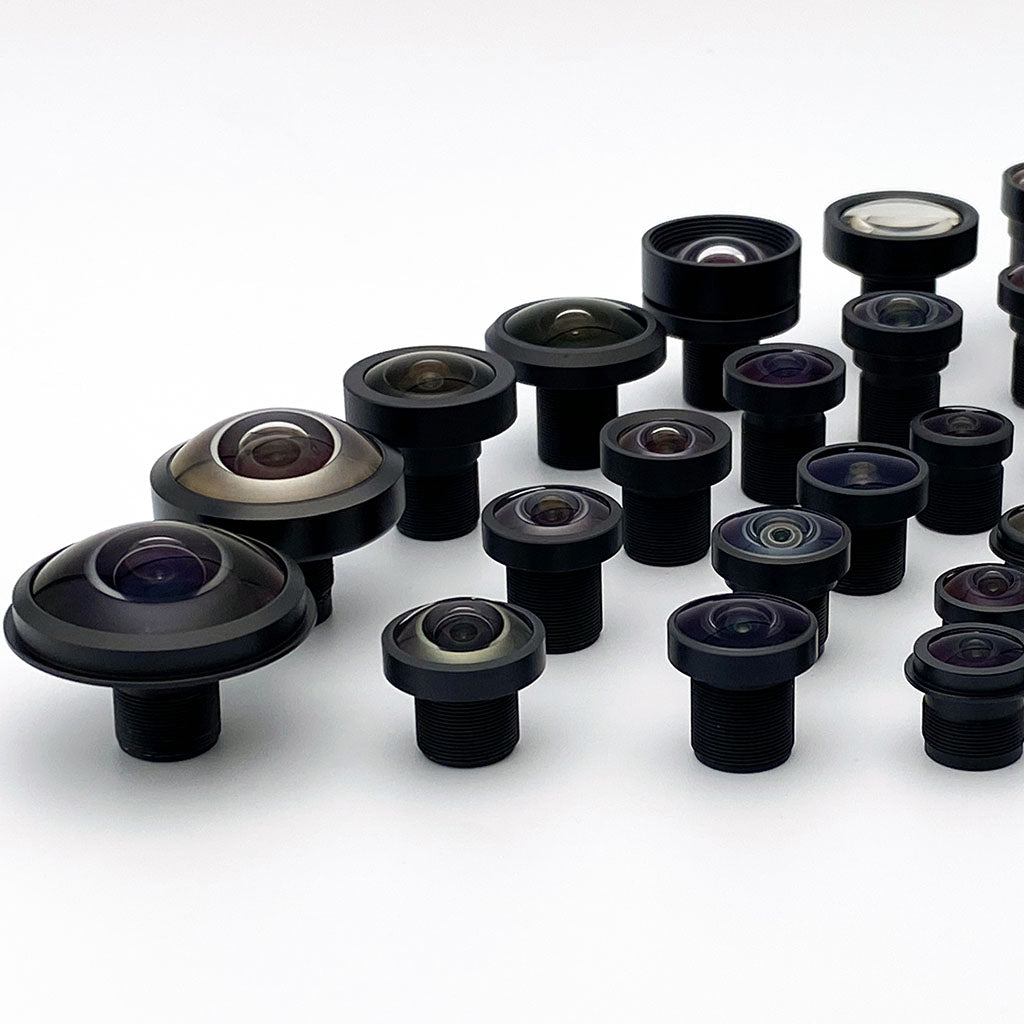
M12 lenses (also called S-mount lenses or board mount lenses) are miniature threaded lenses with M12 × 0.5mm thread pitch designed for embedded cameras and computer vision applications. These compact board lenses are commonly used in security cameras, robotics, drones, and automotive vision systems where space and weight constraints exist.
M12 mount lenses deliver high-quality imaging comparable to larger C-mount alternatives while reducing system size by 60-80%. Browse our complete M12 lens collection with over 200 optical designs.
When selecting an M12 lens for your embedded camera, consider these key factors:
- Field of View: Use our FoV calculator to determine coverage requirements
- Depth of Field: Calculate with our DOF calculator for your working distance
- Sensor Format: Verify the lens image circle covers your sensor diagonal (1/6" to 1/1.6")
- Resolution: Match lens MTF to sensor pixel pitch
- F-Number: Lower values (F1.4-F1.8) for low light; higher for extended DOF
- Chief Ray Angle: Maintain ±5-7° match to prevent color shading
- Environmental: IP67 rating for outdoor applications
Read our complete guide on sensor format compatibility for detailed specifications.
Our M12 lens collection spans from ultra-wide 0.8mm fisheye to 75mm telephoto configurations:
- Fisheye (0.8mm-1.8mm): 150°-220° FOV for panoramic and SLAM applications
- Wide angle (2.1mm-4mm): 70°-140° FOV for robotics and surveillance
- Standard (6mm-12mm): 40°-60° FOV for general machine vision
- Telephoto (16mm-75mm): Under 30° FOV for inspection and detail capture
Use our Effective Focal Length calculator to determine the optimal focal length for your target field of view.
M12 lenses are compatible with most CMOS sensors used in embedded vision:
- Sony IMX series: IMX477, IMX577, IMX678, IMX283
- OmniVision OV series: OV5647, OV9281, OV2311
- OnSemi AR series: AR0234, AR0144, AR0821
Most M12 lenses support sensors up to 1/1.8" format. Learn more about CRA matching in our technical blog.
Chief Ray Angle (CRA) is the angle between the chief ray of light and the optical axis at the image sensor. Modern CMOS sensors have microlenses optimized for specific CRA values to direct light into the photodiodes efficiently.
Why CRA matters: CRA mismatch between lens and sensor causes color shading (pink/green tinting in corners), vignetting, and reduced sensitivity. For RGB sensors, maintain CRA matching within ±5-7° to prevent these image quality issues. Monochrome sensors are more tolerant of CRA mismatch.
Read our comprehensive guide on CRA mismatch and how to avoid it.
Field of View Calculators
A field of view calculator determines how much of a scene your camera captures based on lens focal length and sensor dimensions. For rectilinear lenses, the formula is:
Our FoV calculator includes distortion modeling for wide angle and fisheye lenses, providing accurate coverage predictions. Enter your sensor dimensions and focal length to calculate horizontal, vertical, and diagonal field of view angles plus scene coverage at any working distance.
Barrel distortion and fisheye projections concentrate more angle near the image periphery, so actual coverage can exceed rectilinear predictions for the same focal length. Our FoV calculator includes:
- Brown-Conrady distortion: Radial/tangential correction for standard wide angle lenses
- Equidistant projection: r ∝ θ for navigation fisheye lenses
- Equisolid-angle: r ∝ 2·sin(θ/2) for equal area mapping
- Stereographic: r ∝ 2·tan(θ/2) for conformal mapping
Learn more about lens distortion models in our technical articles.
Angular FoV is the total cone angle the sensor captures, independent of distance. IFOV (Instantaneous Field of View) is the average angle per pixel:
Example: 90° HFOV over 1920 pixels = 0.047°/pixel (2.81 arcmin/pixel). At 1m working distance, scene width is 2m, so each pixel spans approximately 1.04mm.
Understanding IFOV is critical for machine vision resolution requirements. Use our FoV calculator to determine both angular and linear field of view for your application.
Optical format names derive from vidicon tube conventions and do not equal physical diagonal measurements in inches:
- 1/4": ~4.5mm diagonal
- 1/3": ~6mm diagonal
- 1/2.3": ~7.7-7.9mm diagonal
- 1/2": ~8mm diagonal
- 2/3": ~11mm diagonal
- 1": ~16mm diagonal
Always use the actual active width and height from the sensor datasheet for accurate FoV calculations. Download our sensor format reference chart for complete specifications.
Wide Angle & Fisheye Lenses
Wide angle M12 lenses range from 1.8mm to 4mm focal length, providing 70° to 140° field of view depending on sensor format:
- 2.1mm: 120°+ on 1/2.3" sensors – ideal for panoramic surveillance
- 2.8mm: 90-110° FOV – popular for robotics navigation
- 3.6mm: 75-90° FOV – balanced wide angle for general vision
These are ideal for robotics navigation, surveillance, and situational awareness applications where peripheral vision is critical. Browse our wide angle M12 lenses with detailed specifications.
Fisheye lenses use non-rectilinear projection models to achieve 150°-220° field of view:
- Equidistant: r ∝ θ – uniform angle-to-distance mapping
- Equisolid-angle: r ∝ 2·sin(θ/2) – preserves solid angles
- Stereographic: r ∝ 2·tan(θ/2) – conformal mapping
Unlike standard wide angle lenses that attempt to keep straight lines straight, fisheye lenses intentionally introduce barrel distortion to capture hemispherical views. This makes them ideal for panoramic imaging, SLAM navigation, and 360° camera systems where maximum coverage outweighs geometric accuracy.
Explore our fisheye M12 lens collection for embedded vision applications.
Wide angle and fisheye M12 lenses excel in applications requiring maximum scene coverage:
- Mobile robotics: SLAM navigation, obstacle avoidance, 360° awareness
- Aerial robotics: Drone FPV, terrain mapping, collision avoidance
- Surveillance: Panoramic monitoring, parking lot coverage
- Automotive: Surround view, backup cameras, driver monitoring
- Smart retail: Overhead people counting, loss prevention
The trade-off: wide angle lenses introduce barrel distortion requiring computational correction, while reducing per-pixel angular resolution at the edges. Read our technical blog for application-specific guidance.
Low distortion wide angle lenses (typically under 3% TV distortion) maintain straight lines while providing 70-100° field of view. These are preferred for machine vision inspection, barcode reading, and metrology where geometric accuracy matters.
Fisheye lenses intentionally use non-rectilinear projection to achieve 150°+ field of view. They're ideal for navigation and situational awareness where maximum coverage trumps geometric accuracy.
Browse our low distortion M12 lenses for inspection applications or fisheye M12 lenses for panoramic coverage.
C-Mount-Objektive
M12 lenses use M12 × 0.5mm threading and are designed for compact embedded cameras. They typically support sensors up to 1/1.6" format with focal lengths from 0.8mm-75mm.
C-mount lenses use 1"-32 TPI threading for larger industrial cameras. They support sensors up to 1.2" format with superior optical performance at longer focal lengths, featuring lockable focus/iris rings and industrial metal construction.
Our C-mount lenses support sensors up to 1.2" format, including smaller formats:
- 1/3" to 1/2" format: Compact sensors (~6-8mm diagonal)
- 2/3" format: Standard machine vision sensors (~11mm diagonal)
- 1" format: High-resolution inspection (~16mm diagonal)
- 1.1" format: Large area sensors (~18mm diagonal)
- 1.2" format: Maximum coverage (~20mm diagonal)
C-mount lenses feature focal lengths from 8mm-75mm with apertures as fast as F1.4. Industrial metal construction ensures vibration resistance and long-term stability.
Choose C-mount lenses when you need:
- Larger sensor format support (1" and above)
- Maximum optical performance and resolution (20MP+)
- Lockable focus and iris for production stability
- Industrial durability with vibration resistance
- Interchangeable lens flexibility
Choose M12 lenses when space/weight constraints exist, for embedded systems, or when cost optimization is priority.
Optische Filter
We offer a comprehensive range of optical filters for embedded vision:
- IR-cut filters: Block infrared above 650nm for accurate color reproduction
- IR-pass filters: Transmit infrared for night vision and covert surveillance
- Bandpass filters: Specific wavelength transmission (350nm-1100nm)
- Polarizing filters: Reduce glare and reflections
Filter-lens bonding services are available for integrated solutions. Custom spectral response curves can be specified for laser projection systems and specialized machine vision applications.
Yes, we offer filter integration services where optical filters are permanently bonded to M12 lenses. This provides several advantages:
- Eliminates air-glass interfaces (reduces reflections)
- Reduces assembly complexity and cost
- Ensures consistent optical alignment
- Protects filter from contamination
Filter integration is part of our lens customization services. Minimum order quantities apply.
Shipping & Ordering
Yes, sample quantities of M12 lenses ship same-day from our US inventory. We maintain 25,000+ imaging lenses in stock at our San Diego, California facility for immediate shipment.
Sample orders (1-10 units) ship with full tracking. Volume orders up to 10,000 units typically ship within 1-2 business days when items are in stock. Free shipping via USPS is available for US orders, with FedEx 2nd Day Air for orders over $2,000. International shipments available with proper export documentation.
We support volume manufacturing up to 10,000+ units per month with consistent quality across all production batches. Our capabilities include:
- Buffer stock programs: Maintain inventory for JIT delivery
- Blanket orders: Scheduled releases against committed quantities
- Quality validation: 100% MTF testing with batch documentation
- Traceability: Unit-level reports available (additional cost)
Contact us at contact@commonlands.com for volume pricing and lead times.
Yes, free shipping is available for US orders:
- Standard orders: Free shipping via USPS with tracking
- Orders over $2,000: Free FedEx 2nd Day Air shipping
International shipping rates are calculated at checkout based on destination and package weight.
Quality & Testing
MTF (Modulation Transfer Function) measures how well a lens preserves contrast at different spatial frequencies—essentially quantifying sharpness and resolution capability. MTF values range from 0 to 1 (or 0% to 100%), where higher values indicate better contrast preservation.
For machine vision applications, you want the lens MTF at your sensor's Nyquist frequency (1/(2×pixel_pitch)) to exceed 20-30% for adequate sampling, with 50%+ preferred for high-quality imaging. A lens with poor MTF wastes sensor resolution capability. Read more about optical performance metrics in our technical blog.
Every imaging lens undergoes MTF testing at a 100% inspection rate. Testing is performed on multiple production MTF machines that are calibrated to our reference Trioptics HR2 optical bench, which is traceable to PTB (Physikalisch-Technische Bundesanstalt) standards. This means each individual lens is measured for spatial frequency response—not statistical sampling.
Our quality assurance process includes:
- Calibration hierarchy: Production MTF machines calibrated to Trioptics HR2, traceable to PTB national metrology standards
- Individual MTF measurement: Each lens tested at multiple field positions (center, 0.7 field, corner) across tangential and sagittal orientations
- Distortion mapping: Barrel/pincushion distortion characterization per lens design specifications
- Relative illumination: Corner light falloff measurement to verify uniformity
- Back focal length verification: Ensures proper sensor-plane focus position
Our ISO9001:2015 certified quality management system ensures consistent lens quality across all production batches. Unit-level test reports with actual MTF data, distortion coefficients, and measurement timestamps are available at additional cost for applications requiring full traceability.
Commonlands maintains the following certifications and compliance:
- ISO9001:2015: Certified quality management system covering design, procurement, testing, and fulfillment processes
- RoHS: Restriction of Hazardous Substances compliance for all products
- REACH: EU chemical safety regulation compliance
Our San Diego facilities at 8170 and 8148 Ronson Road feature comprehensive optical testing equipment including Trioptics HR2 MTF bench and Class 1000 hardwall cleanroom for camera module assembly.
Customization & Engineering Support
We offer comprehensive lens customization services:
- Filter integration: IR-pass, bandpass, polarizing filters bonded to lens
- F-number modifications: Adjust aperture for depth of field control
- Mechanical modifications: Custom barrel dimensions, flange focal distance
- Ingress protection: IP67/IP69K sealing for harsh environments
- Thermal optimization: All-glass construction for wide temperature range
- Coatings: Anti-reflection, hydrophobic surface treatments
Minimum order quantities typically 500-1000 units with 4-6 week lead times, or up to 12 weeks if glass components require polishing.
Our custom lens design services are integrated with our US manufacturing—we design lenses specifically optimized for production at our San Diego facility. This ensures design-for-manufacturability (DFM) alignment from the earliest stages.
Design capabilities include:
- Optical design & analysis: Zemax OpticStudio and CodeV ray tracing, tolerance analysis, Monte Carlo sensitivity studies
- Wide-angle & fisheye design: Specialized expertise in short focal length, high-distortion optics
- Athermalization: Temperature-compensated designs for outdoor operating ranges (-40°C to +85°C)
- Stray light analysis: Ghost image reduction for high-contrast applications
Manufacturing options:
- Manual assembly: 1-500 units, ideal for prototypes and engineering validation
- Automated assembly: 1,000+ units/month for production volumes
Component sourcing: Non-China sourcing available from Japan, Taiwan, South Korea, and US suppliers for supply chain diversification requirements.
Contact our engineering team at contact@commonlands.com to discuss your requirements.
Our US-based optical engineering team provides comprehensive support:
- Lens selection guidance: Based on sensor specs and application requirements
- Technical documentation: Datasheets, drawings, optical specifications
- CAD files: .STP 3D models for mechanical integration
- Zemax data: Optical design files for system modeling
- Application engineering: Custom design consultation
Contact our team at contact@commonlands.com or call +1(858)333-7325.
IP67 rated lenses are dust-tight (6) and protected against water immersion up to 1 meter for 30 minutes (7). This rating eliminates the need for protective windows that introduce reflections and reduce transmission.
Applications requiring IP67:
- Outdoor robotics and agricultural equipment
- Automotive cameras (surround view, backup)
- Marine and underwater systems
- Industrial wash-down environments
We also offer IP69K rated lenses for high-pressure, high-temperature wash-down applications. Browse our ingress protected lenses.
Montage des Kameramoduls
Yes, we provide complete camera module assembly services in our Class 1000 hardwall cleanroom. Services include:
- Precision alignment: Lens-to-sensor active alignment
- Bonding: UV cure or thermal cure adhesive options
- Integration: Flex cable, connector assembly
- Testing: 100% functional and optical verification
We support Sony IMX, OmniVision, and OnSemi sensors with production volumes from 100 to 10,000+ units per month.
We support most CMOS sensors used in embedded vision applications:
- Sony: IMX477, IMX577, IMX678, IMX283, IMX290, IMX327
- OmniVision: OV5647, OV9281, OV2311, OV2640
- OnSemi: AR0234, AR0144, AR0821, AR0135
Contact us with your specific sensor requirements. We can work with sensors from other manufacturers on a project basis.
We support production volumes from prototype quantities (as low as 10 units for NRE-funded projects) through 10,000+ units per month for volume manufacturing. Typical minimum order quantities:
- Prototype/Development: 10-100 units (NRE may apply)
- Low volume production: 100-1,000 units
- Volume manufacturing: 1,000-10,000+ units/month
Contact our engineering team to discuss your specific volume requirements and timeline.
Still Have Questions?
Our US-based optical engineering team is ready to help with lens selection, custom designs, and technical integration support.
Contact Our Engineering Team