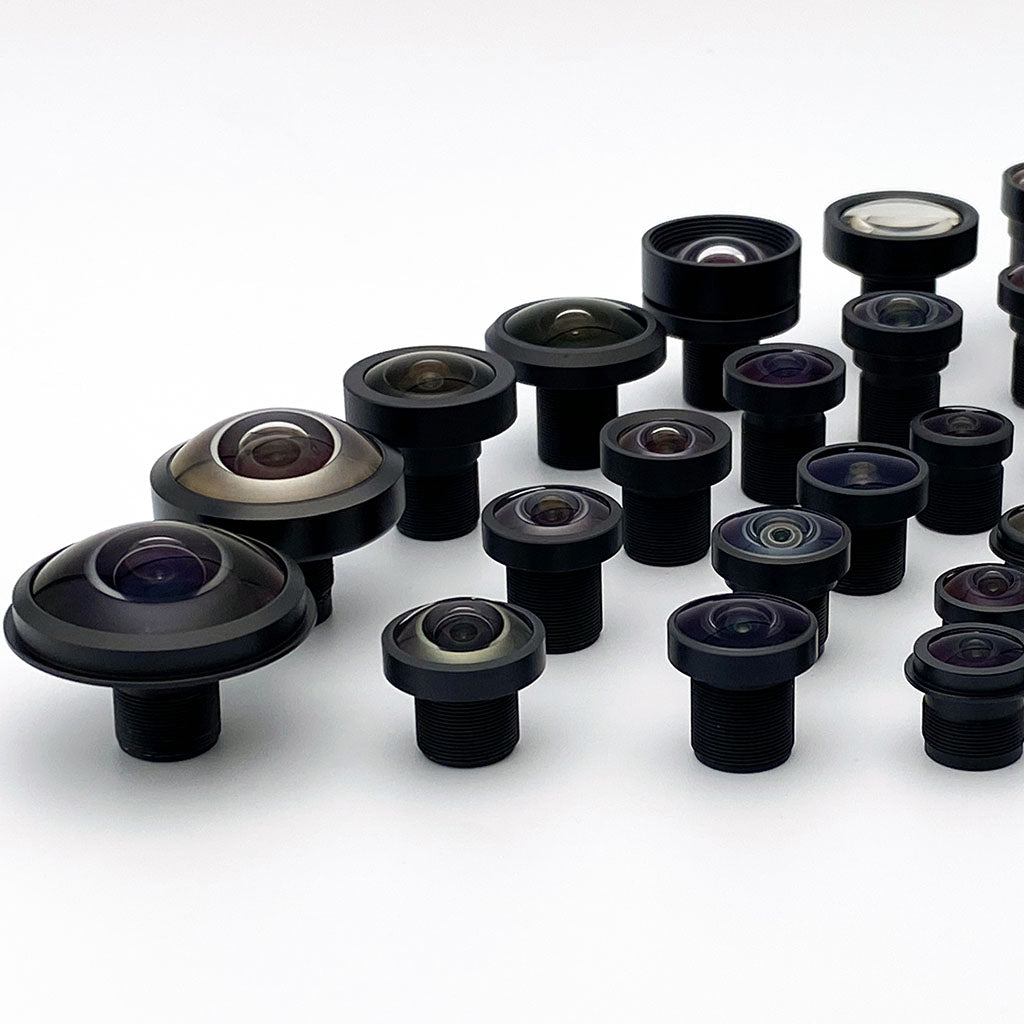

So wählen Sie die Brennweite für die industrielle Bildverarbeitung aus: Formel, Sensorgröße und Auswahlschritte
Die Brennweite ist ein geometrisches Problem, für das es je nach Konfiguration eine bestimmte Lösung gibt. Dieser Leitfaden behandelt die Formel, die Bedeutung des Begriffs „effektive Brennweite“, den gesamten Auswahlprozess und die Frage, wann ein Teleobjektiv die richtige Wahl ist.

To choose a focal length for machine vision, start from three measured numbers: the scene width the camera must cover, the working distance from the front of the lens to the target, and the active width of your sensor. The required focal length is EFL = (WD × sensor_width) / FOV_width for rectilinear lenses, a far-conjugate approximation that holds closely at normal machine vision working distances, where the distance is long compared with the focal length.
Wählen Sie die am besten passende Standardbrennweite aus und überprüfen Sie vor der Bestellung die Verzeichnung, die Schärfentiefe und den Bildkreis. Der Sichtfeldrechner überprüft jede Kombination aus Objektiv und Sensor in Sekundenschnelle.
Wie berechne ich die benötigte Brennweite?
Die erforderliche Brennweite entspricht der aktiven Sensorbreite multipliziert mit dem Arbeitsabstand, geteilt durch die erforderliche Bildbreite. Ein 1/2,7"-Sensor (5,37 mm aktive Breite), der ein 120 mm breites Bauteil aus einer Entfernung von 400 mm abbildet, benötigt (5,37 × 400) / 120 = 17,9 mm, wodurch 16 mm und 21,8 mm als praktische hochauflösende Standardoptionen in Frage kommen.
This geometry is a far-conjugate approximation, exact only in a pinhole ray model. Real finite-conjugate imaging follows Gaussian conjugates measured from the principal planes, and the error grows with magnification. Covering a 100mm scene from 300mm with a 14.1mm-wide sensor (m ≈ 0.14), the formula gives 42.3mm, while the thin-lens form (Hecht, Optics, 5th ed., §5.2) f = WD × m / (1 + m) gives about 37mm. Fisheye and F-theta lenses use different projections. Use datasheet FOV values for those.

Was ist die effektive Brennweite?
Effective focal length (EFL) is the distance from a lens's rear principal plane to its focal point when the lens is focused at infinity. With the sensor size and the object and image conjugates, it sets field of view and magnification. The mm value printed on a lens listing (6mm, 12mm, 35mm) is the EFL. Nominal EFL does not change with working distance: a 12mm lens stays a 12mm lens at 500mm or 100mm. The effective value drifts slightly with focus breathing in internal-focus designs.
| Begriff | Was ist das? | Was es steuert |
|---|---|---|
| EFL (effektive Brennweite) | Optische Parameter der Brillenglasverordnung | Field of view and magnification, with sensor and conjugates |
| BFL / MBFL (Hintere Brennweite) | Hinterer Abstand pro Linse | Spielraum zwischen Halterung und Adapter (ob das Objektiv scharfstellen kann) |
| FFD (Flanschbrennweite) | Standardausführung der Halterung | Objektivkompatibilität (17,526 mm C-Mount, 12,526 mm CS-Mount, keine für M12) |
The EFL calculator runs the rectilinear math for common sensor formats and flags where the wide-angle caution applies.
Wie wählt man Schritt für Schritt ein Objektiv für die industrielle Bildverarbeitung aus?
- Legen Sie das Sichtfeld fest. Geben Sie die Abmessungen der Szene in Millimetern an der Zielebene an, zuzüglich einer Toleranz von 10–20 % für die Platzierung. Eine 200 mm breite Platine ergibt ein Entwurfsfeld von 240 mm.
- Measure the working distance. Working distance runs from the front of the lens to the target. Early in a project it is a design variable. Once the mechanical design commits, it hardens into a number you measure rather than choose. For M12 builds, the nearest reachable distance follows from the lens prescription, holder height and thread engagement, sensor-stack clearance, and the corner sharpness the task demands. Ask Commonlands engineering to confirm it. C-mount working distance varies by product, typically 100mm to infinity. The working distance guide covers this hardening.
- Entnehmen Sie die Abmessungen des aktiven Sensors dem Datenblatt des Sensors ( Pixelanzahl × Pixelabstand) und niemals der Angabe des Nennformats. In der Bildsensordatenbank sind die aktiven Bereiche gängiger Bauteile aufgeführt.
- Set the smallest feature to resolve. Divide scene width by horizontal pixel count for ground sampling distance (mm/pixel). Sensor Nyquist is a sampling ceiling, 1000/(2 × pixel_pitch_um) lp/mm, or two samples per line pair. Two pixels across the smallest feature is a separate inspection rule of thumb, and the headroom you need above it depends on contrast, the algorithm, and your inspection or decoder vendor's minimum sampling spec. The spatial resolution guide covers the math.
- Berechnen Sie die Brennweite. EFL = (WD × Sensorbreite) / FOV-Breite, und wählen Sie anschließend die am besten passenden Standardwerte aus. Der EFL-Rechner erledigt dies in einem Schritt.
- Choose the mount family. M12 fits compact, light, board-level builds. C-mount fits larger sensors and an adjustable iris. Its focus ring's internal mechanism and near-limit behavior vary by design, so verify both on the datasheet. CS-mount uses the same thread as C-mount with a shorter 12.526mm flange focal distance, compared with 17.526mm for C-mount. The lens mount guide compares thread, flange, and coverage in detail.
- Verify image quality. Run four checks: image circle at least as large as the sensor diagonal, distortion against the application's position-error budget, depth of field spanning the object height range (run the depth of field calculator), and lens MTF at the feature's spatial frequency (see the MTF curve guide).
Sollten Sie sich für eine kurze, mittlere oder lange Brennweite entscheiden?
Commonlands M12 lenses span all three focal length bands, and a medium range near 5mm to 16mm fits most factory inspection setups. Treat the bands as rough groupings, not hard thresholds. Shorter lenses tend to buy scene coverage and depth of field from close range. Longer lenses tend to buy pixel density at the cost of shallower depth of field. Distortion follows the lens projection and correction, not focal length alone. Start medium unless the geometry forces you elsewhere. The depth of field guide covers the long-lens trade.
| Brennweitenbereich | Sichtfeld (relativ) | Distortion (design-dependent) | Schärfentiefe | Pixeldichte im Zielbereich | Typische Anwendung |
|---|---|---|---|---|---|
| Short (<5mm) | Breit | Design- and field-dependent | Tief | Nach unten | Wide coverage, navigation, autonomous mobile robots (AMRs) |
| Mittel (5–16 mm) | Mäßig | Varies | Mäßig | Mäßig | Allgemeine Überprüfung, Barcode-Erfassung |
| Lang (>16 mm) | Schmal | Design- and field-dependent | Flach | Höher | Erkennung feiner Merkmale, Messtechnik |
The field of view column is relative, with no degree ranges, because the angle depends on the sensor as much as the lens: the same 12mm lens reads 25.2° on a 1/2.7" sensor and 33.3° on a 1/1.8" sensor. Compute the actual angle for your lens with the angle of view calculator before classifying a candidate as wide or narrow.
Welche M12-Brennweiten decken die meisten Anwendungsbereiche ab?
Three stock M12 lenses span the working range for most machine vision setups: 3.3mm for wide coverage, 6.2mm as the general-purpose default, and 12.5mm where pixel density matters. The full M12 catalog runs 0.8mm fisheye to 100mm telephoto.
Commonlands stocks M12 lenses in the US, with aperture and filter variants listed on each product page. Orders placed before 12 PM PT ship the same day from San Diego, CA.
Commonlands M12 lens options by focal length. Field-of-view angles are diagonal (DFOV) at each lens's stated reference circle, which can be smaller than its full image circle.
| Objektiv | EFL | Sensorformat | FOV (diagonal) | Verzerrung | Preis | Am besten geeignet für |
|---|---|---|---|---|---|---|
| CIL036 | 3,3 mm | Siehe Produktseite | 89° at the 6.4mm reference circle | -0,7 % Fernsehen | $19 | Breites Sichtfeld bei geringer Verzerrung in beengten Einbausituationen |
| CIL062 | 6,2 mm | Bis zu 1/1,8" | 60° at 7.2mm reference circle (9.0mm full circle) | -2% rectilinear at 8.8mm | $19 | Eine ausgewogene allgemeine Überprüfung und der Standard-Ausgangspunkt |
| CIL125 | 12,5 mm | Siehe Produktseite | 35° at 7.9mm reference circle | -1,4 % optisch | $39 | Engeres Bildfeld mit höherer Pixeldichte für feine Details und Beschriftungen |
TV distortion is measured as the image-height deviation at the frame edge, rectilinear (optical) distortion against the paraxial ideal ray height, and F-theta distortion against the r = f·θ reference. Because the references differ, the percentages are not directly comparable row to row.
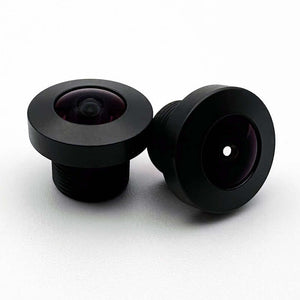
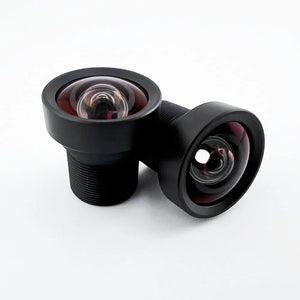
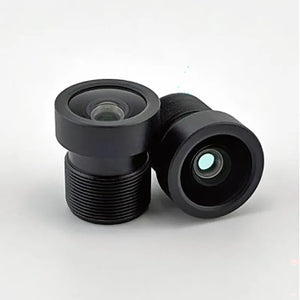
Wann sollte man sich für ein Teleobjektiv für die industrielle Bildverarbeitung entscheiden?
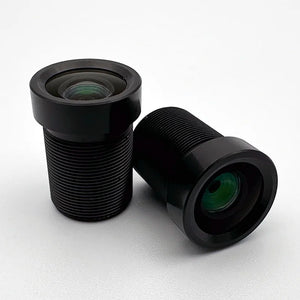
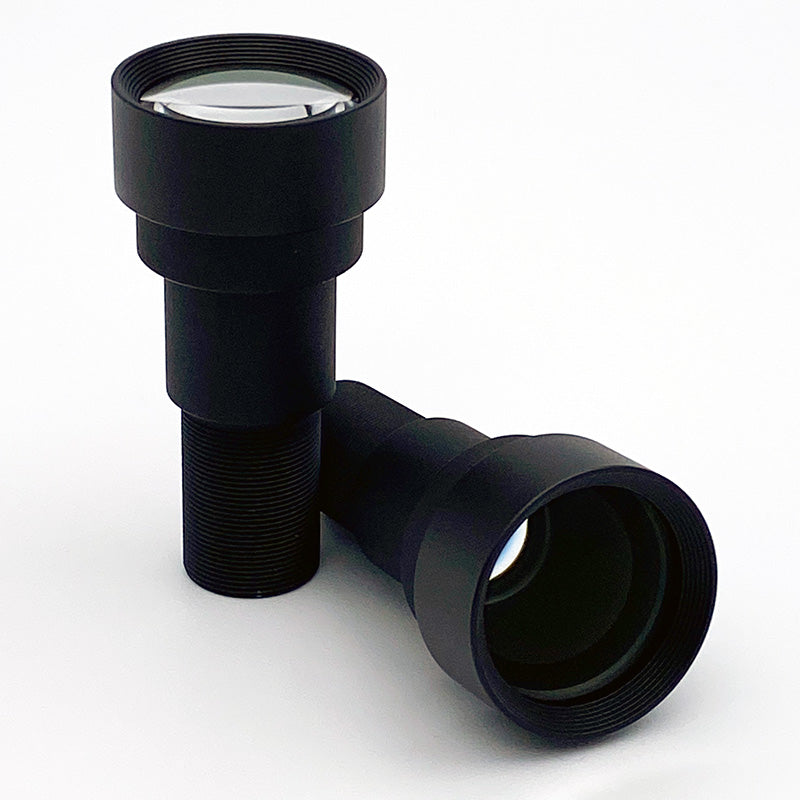
Choose a telephoto machine vision lens when the target is small or distant and the camera cannot move closer. As a rough guide, that means the target fills only a small fraction of the frame with the lens you have. Commonlands telephoto M12 options run 12.5mm to 50mm, with 75mm and 100mm models at the long end of the catalog. All of them trade scene coverage for magnification, tighter focus tolerance, and higher vibration sensitivity.
In machine vision, "telephoto" is used loosely for any long-EFL lens. Strictly it names a construction shorter than its focal length, so a long-focus lens is not necessarily telephoto (Smith, Modern Optical Engineering, 4th ed.). Doubling the EFL halves the linear field of view at the same working distance and doubles the apparent target size. Typical applications are aerial inspection from drones, traffic monitoring at distance, overhead conveyor lines, and barcode or OCR reading at long standoff.
Long lenses are less forgiving than short ones. Depth of field shrinks rapidly as focal length grows, so a focus setting easy at 6mm becomes critical at 35mm, and image shift from platform wobble scales with focal length. Plan stiffer mounts, lock focus, and re-verify after mechanical service. The focusing guide covers the procedure.
Telephoto is also often the wrong answer: to monitor a wide area or run on a vibration-heavy platform, a shorter focal length tolerates the pointing error and motion that would push a narrow frame off target.
Near-focus behavior differs by mount. A C-mount telephoto focuses by ring rotation. The ring may drive the whole cell, a front group, or a cam, and near-stop sharpness is design-specific, so confirm minimum object distance with Commonlands engineering. M12 telephotos are rigid barrels focused by thread rotation: thread engagement, the barrel shoulder, and rear-element clearance set hard near-focus limits, so short standoffs demand deep holders, and close-range sharpness falls to conjugate-dependent aberrations such as field curvature, not center focus alone.
Selected telephoto M12 lenses reach 1/1.7" sensor coverage in a fixed-aperture board-lens package, the right fit for drones, embedded systems, and weight-limited payloads. Move to C-mount when the sensor is larger, when you need an iris to stop down for depth of field, or when lighting is too dim to fix at a fixed aperture. The low-light section of the f-number guide covers that trade.
Commonlands telephoto M12 lenses from 12.5mm to 50mm, ordered by focal length.
| Teil | EFL | Format | Beschluss | Blende | Preis |
|---|---|---|---|---|---|
| CIL125 | 12,5 mm | Bis zu 1/2" | 12 MP | Behoben | $39 |
| CIL121 | 21,8 mm | Bis zu 1/1,7" | 12 MP+ | Behoben | $70 |
| CIL350 | 35 mm | 1/1,7" | 8–10 MP | Behoben | $59 |
| CIL051 | 50 mm | Bis zu 1/1,8" | 12 MP | Behoben | $79 |
The resolution column names the sensor class each design targets. MP ratings are unstandardized labels with no aperture, field, spectrum, or contrast conditions attached. Confirm against the measured MTF data and pixel-pitch pairing on each product page.
Was passiert, wenn die berechnete Brennweite nicht existiert?
Round to the nearest stock focal length and recompute the field of view. Rounding shorter gives extra coverage you can crop, the safe default when installation geometry is not locked. Rounding longer gives less coverage and is only acceptable once you confirm the scene still fits the sensor, the call when the feature is small and resolution outweighs coverage. If neither works, a 10–20% working distance change is a starting point we use, provided magnification, clearance, perspective, and lighting allow.
Commonlands stocks M12 focal lengths in discrete steps (2.6mm, 3.3mm, 3.6mm, 6.2mm, 8mm, 12.5mm, 14.2mm, 16mm, 18mm, 19mm, 21.8mm, 25mm, and up), so a calculated value will often land between them. The steps cluster tightly from 12mm to 25mm, where the nearest option usually sits within about 10% of the calculated value. Some intermediate steps, including the 18mm and 19mm options, are lower-resolution designs rated for 2MP sensors and below, so check the resolution rating before shortlisting.
Whatever the rounding decision, validate with physical test images before locking the design: mount the lens at the planned distance, image a calibration target or the real part, and confirm the features resolve and the scene fits. Test images catch corner vignetting, focus error at the target plane, and distortion in the actual part geometry that the math does not.

Häufig gestellte Fragen
The Commonlands FOV calculator runs these formulas for any sensor. The answers below explain the math behind it.
Wie berechne ich die Brennweite anhand des Sichtfelds und des Arbeitsabstands?
Multiplizieren Sie die aktive Sensorbreite mit dem Arbeitsabstand und dividieren Sie das Ergebnis durch die erforderliche Bildbreite: EFL = (WD × Sensorbreite) / FOV-Breite. Ein 1/2,7"-Sensor (5,37 mm aktive Breite) bei einem Arbeitsabstand von 400 mm, der ein Bildfeld von 120 mm abdeckt, benötigt (5,37 × 400) / 120 = 17,9 mm, sodass 16 mm und 21,8 mm als hochauflösende Standardoptionen in Frage kommen (18 mm und 19 mm sind als Optionen mit niedrigerer Auflösung für 2-MP-Sensoren und darunter erhältlich). Der EFL-Rechner berechnet dies direkt.
Was ist die effektive Brennweite?
Effective focal length (EFL) is the distance from a lens's rear principal plane to its focal point when the lens is focused at infinity. With the sensor size and the object and image conjugates, it sets field of view and magnification. The mm value on a machine vision lens listing (6mm, 12mm, 35mm) is the EFL, not the back focal length and not the flange focal distance.
Welche Schritte sind bei der Auswahl von Objektiven für die industrielle Bildverarbeitung zu beachten?
Machine vision lens selection runs in a fixed order: define the required field of view, measure the working distance, and pull active sensor dimensions from the sensor datasheet. Then set the smallest feature to resolve, calculate focal length with EFL = (WD × sensor_width) / FOV_width, and choose the mount family. The final step is to verify image circle, distortion, depth of field, and MTF.
Was sind Teleobjektive für die industrielle Bildverarbeitung?
Teleobjektive für die industrielle Bildverarbeitung sind Objektive mit langer Brennweite, die bei einem bestimmten Arbeitsabstand ein enges Sichtfeld und eine höhere Vergrößerung erzeugen. Gängige M12-Teleobjektive haben Brennweiten von 12,5 mm bis 50 mm und bilden kleine oder weit entfernte Objekte ab (Luftinspektion, Verkehrsüberwachung, Barcode-Erfassung aus großer Entfernung), wobei jedoch engere Toleranzen hinsichtlich Fokussierung und Vibration in Kauf genommen werden müssen.
Was passiert, wenn meine ideale Brennweite nicht existiert?
Choose the nearest stock focal length and recompute the field of view. Rounding shorter adds coverage you can crop in software, which is the safer direction. Rounding longer cuts coverage and requires confirming the scene still fits the sensor. A 10–20% working distance change is a starting point we use when magnification, clearance, perspective, and lighting allow. Verify any candidate with the field of view calculator before ordering.
Empfehlung für eine Brennweite abrufen
Send your working distance, scene size, and sensor part number to the Commonlands engineering team in San Diego and they will run the numbers with you. Orders placed before 12 PM PT ship the same day.