
Sensorgröße und Objektivkompatibilität in der industriellen Bildverarbeitung: Bildkreis, Vignettierung und relative Beleuchtung
This guide shows how to match a lens to a sensor: coverage math, vignetting mechanisms, and the relative illumination curve that combines them.

A lens matches a sensor when its image circle diameter equals or exceeds the sensor diagonal, with margin left for corner sharpness. That comparison is necessary but not sufficient, and the image circle figure means little without its criterion. After coverage you still check mechanical vignetting, aperture-dependent optical vignetting, the natural falloff of the projection that cos4 models to first order, and chief ray angle (CRA) match to the sensor's microlens array. For sensor format dimensions, naming conventions, and diagonal charts, see the CMOS sensor size guide.
Wie kann ich feststellen, ob ein Objektiv meinen Sensor abdeckt?
Compare the lens image circle diameter to the sensor diagonal. Clearing the diagonal is necessary, not sufficient: an image circle figure means little until you know the criterion behind it, which is the relative illumination or MTF the vendor still holds at that radius, and at which aperture, wavelength, and conjugate. Ask for that criterion. Below the diagonal the corners darken, from shading to black depending on the lens. Calculate the diagonal from the active area, not from the format name.
Coverage on its own says nothing about chief ray angle or mechanics. A mechanical fit (mount, flange distance, rear clearance) and an optical fit (image circle criterion, CRA, relative illumination) both have to hold, and a correct mount does not rule out vignetting.
For a 1/2-inch sensor with a 6.4 × 4.8mm active area: diagonal = √(40.96 + 23.04) = √64 = 8.0mm. That sensor needs an image circle of at least 8.0mm plus margin. Round the diagonal up and the lens's rated image circle down before comparing, so a borderline pairing is judged conservatively.
Angaben zum Sensorformat und zum minimalen Bildkreis
Sensor formats Commonlands lenses cover, with the minimum image circle each needs to reach the diagonal.
| Sensorformat | Typische aktive Fläche (mm) | Diagonale (mm) | Minimaler Bildkreis | Typische Objektivklasse |
|---|---|---|---|---|
| 1/4" | 3,6 × 2,7 | 4.5 | 4.5mm+ | M12 |
| 1/3" | 4,8 × 3,6 | 6.0 | 6,0 mm+ | M12 |
| 1/2,9" | 5,6 × 3,2 | 6.4 | 6,4 mm+ | M12 |
| 1/2,7" | 5,3 × 4,0 | 6.6 | 6,6 mm+ | M12 |
| 1/2,5" | 5,8 × 4,3 | 7.2 | 7,2 mm+ | M12 |
| 1/2" | 6,4 × 4,8 | 8.0 | 8,0 mm+ | M12 oder C-Mount |
| 1/1,8" | 7,2 × 5,4 | 9.0 | 9,0 mm+ | M12 oder C-Mount |
| 1/1,7" | 7,6 × 5,7 | 9.5 | 9,5 mm+ | M12 oder C-Mount |
| 2/3" | 8,8 × 6,6 | 11.0 | 11,0 mm+ | C-Mount |
| 1" | 12,8 × 9,6 | 16.0 | 16,0 mm+ | C-Mount |
| 1.1" | 14.1 × 10.35 | 17.5 | 17,5 mm+ | C-Mount |
Active area varies by manufacturer and model within one format label, so use the exact width and height from the sensor datasheet, or the image sensors database.

Was verursacht Vignettierung in der industriellen Bildverarbeitung?
Vignetting has three mechanisms, each with a different fix. Mechanical vignetting is ray clipping by physical apertures: barrel bores, retainers, filter threads, and the mount cut into off-axis bundles whatever the iris is set to. A published image circle is the usable field that clipping leaves under the vendor's criterion, and illumination or aberration can set that limit first. Beyond the published circle, performance is unspecified: expect gradual shading and aberration growth, with hard clipping only at the mechanical cutoff.
Optical vignetting is aperture-dependent roll-off, from off-axis bundles seeing a smaller effective aperture. It is worst wide open and improves as you stop down, which a C-mount iris ring lets you do. Most M12 lenses have no iris and are fixed at manufacture. Natural falloff is what remains when nothing is clipped, and cos4 models it to first order for a rectilinear lens whose pupil magnification is near one.
At a 20° half-angle, cos4 gives about a 22% drop. At 30°, the drop is about 44%. At 45°, it reaches about 75%. The half-angle that matters for corners is the diagonal one set by the sensor, not the horizontal field, so a lens with a 30° horizontal half-angle has a larger corner angle and a larger loss.
Those figures are a first-order reference, not a floor and not a ceiling. Measured relative illumination sits above or below cos4 depending on projection, pupil aberration, and pupil magnification, and it moves with aperture wherever optical vignetting is also present. Wide-angle and fisheye designs routinely beat the model. A lens with heavy mechanical vignetting falls under it. Read the measured curve.
How to tell the three vignetting mechanisms apart when choosing a Commonlands lens: match the symptom to its mechanism and fix.
| Symptom | Möglicher Mechanismus | Zunächst prüfen | Lässt sich das durch Abblenden beheben? |
|---|---|---|---|
| Harte schwarze Ecken, scharfe Kanten | Mechanische Vignettierung | Bildkreis mit der Sensordiagonale vergleichen | Correct the obstructing aperture. A different holder, filter mount, accessory, or lens may be needed |
| Gleichmäßiger radialer Lichtabfall, verbessert bei abgeblendeter Blende | Optische Vignettierung | Measure relative illumination at multiple F# settings | Ja, mit C-Mount und Blendenring |
| Gleichmäßiger radialer Lichtabfall, bei abgeblendeter Blende unverändert | Natural falloff, modeled to first order by cos4 | Compare the calculated corner (diagonal) half-angle falloff with the measured curve | No. Projection geometry sets it. Stopping down moves the measured curve only where optical vignetting is also present, and magnitude depends on the design |
| Eckverdunkelung mit Farbverschiebung | CRA-Diskrepanz (siehe unten) | Vergleiche die CRA-Kurve des Objektivs mit den Spezifikationen der Sensor-Mikrolinsen | Per-channel calibration can reduce repeatable color shading, but cannot recover lost SNR or arbitrary angular crosstalk |
Flat-field correction rescales what the sensor actually recorded. It cannot recover a corner that read zero or clipped at saturation, it cannot rebuild SNR or MTF that were never captured, and it fails on color-dependent angular crosstalk and on shading that drifts with illuminant, temperature, or focus. Where corner quality drives the pass/fail decision, fix the optics first and treat correction as cleanup, not the primary fix.
Was versteht man unter relativer Beleuchtungsstärke bei einem Objektiv?
Relative illumination is the normalized brightness at a field position, expressed as a ratio to the on-axis illuminance. A lens at 70% relative illumination in the corner delivers 30% less light there than at center under the same exposure. It is the lens-side curve that combines mechanical vignetting, optical vignetting, and cos4 falloff. Sensor microlens CRA mismatch adds corner falloff at the camera-system level, not within the lens curve itself unless it is measured through the sensor.
A low distortion spec does not buy corner brightness: a lens under 0.2% distortion can still sit at 50% relative illumination at the corner, so check both specs separately for dimensional work.
What feeds the relative illumination curve on a Commonlands M12 or C-mount lens, and what changes each contributor.
| Beitragsmechanismus | Was sich dadurch ändert | Was hilft dagegen? |
|---|---|---|
| Natural roll-off (cos4 model) | To first order, illuminance falls as the fourth power of the cosine of the field half-angle under rectilinear projection. Measured curves land above or below the model depending on projection, pupil aberration, and pupil magnification | Largely fixed by projection geometry for rectilinear designs. Accept it or choose a longer focal length, or a lens whose projection is intentionally engineered to reduce it |
| Optische (Blenden-)Vignettierung | Schräg einfallende Strahlenbündel treffen auf eine verkleinerte effektive Apertur | Stop down the iris on C-mount. Most M12 lenses are fixed at design |
| Mechanische Vignettierung | Barrels, retainers, and mount bores clip off-axis bundles. The rated image circle marks where usable field ends under the vendor's criterion | Use a lens with a larger rated image circle, and confirm the criterion behind that rating |
| CRA-Diskrepanz | Der Hauptstrahlwinkel an der Ecke passt nicht zum Design der Mikrolinsen des Sensors | Wählen Sie ein Objektiv mit einem CRA-Profil, das auf die Sensorspezifikationen abgestimmt ist. |
| Filter-/Fenster-Stapel | An interference coating's passband shifts and broadens with incidence angle, and every ray in the f-number cone at a field point arrives at a different angle, so the full cone sets the shift while the chief ray only marks its center. Fresnel loss also rises at those angles, and a plane plate in converging light adds aberration | Specify filters against the corner cone angles and the band actually in use, not the chief ray alone. A slower cone or an angle-tolerant coating narrows the spread |
Spielt der CRA eine Rolle, sobald der Bildkreis groß genug ist?
Yes. Chief ray angle (CRA) is the angle at which the principal ray reaches the sensor at a given field position: near zero at center, oblique at the corners. CMOS sensors have microlens arrays shaped for a CRA profile that varies with field height, so a corner mismatch steers light away from the photodiode and corner sensitivity drops.
Request the lens CRA profile at 0°, half-field, and full-field, and compare it against the sensor's microlens CRA at the same heights. A full-field mismatch beyond the sensor's rated CRA acceptance tolerance produces measurable corner shading. That tolerance is sensor-specific, so read it from the sensor datasheet rather than assuming a threshold. Ask the manufacturer if it is not published. Commonlands supplies CRA data where available for its M12 and C-mount lenses.
Fisheye-Füllfaktor: die beabsichtigte Ausnahme von der Abdeckungsregel
Standard lenses are specified so the image circle covers the sensor diagonal. Fisheye systems deliberately vary that ratio, because a fisheye still has a defined image circle. A complete circular image needs the circle to fit inside the sensor's short dimension, not just the diagonal, so a circle can clear the diagonal and still be clipped top and bottom.
How a Commonlands fisheye lens fills different sensors, set by the image-circle-to-sensor ratio.
| Füllmodus | Bildkreis vs. Sensor | Was der Sensor sieht | Typische Anwendung |
|---|---|---|---|
| Rundes Fischaugenobjektiv | Bildkreis kleiner als die kurze Seite des Sensors | Complete circular image with black corners. Maximum fisheye FOV visible | 360-Grad-Bildgebung, Panoramaaufnahmen |
| Vollformat-Fischauge | Bildkreis auf Höhe der Sensordiagonale oder knapp darüber | Fisheye-Inhalte füllen den Bildausschnitt von Rand zu Rand aus | SLAM, Robotik, Surround-View-Systeme |
| Zugeschnittenes Fischaugenobjektiv | Bildkreis größer als die Diagonale des Sensors | Sensor captures only the central region. Narrower effective FOV, with the high-distortion outer field cropped out rather than corrected | Kompakte Embedded-Systeme mit einem Weitwinkel-Fischaugenobjektiv bei moderatem Sichtfeld |
Beispiele für Commonlands-Produkte in verschiedenen Formaten
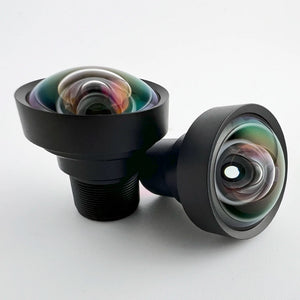
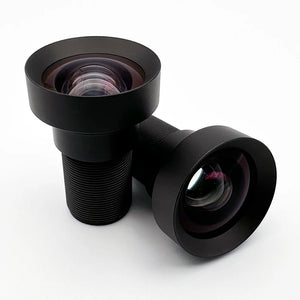
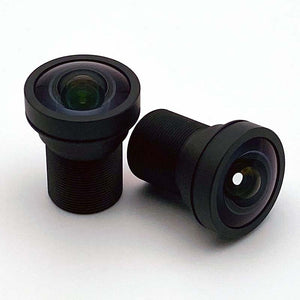
These Commonlands lenses show how image circle, sensor format, and mount scale together.
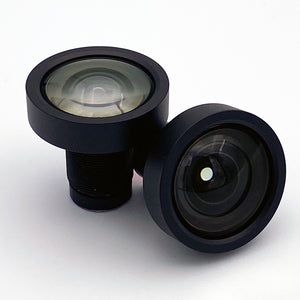
Objektivempfehlungen nach Sensorformat
This table maps common formats to a Commonlands lens whose published image circle clears the sensor diagonal, reusing the diagonals from the reference table above.
| Sensorformat | Diagonale (mm) | Beispielsensoren / Einsatzbereiche | Empfohlenes „Commonlands“-Objektiv | Bildkreis des Objektivs |
|---|---|---|---|---|
| 1/4" | 4.5 | Kostengünstige Überwachung, Webcams | CIL343 4,4 mm M12 | 8.8mm-9.7mm. Oversized for 1/4" |
| 1/3" | 6.0 | Überwachungskameras, Drohnen | CIL062 6 mm M12 | 9,0 mm |
| 1/2" | 8.0 | Kompaktkameras, Drohnen | CIL085 8 mm M12 | 8,9 mm |
| 2/3" | 11.0 | Bildverarbeitung mit Global-Shutter | CIL522 12 mm C-Mount | 11,4 mm |
| 1" | 16.0 | Bildverarbeitung mit Global-Shutter | CIL544 25 mm C-Mount | 17,6 mm |
The CIL544 covers 1.1-inch sensors, the top of the Commonlands C-mount range. Large-format C-mount lenses from Fujinon, Kowa, or Edmund Optics reach 4/3-inch. Larger formats such as APS-C require a lens image circle and ray clearance suitable for the active area. The sensor diagonal does not need to fit through the mount bore. Check off-axis ray clearance through the mount and filters, along with image quality across the field. Larger mounts are common for these formats.

Häufig gestellte Fragen
These answers apply to any lens and sensor pair. Commonlands lists image circle in millimeters for its M12 and C-mount lenses.
Spielt der CRA eine Rolle, sobald der Bildkreis groß genug ist?
Ja. Der Hauptstrahlwinkel beschreibt den Winkel, in dem das Licht an den Ecken des Sensors aus dem Objektiv austritt. Stimmt dieser Winkel nicht mit dem Auslegungswinkel des Mikrolinsenarrays des Sensors überein, können die Mikrolinsen das Licht nicht effizient auf die Fotodiode lenken. Die Folge sind Bildrandabschattungen oder Farbabweichungen, selbst wenn der Bildkreis den Sensor vollständig abdeckt. Eine solche Fehlanpassung tritt am häufigsten bei Weitwinkel-M12-Objektiven in Verbindung mit hochauflösenden Sensoren auf.
Kann eine Flat-Field-Korrektur die Vignettierung des Objektivs beheben?
Flat-field correction normalizes brightness by dividing each pixel by a gain factor from a reference white image, and it removes the visible appearance of corner darkening. It cannot restore photons or signal-to-noise ratio that were never collected: a corner receiving 50% of center illumination has its signal and its noise amplified by the same gain factor, so corner SNR is unchanged by the correction. It cannot recover a corner that read zero or clipped at saturation.
Ist ein größerer Bildkreis immer besser?
A larger image circle can place the sensor inside a better-corrected region, but it does not guarantee better edge MTF, illumination, or CRA matching. Compare those measurements at the same sensor size, aperture, wavelength, and working distance. Include alignment tolerances and the manufacturer's image-circle definition when deciding how much coverage margin is needed.
Kann ein 1/3-Zoll-Objektiv mit einem 1/2-Zoll-Sensor verwendet werden?
Typically not without vignetting. A 1/3-inch format lens has an image circle around 6.0mm, and a 1/2-inch sensor has a diagonal around 8.0mm. The sensor corner sits at a radius of 4.0mm while the published circle's edge is at a radius of 3.0mm, so the corners sit about 1mm outside the published circle, where performance is unspecified: expect gradual shading and aberration growth, with hard clipping only at the mechanical cutoff.
Warum verhalten sich Fischaugenobjektive bei unterschiedlichen Sensorgrößen unterschiedlich?
The sensor samples a different portion of the fisheye image circle. A complete circular image requires the circle to fit within the sensor's short dimension. A full-frame fisheye covers the diagonal, while a smaller sensor crops the available field. Use the lens's projection data to calculate the resulting angles rather than the rectilinear formula.
Benötigen Sie Hilfe bei der Auswahl eines Objektivs, das zu Ihrem Sensor passt?
Commonlands veröffentlicht die Bildkreisspezifikationen sowie, sofern verfügbar, Daten zur relativen Beleuchtungsstärke und zum CRA für unsere M12- und C-Mount-Objektive. Senden Sie uns die Artikelnummer Ihres Sensors und den Arbeitsabstand, und wir empfehlen Ihnen Objektive, die den Bildkreis mit ausreichendem Spielraum abdecken.