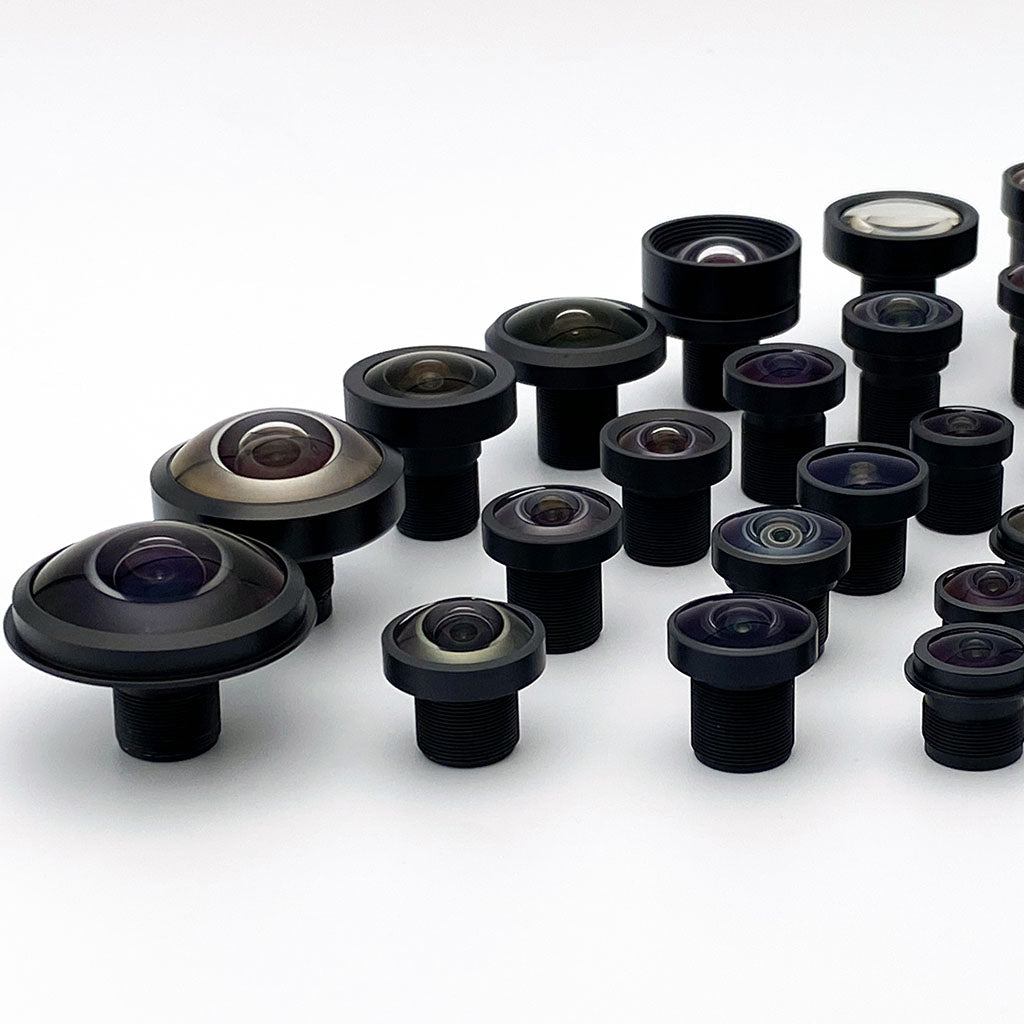

Was ist ein Objektiv mit geringer Verzerrung? Tonnen-, Kissen- und TV-Verzerrung in der industriellen Bildverarbeitung
Barrel and pincushion distortion get measured two different ways, TV and optical, and the two numbers do not translate directly. This guide covers what geometric correction actually fixes and when a low distortion lens is enough versus when you need telecentric optics instead.

A low distortion lens is a lens whose optical design minimizes geometric mapping error across the image field, so straight lines in the scene stay straight on the sensor. Distortion is signed and named by convention. Barrel distortion (negative) bows lines outward, and pincushion distortion (positive) bows them inward, though some datasheets publish only an unsigned magnitude. The number is also meaningless without knowing whether it is TV distortion or optical (radial) distortion, since the two metrics report different values for the same lens.
Commonlands low distortion M12 lenses include the CIL036 (−0.7% TV distortion) and the CIL052 at −0.1% optical distortion for precision work. The CIL059 (−4% rectilinear distortion) sits in the 2 to 4% tier that expects calibration first. Those figures use different metrics, so compare within one convention. Low distortion is not telecentricity: it fixes where image points land at a fixed working distance, not whether magnification holds as object distance changes.
Was ist ein Objektiv mit geringer Verzerrung?
Every lens projects a three-dimensional scene onto a flat sensor. The ideal rectilinear projection maps straight scene lines to straight image lines, preserving collinearity. Angle and local-shape preservation belongs to the stereographic projection instead. A low distortion lens is one where deviation from that ideal has been reduced through optical design, often with aspherical surfaces or balanced element groups that hold residual distortion to a small, specified percentage of image height.
The Commonlands CIL052 5.2mm M12 lens is specified at −0.1% rectilinear (optical) distortion at its 7.2mm reference image circle. The CIL535 35mm C-mount lens is specified at −0.1% from rectilinear at minimum object distance.

Erklärung der Tonnen-, Kissen- und TV-Verzerrung
Barrel and pincushion distortion are opposite-signed forms of the same mapping error: image points land at the wrong radial distance from the ideal rectilinear projection, which reads locally as magnification changing with field height. Third-order theory gives the leading term. Wide designs add higher-order terms and can show mustache profiles. Barrel, dominant in short-focal-length machine vision lenses, is reported as a negative percentage. Pincushion, more common in telephoto and zoom designs, as positive.
Tangential distortion, a separate non-radial component, comes from elements slightly decentered or tilted during manufacture. It is usually much smaller than radial distortion but can still matter for sub-pixel metrology.
A percentage is meaningless without its metric. TV distortion is a broadcast convention (EIA/IEC) that images a rectangular grid and expresses the bow of a horizontal line near the top of the frame as a percentage of the full picture height. Optical distortion (also called radial or rectilinear) reports the direct percentage displacement of a point from its ideal position, usually at the edge of a stated image circle.
The two methods do not agree numerically for the same lens, so a datasheet reading −3% TV cannot be compared with a competitor's −3% rectilinear. TV distortion samples one line and references picture height rather than the corner, so it usually reports the smaller number, but no fixed ratio converts one into the other.
The ratio between them moves with the TV formula variant, the aspect ratio, the sampled line, the reference projection, and the shape of the distortion curve, which is not a simple radial cubic in mustache designs.
The table lists published distortion for ten Commonlands lenses with each figure's metric and, where stated, its reference image circle. "Display spec" marks a figure published without stating whether it is TV or rectilinear.
| Objektiv | Montage | EFL | Verzerrung (wie veröffentlicht) | Metrisch | Preis |
|---|---|---|---|---|---|
| CIL018 | M12 | 1,8 mm | −14% | Technische Daten des Displays | $39 |
| CIL023 | M12 | 2,2 mm | −5% | Fernseher (4:3) | $39 |
| CIL028 | M12 | 2,6 mm | −1% | Fernseher (4:3) | $39 |
| CIL034 | M12 | 3,2 mm | <1% | Technische Daten des Displays | $39 |
| CIL036 | M12 | 3,3 mm | −0.7% | Fernsehen | $19 |
| CIL038 | M12 | 3,85 mm | <1% | TV @7,0 mm | $39 |
| CIL052 | M12 | 5,2 mm | −0.1% | Geradlinig @7,2 mm | $79 |
| CIL059 | M12 | 5,9 mm | −4% | Geradlinig @8,8 mm | $49 |
| CIL062 | M12 | 6,2 mm | −2% | Geradlinig @8,8 mm | $19 |
| CIL535 | C-Mount | 35 mm | −0.1% | Von rectilinear @ MOD | $149 |
Was eine geringe Verzerrung tatsächlich bewirkt
Commonlands low distortion M12 lenses reduce the displacement of image points from the ideal rectilinear projection. Barcode decoders and character recognition depend on module widths and character proportions staying consistent across the frame, and barrel distortion warps them near the corners, lowering decode and classification rates on dense codes or tightly spaced fonts.
For flat parts imaged at a fixed working distance (PCB panels, labels, gaskets), low distortion optics let tighter tolerances hold without aggressive correction. Stereo depth, robotic pick-and-place, and multi-camera stitching lean on it too, because their calibration uses distortion parameters to map pixels to viewing rays or corrected image coordinates.
Distortion is not automatically the dominant error. Part or camera tilt, perspective error from part height, magnification calibration, edge contrast and MTF, thresholding, and illumination uniformity compete for the same budget, so measure before assuming distortion is the limit. Low distortion removes one error source. Dimensional accuracy still needs magnification tied to a length standard, controlled perspective, repeatable focus and mounting, and edge localization that holds under the lighting in use.
Software correction can calibrate distortion out, but not for free: warping adds computation and, where resampling is heaviest, softens effective resolution and correlates pixel noise. Starting with low distortion shrinks the residual, so the system degrades less when calibration drifts.
Auswahl eines M12-Objektivs mit geringer Verzerrung
Standard wide-angle M12 lenses can introduce substantial barrel distortion at fields of view above 100 degrees, often double digits when distortion is not deliberately controlled. Wider angles are progressively harder to correct, so a wide field with low distortion takes more elements and tighter tolerances: a 60 degree M12 lens reaches very low distortion with modest design effort, while a 120+ degree design needs dedicated correction.
Auswahlhilfe nach Verzerrungsanforderungen
These tiers are Commonlands application guidance, not an industry standard. No standards body defines a distortion threshold, so treat them as starting points, note the metric and reference image circle behind each number, and convert the percentage into a pixel budget for your own sensor before committing.
- For precision measurement under 0.2%, the CIL052 is the tightest M12 spec in the lineup. The C-mount CIL535 reaches comparable accuracy at a longer focal length.
- For barcode reading and general inspection under 1%, the CIL036 (−0.7% TV) and CIL038 (<1% TV at a 7.0mm circle) meet it in the TV convention without software correction. The CIL028 (−1% TV, 4:3) sits at the line. The CIL034 publishes <1% without a stated metric, so verify it against your pixel budget.
- 2 to 4% with calibration: the CIL062 and CIL059 paired with OpenCV-style calibration suit many robotics and computer vision applications.
- Wide-angle, distortion still controlled: the CIL018 (1.8mm, 128° field of view) stays rectilinear rather than fisheye. Its −14% typically needs calibration. For fisheye projections, the fisheye distortion guide explains models such as Kannala-Brandt. Choose a model from the lens projection and calibration residuals, rather than a 120° cutoff.
What else to validate
Confirm MTF across the field at the working aperture, chief ray angle (CRA) compatibility with the target sensor, and image circle coverage against the sensor diagonal with margin. A tight distortion number does not guarantee good corner image quality.
A Commonlands M12 lens focus range is build-specific: prescription, holder height, thread engagement, sensor-stack clearance, and your full-field quality budget all move the near limit, so ask Commonlands engineering to verify it. Adjustable Commonlands C-mount lenses focus by ring rotation. The internal mechanism and near-limit image behavior differ by design.
For splash or outdoor exposure the IP67-rated CIL034 variant adds IEC 60529 dust and immersion sealing (not the washdown jet test). Not every SKU carries ingress protection. For a wider field than low distortion allows without heavy correction, the field of view guide and calculator show the tradeoff.
Wie man Verzerrungsangaben in der Praxis interpretiert
An optical (radial) spec gives the percentage displacement of image height at the edge of a stated image circle. A TV spec reports the bow of a sampled line as a percentage of picture height. Negative is barrel, positive is pincushion, and most machine vision lenses are barrel. Most Commonlands figures carry their metric and reference image circle. The table above marks the rest as display specs.
Umrechnung von Prozent in Pixel
Check that displacement against the measurement tolerance and pixel pitch. Also confirm whether the spec was measured at minimum object distance or at a working distance relevant to your setup, since distortion can shift with focus position, particularly at short working distances.
Bildkreis im Vergleich zur Sensorgröße
Distortion is specified at a rated image circle, and in a third-order-dominated design it grows toward the edge of the field. A sensor smaller than that circle captures only the inner portion, where distortion is lower, so the same lens shows more corner distortion on a larger sensor. Match the reference image circle to the sensor in use before comparing published numbers.
Verzerrungskorrektur in der Software
Calibration measures the distortion coefficients of a specific lens-sensor-focus combination. The procedure:
- Mount the lens and camera rigidly, then capture 15-20 images of a checkerboard or dot grid across the full field, including all four corners.
- Run the solver: OpenCV's
calibrateCamera()for an appropriate pinhole model with radial and tangential distortion, orcv2.fisheye.calibrate()for an angle-based fisheye model. Choose by projection and measured residuals across the required field. The rectilinear projection r = f tan(θ) diverges as the off-axis half-angle approaches 90 degrees. Brown-Conrady's tangential polynomial terms are not that tangent function. - Check reprojection error: under 0.5 pixels is the working target we use, not a guaranteed result. It measures how well the model fits the images you captured, so it moves with the model chosen, target metrology, pose and field coverage, and feature localization, and it says nothing about how the fit holds once focus or temperature shifts.
- Apply the correction to every frame, and recalibrate whenever focus, aperture, or mounting changes.
Geringe Verzerrung vs. telezentrisches Objektiv: Die richtige Wahl treffen
Low distortion and telecentricity fix different problems and get confused because both read as "accurate" optics. Distortion is an aberration, a property of the lens elements and how they bend rays onto the sensor. It is fixed and repeatable for a given lens, focus, and aperture, so it can be characterized and corrected in software. Correcting it does not change the lens's projection model: an entocentric lens stays entocentric, and its magnification still shifts when object distance changes.
Perspective-driven magnification change is not an aberration but a geometric consequence of central projection, and it cannot be eliminated within the entocentric class. Only telecentric optics hold magnification nearly constant through the usable depth of field. Software cannot correct it without knowing the 3D position of every scene point, so a lens with zero distortion still changes magnification by roughly h/d (height variation over working distance) when the surface is not flat or working distance varies.
Die praktische Grenze
For a 35mm lens at 500mm working distance, a 5mm height variation across a part produces roughly 1% magnification change between the top and bottom of the feature. If measurement tolerance is 0.5%, a low-distortion lens at −0.1% is well within budget on the distortion axis but already over budget on the perspective axis. Choosing a lower-distortion lens does not help.
For a flat PCB imaged at a fixed working distance with no height variation, a well-corrected low distortion lens with calibration is the cheaper, smaller fix. Telecentric lenses are not a current Commonlands product. They are larger, more expensive, and field-of-view-limited. See the full telecentric lens guide for the entrance-pupil mechanism and when telecentric optics are the correct call.
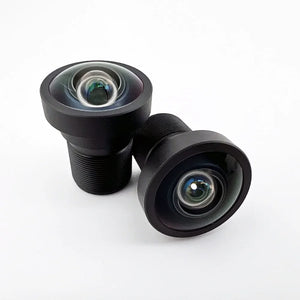
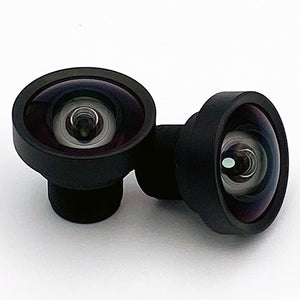
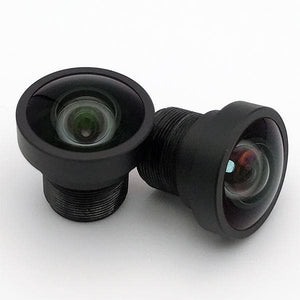
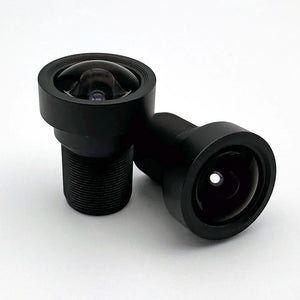
Beispiele für verzerrungsarme Objektive von Commonlands
These M12 and C-mount lenses are specified for precision measurement, barcode reading, and inspection.

Häufig gestellte Fragen
These answers define the terms used on Commonlands distortion datasheets.
Was ist ein Objektiv mit geringer Verzerrung?
A low distortion lens is a lens whose optical design keeps geometric mapping error small across the image field, typically published under 1% for machine vision M12 lenses and under 0.2% for precision options, against a stated metric and reference image circle. Standard lenses displace image points from their ideal rectilinear positions, bowing straight lines into curves. A low distortion lens minimizes that displacement so scene geometry maps more faithfully onto the sensor.
Was ist der Unterschied zwischen Tonnenverzerrung und Kissenverzerrung?
Bei der tonnenförmigen Verzeichnung werden gerade Linien von der Bildmitte aus nach außen gekrümmt; sie wird als negativer Prozentsatz angegeben. Bei der kissenförmigen Verzeichnung werden Linien nach innen zur Bildmitte hin gekrümmt; sie wird als positiver Prozentsatz angegeben. Die tonnenförmige Verzeichnung tritt in der industriellen Bildverarbeitung weitaus häufiger auf, da die meisten eingebetteten Kameras M12-Objektive mit kurzer Brennweite verwenden, die typischerweise eine tonnenförmige (negative) Verzeichnung aufweisen, sofern diese nicht durch die Konstruktion gezielt korrigiert wird.
Was ist der Unterschied zwischen Fernsehverzerrung und optischer Verzerrung?
TV distortion measures line bowing under a specified convention. Optical or geometric distortion compares image height with an ideal projection. Their percentages are not interchangeable, and a small TV value does not guarantee accurate local magnification. Request the distortion definition, reference field height, and full curve before using a value in a measurement error budget.
Ist eine geringe Verzerrung dasselbe wie Telezentrizität?
Nein. Eine geringe Verzeichnung verringert geometrische Abbildungsfehler bei einem festen Arbeitsabstand. Die Telezentrizität regelt die Position der Eintrittspupille, sodass die Vergrößerung bei Änderungen des Objektabstands nahezu konstant bleibt. Ein Objektiv kann eine Verzeichnung von unter 0,2 % aufweisen und dennoch eine große Änderung der Vergrößerung zeigen, wenn sich der Arbeitsabstand verschiebt. Die beiden Eigenschaften sind orthogonal zueinander, und eine geringe Verzeichnung ist kein Ersatz für Telezentrizität.
Wie viel Verzerrung ist bei der industriellen Bildverarbeitung akzeptabel?
Acceptable distortion depends on the application, and these tiers are Commonlands starting guidance rather than a standard. Read every figure with its metric (TV or optical) and its reference image circle, then convert it to pixels at your sensor and check it against your error budget. For barcode reading and general computer vision, under 1% often avoids per-deployment calibration. For dimensional measurement, under 0.2% is a common target. Where geometry is inferred loosely, 2-4% can work after a one-time calibration.
Benötigen Sie Hilfe bei der Auswahl eines Objektivs mit geringer Verzerrung für Ihre Anwendung?
Commonlands engineers can review your sensor format, working distance, and distortion budget to recommend the right lens. Same-day shipping on stocked lenses for orders placed before 12 PM PT.