
Was ist ein telezentrisches Objektiv? Telezentrizität im Objektraum, perspektivische Abweichungen und Alternativen in der industriellen Bildverarbeitung
This guide explains object-space telecentricity, image-space telecentricity, and perspective error. It also covers when a standard M12 or C-mount lens is the right choice instead.

A telecentric lens is a lens in which the chief rays on at least one side of the system run parallel to the optical axis instead of converging toward a finite point. In the object-space form used for machine vision metrology, the entrance pupil sits at optical infinity, so apparent object size stays constant as the object shifts slightly in depth.
Telecentric lenses are not a Commonlands product. This page explains the concept so engineers can decide whether they need one or whether a standard M12 or C-mount lens already solves the problem.
Was versteht man unter objektseitiger Telezentrizität?
Die objektseitige Telezentrizität ist eine Eigenschaft eines Objektivs, bei der die Eintrittspupille auf der Objektseite im optischen Unendlichen liegt. Die Hauptstrahlen von jedem Bildpunkt verlaufen parallel zur optischen Achse, bevor sie in das Objektiv eintreten. Dadurch bleibt die Vergrößerung wesentlich konstanter, wenn sich das Objekt leicht näher an das Objektiv heran- oder weiter davon entfernt, als dies bei einem Standardobjektiv mit derselben Brennweite der Fall wäre.
The entrance pupil is the image of the aperture stop seen from the object side. In a standard lens it sits at a finite distance. As a result, a chief ray's angle of arrival changes when the object moves axially, and apparent size changes with it. Placing the aperture stop at the rear focal plane of the front group maps that pupil to infinity and holds the object-side chief rays parallel.
No lens is perfectly telecentric across the full field at every distance. Telecentric error is specified as a maximum chief-ray angle in degrees, milliradians, or arc-minutes, and checked against the measurement tolerance for tight metrology work.
Pupil location and aperture size are independent. The entrance pupil position sets telecentricity. F# sets depth of field and light throughput. An object-space telecentric lens can be built with a wide or narrow aperture. The stop location, not its diameter, is what makes the design telecentric.
The geometry also costs size: the front element must be at least as large as the object field, so a lens covering a 50mm field needs a front element of at least 50mm. Aperture is a separate decision. Many telecentric gauging setups do run at a high F# with bright LED backlighting, but that follows from wanting depth of field and edge stability at the measurement plane, not from the size of the front element.
Object-space telecentricity does not increase depth of field. At a given magnification, depth of field depends on F#, the blur criterion you set (commonly scaled to pixel pitch), the wavelength and diffraction, and the lens's through-focus behavior, the same as any lens (estimate it with the depth-of-field calculator). What it changes is how reliably an object measures the same size across that depth, which dimensional measurement relies on and most detection tasks can do without, though stable magnification and reduced perspective shift can still help detection.

Was versteht man unter Bildraum-Telezentrizität?
Die Telezentrizität im Bildraum ist eine Eigenschaft eines Objektivs, bei der die Austrittspupille auf der Bildseite im optischen Unendlichen liegt. Die Hauptstrahlen treffen über das gesamte Bildfeld hinweg nahezu senkrecht auf den Sensor, anstatt in Richtung der Ecken unter zunehmend steileren Winkeln einzutreffen. Es handelt sich hierbei um eine Eigenschaft der Sensorkopplung und nicht um eine Eigenschaft der Messgenauigkeit; außerdem bewirkt sie keine Stabilisierung des Vergrößerungsfaktors in Abhängigkeit von der Objektentfernung.
Both pupils are images of the same aperture stop. In most lenses they sit at finite distances, so the chief ray angle (CRA) at the sensor increases with field position, reaching 20°–30° at the corners of compact small-format modules, the steepest designs in common use. Placing the aperture stop at the front focal plane of the rear group sends the exit pupil to infinity instead.
The benefit is at the sensor. CMOS sensors use microlenses shifted from center to corner to match an expected CRA profile. A mismatch in either direction costs light, whether the rays arrive steeper or shallower than the design expects. That produces shading, and on color sensors, it also shifts corner color. Holding incidence near zero helps only when the sensor is specified for a near-0° CRA.
Die Telezentrizität im Bildraum garantiert keine konstante Vergrößerung in Abhängigkeit vom Objektabstand, und die Telezentrizität im Objektraum garantiert keinen nahezu normalen Einfallswinkel des Hauptstrahls am Sensor. Es handelt sich um unabhängige Eigenschaften, die jeweils unterschiedliche Probleme lösen. Ein bi-telezentrisches Objektiv ist erforderlich, wenn für eine Anwendung beide Eigenschaften benötigt werden.
Image-space telecentricity does not fix distortion or MTF. Evaluate those separately. To decide whether you need it, compare the sensor's maximum CRA spec at the image corner to the lens's expected CRA there. Commonlands M12 and C-mount lenses target the small- and medium-format sensors common in embedded vision, so check the sensor's published CRA profile rather than assuming the format decides it.
Was ist ein Perspektivfehler?
Perspective error is the measurement error that occurs when a conventional entocentric lens views a scene through an angular field of view. Because all chief rays converge toward a single entrance pupil at a finite distance, a feature at one working distance subtends a different angle and measures a different size than the same feature slightly closer or farther from the lens. It is a consequence of projection geometry, not a lens aberration.
This is why perspective error and lens distortion are different problems. Distortion is a fixed optical aberration that misplaces image points relative to an ideal rectilinear grid. It is repeatable and can be characterized and removed through calibration. Perspective error depends on the 3D position of each scene point, which changes from part to part, so no fixed calibration removes it. A lens can measure less than 0.1% distortion and still produce substantial perspective error if part height or working distance varies.
| Fehlertyp | Grundursache | Was ändert sich? | Typische Lösung |
|---|---|---|---|
| Objektivverzerrung | Optische Aberrationen in Linsenelementen | Position des Bildpunkts im Vergleich zum idealen geradlinigen Raster | Low-distortion lens. Software calibration |
| Perspektivfehler | Winkelsichtfeld, zentrale Projektion | Vergrößerung bei Änderung der Objektentfernung | Object-space telecentric lens. Fixed flat scene at constant working distance |
| Parallaxenfehler (verwandtes Thema) | Central projection through a finite entrance pupil, combined with scene depth | Das Merkmal erscheint je nach Körpergröße seitlich verschoben | Object-space telecentric lens. Controlled, fixed working distance |
For a rough estimate, the magnification change across a height variation h at working distance d is approximately h/(d - f), which simplifies to h/d when the working distance is large relative to focal length. A 5mm tall part at 200mm introduces roughly 2.5% variation between its near and far faces. Whether that is acceptable depends on the tolerance, and for sub-pixel metrology it usually is not. Use the field-of-view calculator to check magnification at your working distance.
It shows up most in tall or tilted parts and in setups with variable working distance, and is largely irrelevant for flat parts at a fixed working distance or for presence/absence checks.
A related effect is parallax error: the same projection that changes apparent size with depth also shifts an off-axis feature laterally in proportion to its height. Both are addressed the same way, by fixing working distance mechanically where possible and moving to object-space telecentric optics when fixturing cannot hold depth inside the tolerance budget.
Was ist eine entozentrische Linse?
An entocentric lens is a conventional lens in which all chief rays converge toward a single entrance pupil at a finite distance. Objects farther from the lens appear smaller in the image. This central projection is the standard behavior of ordinary lenses, and the term entocentric simply describes it. It does not imply lower quality.
That pupil is the image of the aperture stop seen from the object side, so it can be real or virtual and can sit ahead of the front element, behind the rear one, or anywhere between. Retrofocus wide-angle designs commonly place it outside the glass. What makes a lens entocentric is the finite pupil distance, not where the pupil lands. Most M12 and C-mount lenses used in machine vision are entocentric unless a product page explicitly states otherwise.
The thin-lens relationship shows why magnification tracks distance: image height equals focal length times object height, divided by (object distance minus focal length). Focused at one working distance, magnification is fixed there, but if the object shifts even a few millimeters, image height changes with it. For a 50mm lens at a 500mm working distance, a 5mm shift changes magnification by roughly 1.1%, which can matter for a system targeting sub-1% accuracy.
Entocentric lenses remain the right default for most machine vision work. Commonlands supplies M12 and C-mount entocentric optics for general inspection, assembly verification, robotic guidance, and barcode or QR reading. They also cover flat or nearly flat parts imaged at a consistent working distance, and wide fields of view where a telecentric front element would grow large and expensive.
Entocentric lenses can still support dimensional measurement when scene geometry is favorable, with careful calibration. The limiting factor is whether depth variation in the scene stays inside the measurement tolerance.
Telezentrische vs. entozentrische Objektive: Die wichtigsten Unterschiede
The three telecentric configurations are easy to conflate. This table separates them by which pupil sits at infinity and which problem each solves.
| Konfiguration | Pupille im Unendlichen | Was unter Kontrolle bleibt | Wo es darauf ankommt |
|---|---|---|---|
| Objektraum-telezentrisch | Eingangspupille | Vergrößerung im Vergleich zur Objektentfernung | Maßprüfung, Messung, Teile mit variabler Höhe |
| Telezentrisch im Bildraum | Austrittspupille | Hauptstrahlwinkel am Sensor | Sensors whose CRA profile the lens has to match |
| Bitezentrisch | Beides | Beides gleichzeitig | Hochpräzise Messtechnik, die ebenfalls eine gleichmäßige Sensorkopplung erfordert |
| Entozentrisch (Standard) | Weder noch | Es gibt keine ausdrücklichen Einschränkungen | Allgemeine Erkennung, Inspektion, Robotik, Barcode-Erfassung |
When a machine-vision catalog says "telecentric" without qualification, it means the object-space form unless stated otherwise. If a vendor lists "bi-telecentric," verify it against the exit pupil specification. Telecentricity, MTF, and distortion are independent specifications, and none substitutes for the others. Where the tolerance budget allows, Commonlands M12 and C-mount entocentric optics cover the same work at lower cost and size.
Telecentric or standard: how to choose
Telecentric lenses solve one problem: magnification stability when object depth cannot be perfectly controlled. The clearest cases are precision dimensional gauging where parts cannot sit at a fixed distance, height-variation inspection where thickness differences or board warp would shift apparent dimensions into false accepts or rejects, and metrology that must hold calibration over long runs despite small drift along the Z axis.
The common factor is depth variation that cannot be removed mechanically. Telecentric optics earn their place when perspective error is a significant fraction of tolerance, not because telecentricity reads as a premium feature.
Build the error budget in one common unit, such as micrometers in object space. Convert depth variation, fixture repeatability, calibration residuals, and telecentricity error into measurement error using the system geometry. Measure how blur affects the chosen edge or feature estimator. Combine the terms using a stated worst-case method, or a statistical method when their distributions and independence are justified.
Most applications do not clear that bar, and a standard low-distortion lens is the right answer more often than engineers assume:
- Detection, presence-absence, and classification, where tight dimensional measurement is not required.
- Parts fixtured accurately enough that depth variation stays small relative to working distance.
- Setups needing working-distance flexibility, when the selected telecentric lens is specified for a fixed working distance. Adjustable-working-distance and variable-magnification telecentric designs also exist, so check the product range.
- Deployments where size, weight, or cost rules out a large telecentric front element.
Check magnification with the field-of-view calculator and focal length with the EFL calculator. The Commonlands engineering team can run that tolerance math for a standard M12 or C-mount alternative.
Hersteller von telezentrischen Objektiven: Bezugsquellen
Commonlands does not stock telecentric lenses. The manufacturers below are established sources for object-space and bi-telecentric optics in industrial machine vision.
| Hersteller | Hauptsitz | Produktfokus | Bekannt für |
|---|---|---|---|
| Opto-Technik | Italien | Spezielle telezentrische Optiken und Optiken für die industrielle Bildverarbeitung | Umfangreicher Katalog telezentrischer Objektive, der sowohl den Objektivraum als auch die bi-telezentrischen Produktreihen abdeckt |
| Edmund Optics | USA | Katalog: Optik und Objektive für die industrielle Bildverarbeitung | TECHSPEC-Sortiment mit telezentrischen Objektiven, großes Lager, schneller Versand |
| VS Technology | Japan | Objektive für die industrielle Bildverarbeitung | Telezentrische und hochauflösende Industrieobjektive |
| Moritex | Japan | Optik und Beleuchtung für die industrielle Bildverarbeitung | Telezentrische Objektive in Kombination mit einer darauf abgestimmten Beleuchtung |
| Sill Optics | Deutschland | Telezentrische, Scan- und F-Theta-Optiken | Telezentrische Messobjektive und Sonderanfertigungen |
| Computar | Japan | Objektive für die industrielle Bildverarbeitung und Videoüberwachung | Telezentrische Objektivserie der Einstiegsklasse neben Standardobjektiven |
Alternativen zu Standardobjektiven von Commonlands
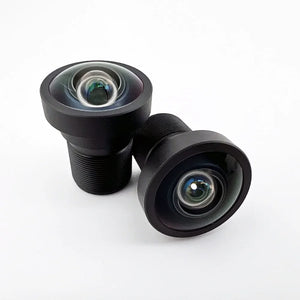
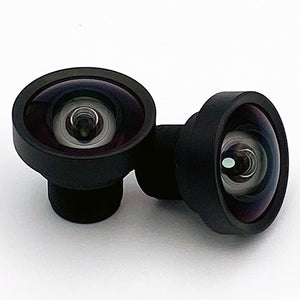
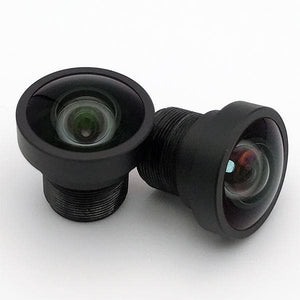
These are entocentric lenses, not telecentric ones. They fit when controlled fixturing, working distances long relative to part height, or a tolerance budget that absorbs residual perspective error means telecentricity is not required. Their distortion is specified rather than absent: the CIL034 holds under 1% on its display spec and the CIL062 measures −2% rectilinear. Those numbers govern in-plane accuracy after calibration, a separate property from magnification stability across depth.
The M12 vs. C-mount guide covers the mechanical differences between the two mount families. The choice turns on sensor format, working distance, and whether adjustable-iris depth-of-field control is needed, not on telecentricity.

Technical references
Häufig gestellte Fragen
Was ist ein telezentrisches Objektiv?
A telecentric lens is one whose chief rays, on at least one side of the system, run parallel to the optical axis instead of converging toward a finite point. The common object-space form places the entrance pupil at optical infinity, so apparent object size stays constant across the usable depth range.
Was versteht man unter objektseitiger Telezentrizität?
Object-space telecentricity means the entrance pupil sits at optical infinity on the object side. Chief rays from every field point travel parallel to the axis, so magnification stays much more constant as the object shifts slightly in depth. This is the form used for dimensional measurement.
Was versteht man unter Bildraum-Telezentrizität?
Image-space telecentricity means the exit pupil sits at optical infinity on the image side, so chief rays arrive near-perpendicular to the sensor across the field. It improves coupling with sensor microlenses and can reduce corner shading, but it does not stabilize magnification versus object distance.
Ist ein telezentrisches Objektiv dasselbe wie ein verzerrungsarmes Objektiv?
No. Low distortion describes how faithfully a lens maps straight lines within a plane. Telecentricity describes chief-ray direction and whether magnification is stable versus depth. A lens can have very low distortion and still show perspective error. They correct different problems.
Verkauft Commonlands telezentrische Objektive?
Nein. Telezentrische Objektive gehören derzeit nicht zum Produktangebot von Commonlands. Diese Seite dient zu Informationszwecken und erläutert die Telezentrizität im Objektbereich, die Telezentrizität im Bildbereich sowie den Perspektivfehler, damit Ingenieure beurteilen können, ob ihre Anwendung tatsächlich telezentrische Optik erfordert oder ob ein Standard-M12-Objektiv oder ein C-Mount-Objektiv die Messtoleranzen bereits erfüllt.
Sie suchen ein Objektiv für Ihre Inspektionsanlage?
Telezentrische Optiken gehören nicht zum Produktangebot von Commonlands, doch Standardobjektive mit M12- und C-Mount-Anschluss decken den Großteil der Bildverarbeitungsanwendungen ab. Nutzen Sie die kostenlosen Rechner, um das Sichtfeld und die Schärfentiefe für Ihren Arbeitsabstand zu berechnen, oder wenden Sie sich an unsere Technikabteilung, um eine bestimmte Messtoleranz zu besprechen.