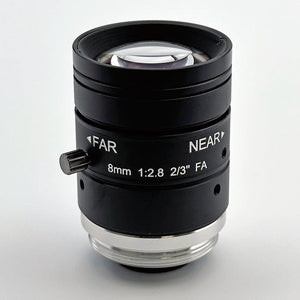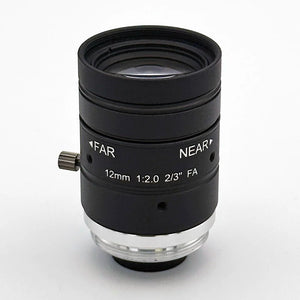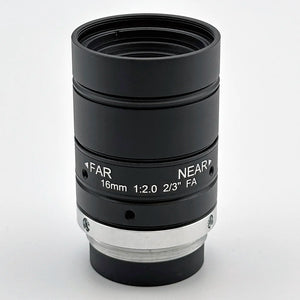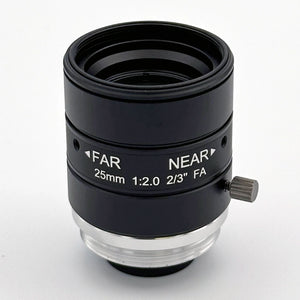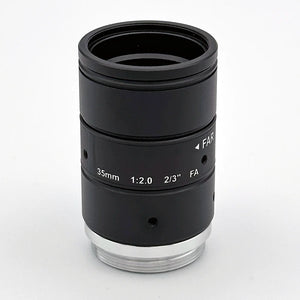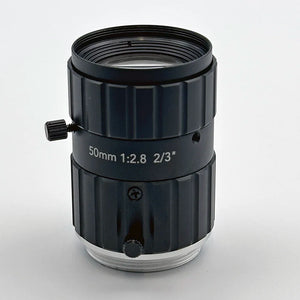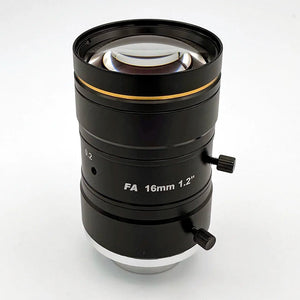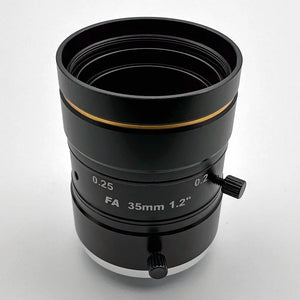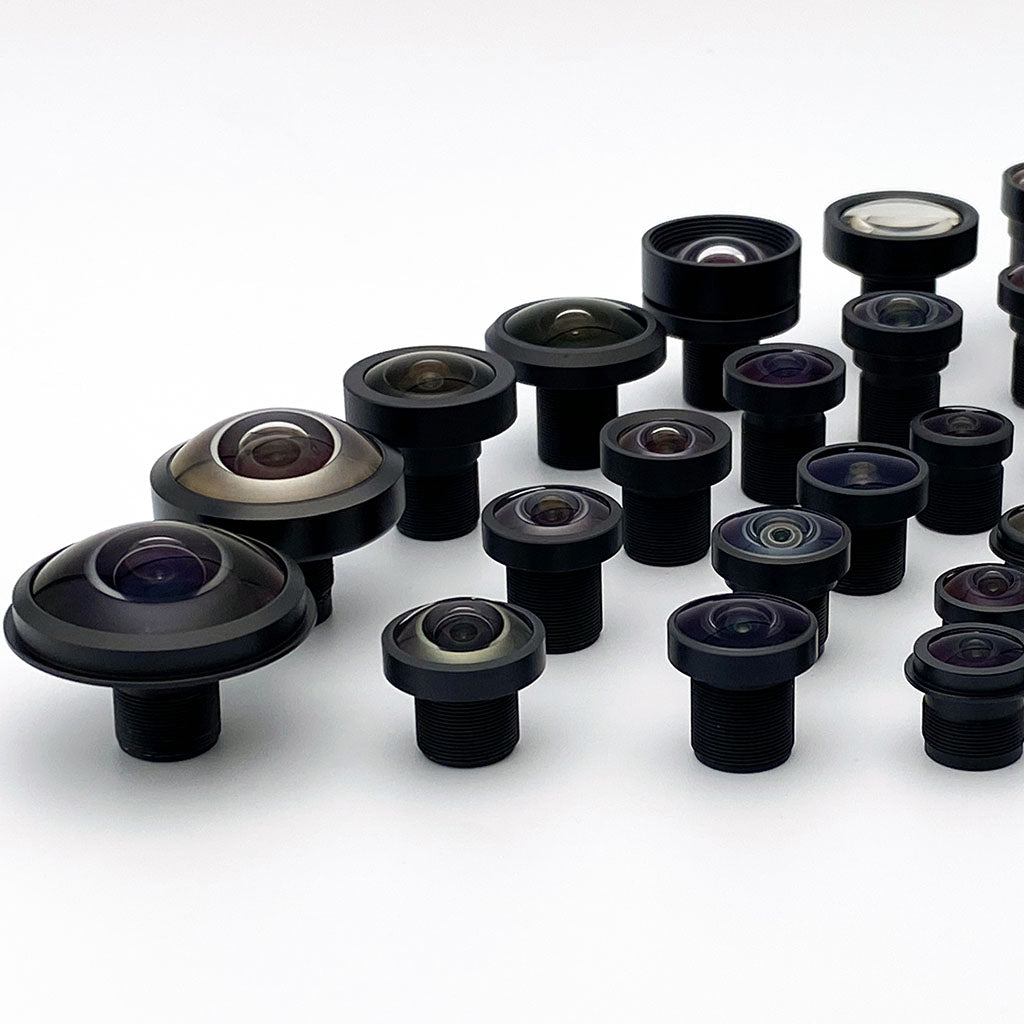

C-Mount-Objektive für Bildverarbeitungssysteme

Industrial optics for cameras with sensors from 1/4" to 1.2" format. All lenses in stock at our US warehouse with same-day shipping.

C-Mount-Objektive eignen sich für Qualitätsprüfungen, ITS-Verkehrsüberwachung, Robotik und Automatisierungssysteme. Dank Brennweiten von 4 bis 75 mm und einer einstellbaren Blende lassen sich Sensorformat und Schärfentiefe an die jeweilige Anwendung anpassen.

Brennweitenbereich 4–75 mm
Sensorreichweite 1/4" bis 1,2"
Auflösung 5–25 MP
C-Mount-Objektive für Bildverarbeitungssysteme

Warum sich C-Mount-Objektive für die industrielle Bildverarbeitung besonders gut eignen

Machine vision systems operate at specific working distances: inspecting parts on conveyors at 500mm, scanning barcodes at 300mm, or monitoring traffic at 10-20 meters. The C-mount thread says nothing about which conjugate a lens is corrected for, so that has to come from the datasheet. The Commonlands machine vision lenses in this collection are corrected for those finite working distances rather than for infinity alone, which is what buys sharper images, more accurate measurements, and better defect detection than a photographic lens optimized for distant subjects. Other C-mount products, surveillance, varifocal, and dedicated macro designs among them, are optimized elsewhere, so check the conjugate before you specify.

The key advantage of C-mount lenses is the adjustable aperture (iris ring), which gives you direct control over depth of field. Stopping down the iris increases depth of field so more of the scene is in focus, which is critical for inspecting parts with varying heights or reading codes on uneven surfaces. In machine vision this tradeoff is practical: reducing the aperture cuts light throughput, but illumination levels can be controlled programmatically with structured lighting, LED ring lights, or backlight arrays. Fast maximum apertures (F/1.4–F/2.0) still provide high light throughput when you need short exposure times for high-speed capture. Combined with image circles that cover sensors from 1/4" to 1.2", these lenses supply the optical half of a reliable industrial vision system. Shutter architecture is the other half and belongs to the sensor: a global shutter exposes every row over the same interval, which is what removes the skew a rolling shutter puts on fast-moving objects. The lens mount has no bearing on it, so choose the shutter on the camera and the image circle on the lens.

Was ist ein C-Mount-Objektiv?

C-Mount ist ein branchenübliches Objektivbefestigungssystem, das durch ein 1"-32-UN-Gewinde und einen Flanschbrennweitenabstand von 17,526 mm definiert ist. Ursprünglich für 16-mm-Filmkameras entwickelt, hat sich C-Mount zur führenden Schnittstelle für die industrielle Bildverarbeitung etabliert, da es Sensoren im Format von 1/4" bis 1,2" unterstützt und gleichzeitig eine kompakte, wiederholgenaue mechanische Verbindung gewährleistet.

The thread and flange are common to every C-mount product, so a C-mount lens from one maker threads onto a C-mount camera from another. Basler, FLIR, Allied Vision, IDS, Teledyne DALSA, and others all build to this standard. Threading on is not the whole compatibility question: rear-element intrusion into the camera throat, clearance around the sensor filter, focus travel, cover-glass thickness, image circle against sensor diagonal, and spectral and chief ray angle behavior stay specific to the lens and the camera.

The shared flange distance gives every lens the same nominal starting point when you swap focal lengths on a production line, which shortens the changeover. It is a starting point rather than a calibration: each lens carries its own focal tolerance, focus setting, and principal-plane locations, and each camera its own registration and sensor stack, so plan on refocusing and re-verifying calibration after a swap.

C-Mount-Objektive unterscheiden sich von CS-Mount-Objektiven (die zwar das gleiche Gewinde, jedoch einen kürzeren Flanschabstand von 12,526 mm aufweisen). Ein C-Mount-Objektiv kann mit einem 5-mm-Distanzring an einer CS-Mount-Kamera verwendet werden, CS-Mount-Objektive sollten jedoch nicht an C-Mount-Kameras eingesetzt werden, da der kürzere Flanschabstand eine korrekte Fokussierung verhindert.

C-Mount-Objektive nach Sensorformat – auf Lager

Bildgebungsoptiken für Sensoren im Format von 1/4" bis 1,2" – Muster werden noch am selben Tag aus Kalifornien versandt

Robuste C-Mount-Objektive – Lagerbestand in den USA

Enhanced mechanical construction for harsh environments. Shock and vibration performance depends on the test profile, the mount and preload, and the limits you accept after the test, so qualify a specific lens against your own profile - Ships within 24 hours

C-Mount-Objektive für die industrielle Bildverarbeitung

C-mount lenses are the industry standard for machine vision systems, quality control applications, and industrial automation. With our complete inventory stocked in California, we ship same-day throughout the United States for orders placed before 12 PM PT. This means you get the lenses you need tomorrow, not next week, which is critical when production lines are waiting.

The C-mount standard (1"-32 thread, 17.526mm flange distance) gives one common mechanical interface across the major camera manufacturers including Basler, FLIR, Allied Vision, and IDS. Clearance in the throat, focus travel, cover-glass thickness, and image circle still decide whether a given pairing works. Supporting sensors from 1/4" to 1.2" format, C-mount lenses provide the flexibility to choose the right sensor for your application, from cost-effective 5MP sensors for basic inspection to high-resolution 25MP sensors for detailed measurement tasks. Lenses designed for larger formats will work with smaller sensors, providing a cropped field of view.

What matters for machine vision is the conjugate a lens is corrected for, and that is a design choice rather than something the C-mount standard sets. The machine vision lenses in this collection are corrected for finite working distances, so a camera inspecting parts at 500mm or reading barcodes at 300mm is working where the design is at its best. Fast apertures from F/1.4 to F/2.0 on those designs maximize light throughput, enabling shorter exposure times to freeze motion and reduce blur in high-speed applications. Read the datasheet for any C-mount lens before you specify it: surveillance, varifocal, and macro designs share the mount and are optimized for other conjugates.

Most of the C-mount lenses in this collection have lockable focus and iris rings, which matter when a camera is bolted to vibrating equipment or a moving robot; the product page for each lens says which rings lock. Operating temperature range, coating band, and the pixel pitch a design targets are per-SKU numbers rather than consequences of the mount or of metal construction, so read them off the product page. The ruggedized models carry the widest environmental ratings on the page, several designs target pixel pitches down to 2.2μm, and several carry coatings that cover visible and NIR together, but no single lens is all of those at once by default.

A pixel pitch or a megapixel label names the sensor class a design targets. It is not a measured resolution, so ask for the MTF curve and its conditions, the spatial frequency, aperture, field height, wavelength band, and conjugate, and compare that against your sensor.

C-Mount- vs. M12-Objektive: Welcher Anschluss eignet sich für Ihre Anwendung?

Sowohl C-Mount als auch M12 sind gängige Objektivfassungen für die industrielle Bildverarbeitung, werden jedoch für unterschiedliche Anwendungen eingesetzt. Hier sehen Sie einen Vergleich der beiden.

Spezifikation C-Mount M12 (S-Mount)
Thema1"-32 UN (25,4 mm)M12×0,5 (12 mm)
Flanschabstand17,526 mmKein Standard (variiert)
Maximales Sensorformat1.2"1/6" to 2/3" (up to 1/1.8" typically, with select designs to 2/3")
Sensor resolution class targeted5 MP bis 25 MP+2MP to 16MP; the highest class published for a Commonlands M12 lens is 12-16MP at 1.55µm, on CIL340 and CIL293
Brennweiten4 mm bis 75 mm0.8mm to 100mm
Typische BlendeF/1,4 bis F/2,8F/1,6 bis F/2,8
FokussiermechanismusLockable focus ring; internal mechanism varies by designEinschrauben (Set-and-Lock)
Iris-SteuerungEinstellbarer BlendenringFeste Blende
Vibration and shock constructionFocus and iris rings lock; more mass on a longer lever armNo moving rings; low mass, bonded assembly
GrößeGrößer, schwererSehr kompakt, leicht
Am besten geeignet fürBildverarbeitung, Qualitätsprüfung, ITS, LaborautomatisierungRobotik, Drohnen, Embedded-Vision, Board-Kameras
ArbeitsabstandJe nach Produkt unterschiedlich, in der Regel 100 mm–∞Set by lens prescription, holder, and sensor stack, not by the mount; confirm per build with Commonlands engineering
Preisspanne130 bis 440 Dollar15 bis 120 Dollar

For machine vision applications requiring depth-of-field control via an adjustable iris or sensors larger than 1/1.8", C-mount is the better choice. Working distance on its own does not select a mount: M12 telephotos at 50mm, 75mm, and 100mm reach well past 500mm, so size the lens from the field of view and resolution you need at your standoff, then decide on iris control and sensor format. The resolution figures in the table name the sensor class each design targets, so treat them as a shortlist filter and confirm against the MTF data and its conditions on the product page. The vibration row describes construction rather than a rating: shock and vibration performance depends on the test profile, the mount and preload, and the optical and mechanical limits you accept after the test, so qualify the specific lens and holder against your own profile. The adjustable aperture is especially valuable when inspecting objects at varying heights: stop down for more depth of field, and compensate with programmable lighting. For embedded systems, robotics, and compact board cameras where size and weight matter most, M12 lenses (fixed aperture) are the standard. Commonlands stocks both. Browse our M12 lens collection or contact our engineering team for help choosing. If you are also comparing suppliers, our guide to Edmund Optics alternatives for imaging lenses covers where a C-mount lens from a specialist beats a catalog house, and where it does not.

Technische FAQ zum C-Mount

Häufige Fragen von Ingenieuren im Bereich der industriellen Bildverarbeitung

Warum sollte man für die industrielle Bildverarbeitung C-Mount-Objektive den M12-Objektiven vorziehen?
The biggest differentiator is the adjustable iris ring on C-mount lenses, which lets you control depth of field. M12 lenses have a fixed aperture, so you get whatever depth of field the manufacturer chose. With C-mount, you can stop down to increase depth of field for inspecting parts with varying heights, and in machine vision this is practical because illumination can be controlled programmatically (structured lighting, LED arrays). C-mount lenses also cover larger sensors, up to 1.2", including the global-shutter sensors used for fast motion, though the shutter is a camera property rather than anything the mount supplies. They have fast maximum apertures (F/1.4–F/2.0) for high-speed capture, and the machine vision designs in this collection are corrected for the finite working distances (200mm–2000mm) typical in inspection and automation.
Welche Sensorformate unterstützen C-Mount-Objektive?
C-mount lenses support sensors from 1/4" (4.5mm diagonal) through 1.2". This includes: 1/4", 1/3", 1/2", 1/1.8", 2/3", 1", 1.1", and 1.2". Each lens is designed to fully cover a specific sensor size. Using a lens designed for a smaller sensor will cause dark corners (vignetting) on a larger sensor. However, lenses designed for larger sensors work perfectly with smaller sensors, providing a narrower field of view. The standardized mounting (1"-32 thread, 17.526mm flange distance) means any C-mount lens threads onto any C-mount camera and starts at the same nominal registration; rear-element clearance, focus travel, cover-glass thickness, and image circle still have to be checked for the specific pairing.
Wie wähle ich die richtige Brennweite für meine Bildverarbeitungsaufgabe aus?
Verwenden Sie folgende Formel: Brennweite = (Arbeitsabstand × Sensorbreite) / Bildfeldbreite. Wenn beispielsweise Ihre Inspektionskamera mit einem 2/3"-Sensor (8,8 mm Breite) einen 200 mm breiten Bereich in 500 mm Entfernung erfassen soll: f = (500 × 8,8) / 200 = 22 mm, daher würden Sie ein 25-mm-Objektiv wählen. Weitwinkelobjektive (4–8 mm) eignen sich ideal für die Flächenabtastung und Navigation. Standardobjektive (12–25 mm) eignen sich gut für allgemeine Inspektionen und die Qualitätskontrolle . Teleobjektive (35–75 mm) sind perfekt für detaillierte Inspektionen oder das Erkennen kleiner Merkmale aus der Ferne.
Was ist der Unterschied zwischen den Objektivversionen mit 5 MP, 12 MP und 25 MP?
The rating names the sensor class a lens is designed and toleranced for, not a measured resolving power. A 25MP lens is built to hold usable contrast at the higher spatial frequencies a 25MP sensor of that format samples, and a 5MP lens is not. The label is not a pixel pitch: two 12MP lenses for different formats target different pitches, so ask for the MTF curve with its conditions, the spatial frequency, aperture, field height, wavelength band, and conjugate, and compare that against your sensor. As a practical matter, a 5MP lens on a 25MP sensor leaves resolution on the table, while a 25MP lens on a 5MP sensor costs more without hurting the image.
Wie schnell werden C-Mount-Objektive aus Ihrem US-Lager versandt?
All C-mount lenses shown on our website are in stock at our California warehouse and ship same-day for orders placed before 12 PM PT. We offer next-day delivery throughout the United States via FedEx and UPS. Volume orders up to 10,000 units typically ship within 1-3 business days depending on quantity. Free shipping is available for orders over $100. International shipping is available with proper export documentation. Contact us for quotes on delivery to your country.

Hilfe bei der Auswahl von C-Mount-Objektiven

Teilen Sie uns Ihre Anforderungen im Bereich der Bildverarbeitung mit, damit wir Ihnen maßgeschneiderte Empfehlungen geben können.