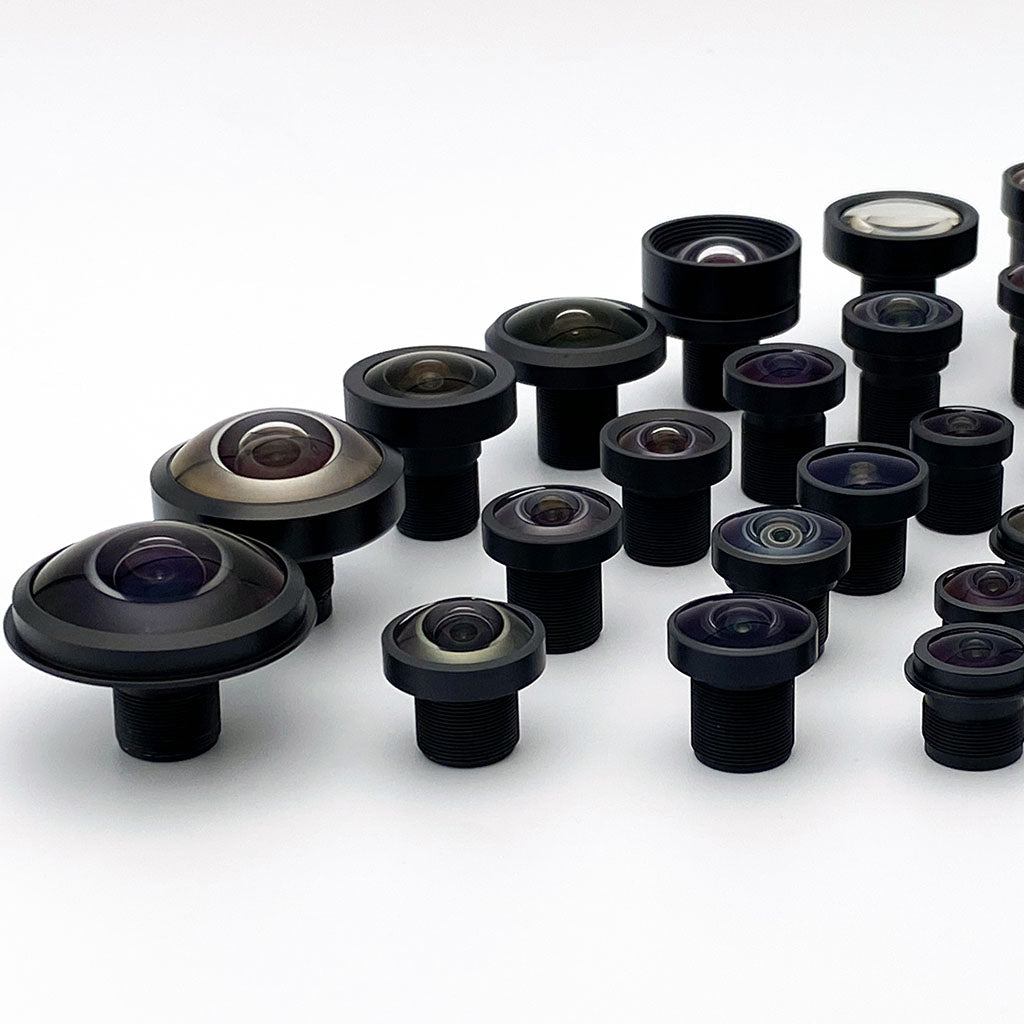

Objektive für die industrielle Bildverarbeitung zur Inspektion von Lebensmittel-, Getränke- und Arzneimittelverpackungen: Ein Leitfaden zur Auswahl
Machine vision optics for food and beverage lines handle fill level, cap/seal, date-code, and foreign-object checks. Pharmaceutical packaging lines add blister-pack completeness, label verification, and tamper-evidence inspection.

Food, beverage, and pharmaceutical packaging lines test machine vision optics harder than most inspection environments. High conveyor speeds call for short exposures, which come from a fast aperture, brighter or strobed lighting, or a more sensitive sensor, and washdown cycles degrade unsealed lenses. Regulated packaging adds traceability requirements a cosmetic defect check does not have. No single focal length or mount type fits every station.
For most tasks the choice is between Commonlands M12 lenses (compact, inexpensive, suited to multi-camera arrays) and C-mount lenses (adjustable iris, higher resolution ceiling, more tuning margin). A flat packaging surface, a tight mechanical envelope, and a sensor 1/1.8″ or smaller point to M12. Product height variation, iris control, or a sensor 2/3″ and larger point to C-mount. Direct high-pressure washdown points to an IP69K-rated M12 lens (IP69K abbreviates ISO 20653's IP6K9K) sized to the belt, or a sealed housing; neither rating covers detergents or sanitation chemistry.
Inhaltsverzeichnis
- Fehlererkennung bei Förderbändern
- Etiketten- und Barcode-Prüfung
- Füllstand- und Verschlussprüfung
- Erkennung von Fremdkörpern und Verunreinigungen
- Sortieren und Klassifizieren
- Prüfung von Arzneimittelverpackungen
- M12 vs. C-Mount für die Lebensmittel- und Pharmaproduktion
- Sensor-Kopplung und Auflösung
- Umweltaspekte
- Commonlands-Produkte
- Die 5 besten Objektive für die Inspektion von Lebensmittel- und Pharmaverpackungen
- Häufig gestellte Fragen

Fehlererkennung bei Förderbändern
Low distortion matters on belt inspection because distorted frames make consistent bounding-box or contour detection harder across the field. The Commonlands CIL512 (12mm C-mount, approximately −1.8% TV distortion) suits wide-belt coverage on a 1.1″ sensor. The CIL533 (16mm, −0.1% optical/rectilinear distortion, a different metric, not directly comparable to CIL512's TV figure) is the lower-distortion choice for narrower fields at longer working distances.
Etiketten- und Barcode-Prüfung
Working distances for label stations typically fall between 150–400mm, where M12 lenses with good off-axis correction are competitive. The Commonlands CIL052 (5.2mm M12, −0.1% distortion) holds consistent resolution across a 1/1.8″ sensor for full-label capture at short working distances. The CIL042 (4.2mm M12, −0.7% TV distortion at a 9.3mm reference circle) covers a wider field for larger labels. TV line bow and radial distortion are different metrics; compare matched distortion measurements and actual decoding performance before ranking these lenses for OCR.
Füllstand- und Verschlussprüfung
Multi-camera setups are common here, one camera per lane or product variant, so cost matters. The Commonlands CIL083 (8mm M12, $19) is the cost-effective choice: at F/2.8 its aperture works with standard line illumination for reasonable exposures, with sensor response and exposure time setting the actual margin, and −0.5% TV distortion is adequate for threshold pass/fail.
For measurement-grade systems where image height maps to a physical volume, the CIL553 (16mm C-mount, −0.09% distortion, 25MP) gives better geometric accuracy and supports higher-resolution sensors for finer increments.
Erkennung von Fremdkörpern und Verunreinigungen
Foreign object detection sometimes pairs machine vision with NIR illumination, because some contaminants that blend into white light differ in reflectance across 700nm to 1100nm. Whether it works is case-specific: the contaminant, its thickness, the product matrix, and the illumination geometry all matter. Silicon NIR often finds insects and dark plant material; clear glass, bone, and metal in bulk product commonly need hyperspectral, SWIR, or X-ray instead.
A standard lens with an IR-cut filter strongly attenuates that range, so it is unsuitable for NIR work regardless of sensor sensitivity.
For NIR food inspection, specify a lens variant without the IR-cut filter. Commonlands offers CIL083-F2.8-M12ANIR for compact M12 installations and CIL512-F2.8-CMANIR for C-mount setups. Both transmit beyond 700nm for NIR illumination sources. See the NIR imaging guide for sensor and illumination pairing.
For visible-light contamination such as surface marks, color patches, or label anomalies, standard lens variants work fine. What matters most is contrast at the spatial frequencies of the smallest contaminant you need to flag.
Sortieren und Klassifizieren
Items must stay fully in frame as they pass, which means a wide-angle lens or a camera set farther back. The Commonlands CIL042 (4.2mm, F/1.9) gives the widest field here and collects more light geometrically than F/2.8 alternatives, so it suits fast lanes where motion blur is the main concern. The CIL083 (8mm, F/2.8) works better for texture grading over a smaller inspection area.
Prüfung von Arzneimittelverpackungen
| Prüfaufgabe | Primäre optische Einschränkung | Ausgangspunkt des Objektivs |
|---|---|---|
| Überprüfung von Etiketten und Chargennummern / UDI | Geringe Verzerrung, Pixeldichte bei kleinstem Zeichen | Low-distortion M12 or C-mount, <0.5% distortion |
| Vollständigkeit von Blisterverpackungen und Beuteln | Schärfentiefe bei unterschiedlichen Höhen des Hohlraums | C-Mount mit einstellbarer Blende |
| Prüfung von Siegeln und Klappen / Manipulationsschutz | Schärfentiefe über gefaltete Kanten und erhabene Nähte | C-Mount mit einstellbarer Blende |
| Anbringung des Kartonetiketts / Druckposition | Geringe Verzerrung über das gesamte Bildfeld | C-Mount, 2/3″- oder 1,1″-Sensor |
Traceability pushes lot-code and UDI reading toward lower distortion and higher edge resolution than a presence check: every character in the lot code and expiration date has to be decoded for recall and serialization audits under frameworks like DSCSA. A lens with 2% barrel distortion compresses character strokes near the periphery, lowering OCR confidence where wide-zone label text sits. A lens under about 0.5% distortion is a common target for skipping software correction, but the real threshold follows the allowed positional error, field position, and measurement tolerance.
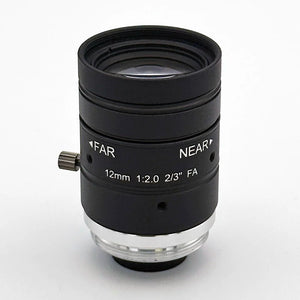
The CIL052 (5.2mm M12) is a compact option for code-reading and label heads. The CIL522 (12mm C-mount, 0.4% distortion, F/1.4) adds an adjustable iris for packaging with depth-of-field pressure.
Blister cavities, formed pouches, and folded flaps sit at different distances from the camera, so at a wide aperture even a few millimeters of height variation can defocus part of the frame. Stopping down extends depth of field, and because machine vision illumination is usually programmable, a two-stop reduction is compensated with more strobe power, not a lens change.
The CIL512 covers up to 1.1″ sensors with a 17.6mm image circle for carton and tray coverage. The CIL544 25mm C-mount handles small-character lot-code work at longer standoff.
Continuous-web label inspection at line speed needs a line-scan camera and line-scan optics, not area-scan. 360-degree vial inspection needs multiple cameras or a pericentric lens. SWIR imaging through opaque packaging needs a sensor and lens matched to the SWIR band. None are current Commonlands products. For those tasks, a specialist in that modality is the better starting point.
M12 vs. C-Mount für die Lebensmittel- und Pharmaproduktion
M12 and C-mount are different optical systems, not variations of the same design. M12 lenses use a rigid body: focus is set by threading the barrel, and there is no internal mechanism for aberration rebalancing at different focus positions.
Adjustable C-mount lenses focus by turning a ring; what moves inside (whole cell, front group, or cam-driven internal groups) and how sharpness holds at the near limit vary by design, so check the datasheet or ask Commonlands engineering before locking a washdown station layout. The C-mount standard itself dictates no focus mechanism; other C-mount lenses use unit or front-cell focus, or ship fixed-focus. See the full mount comparison guide for the mechanical details.
M12 lenses are smaller, lighter, and cheaper, typically $19–79 in the Commonlands food and packaging range. Across arrays of 10–20 cameras on wide conveyors that adds up, and M12 integrates cleanly into compact embedded smart cameras.
| Faktor | M12 | C-Mount |
|---|---|---|
| Preis (Commonlands-Sortiment) | 19–79 Dollar | 119–349 Dollar |
| Größe und Gewicht | Kompakt, geringes Gewicht | Größer, schwerer |
| Blendensteuerung | Feste Blende | Einstellbarer Blendenring |
| Abdeckung der Sensorformate | Most models up to 1/1.8″; select models to 2/3″ | Bis zu 1,1″ und mehr |
| Fokuseinstellung | Gewindedrehung, starrer Körper | Focus ring; internal mechanism varies by design |
| Spritzwasserschutzklasse | IP69K available (CIL190, CIL337, CIL355, CIL384) | Wird in der Regel in einem externen, abgedichteten Gehäuse untergebracht |
| Mehrkamera-Arrays | Aus Kostengründen bevorzugt | Wird verwendet, wenn die Auflösung oder die Anpassung der Schärfentiefe dies erfordern |
For IP69K washdown protection on the lens itself, the CIL190 (19mm M12, F/1.6) covers narrow fields at longer standoff. A wide belt needs a much shorter focal length, so size the field first, then check the IP69K CIL337 (3.6mm), CIL384 (3.34mm), and CIL355 (5.5mm) against it. C-mount installations in direct washdown zones rely on an external sealed housing, since the iris mechanism is not rated for high-pressure water.
Sensor-Kopplung und Auflösung
Basic pass/fail inspection includes fill level threshold, cap presence, or gross defect detection. For these tasks, a 1/3″ sensor with an M12 lens provides adequate resolution at lower cost per camera head. The CIL083 covers up to 1/1.8″ sensors, giving headroom if the sensor format changes later.
Label reading and barcode verification need more pixels across the inspection area. 1/1.8″ sensors at 8–12MP give the pixel density needed for character recognition. The Commonlands CIL052 covers 1/1.8″ at 10MP+, and the CIL042 covers 1/1.7″ at 5–6MP. Neither image circle reaches the 11mm diagonal of a 2/3″ sensor; that step needs a C-mount lens or a select 11mm M12 design.
High-resolution defect detection on large areas (texture grading, print-quality verification, foreign material on wide-format labels) benefits from 1″ or larger sensors. The CIL512 covers a 1.1″ image circle on sensors like the IMX253 for that field coverage and resolution. Use the DOF calculator to check depth of field across your product height range at the chosen aperture.
Umweltaspekte bei der Lebensmittel- und Arzneimittelherstellung
Abwaschbarkeit (IP67 vs. IP69K)
IP67 covers dust ingress plus immersion to 1 meter for 30 minutes, the IEC 60529 IPX7 test. IP6K9K (industry shorthand IP69K) comes from ISO 20653, a separate road-vehicle standard, and covers a defined high-pressure, high-temperature jet spray, not the same test as IEC 60529. These are different requirements: an IP67 rating makes no claim against an 80°C pressure-washer stream, so do not assume it survives one.
Either rating covers one tested variant, mounted as tested, against that standard's dust and water loads only. It does not cover detergents, steam, repeated sanitation cycles, or the rest of the camera. Check it against the plant's protocol. Not every station needs IP69K. Many pharmaceutical labeling and carton cells run in dry, climate-controlled rooms where a standard sealed lens is enough.
For lenses without an IP rating, a sealed housing with an AR-coated optical window is the standard approach, which keeps transmission losses low. The IP rating guide covers what each rating actually tests and its limits.
Temperaturwechselbeanspruchung
Lenses moving between cold storage (0–5°C) and warm production areas (20–30°C) can fog optical elements or shift focus as lens, holder, and sensor-support dimensions change with thermal expansion. Optical polymers have higher, less predictable thermal expansion than glass, so element materials and how the design is athermalized both affect focus stability. Check the datasheet operating-temperature range. See ruggedized machine vision lenses for the Commonlands products built for thermal cycling.
Commonlands-Objektive für die Inspektion von Lebensmittel-, Getränke- und Pharmaverpackungen
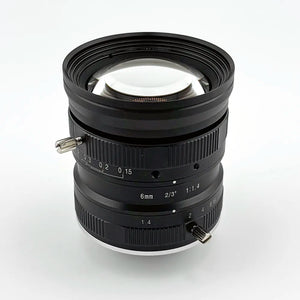
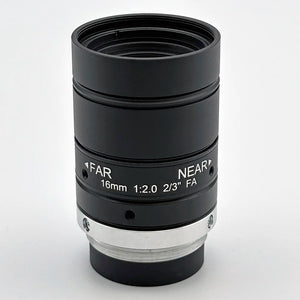
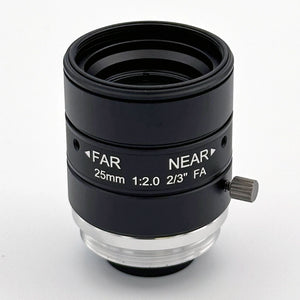
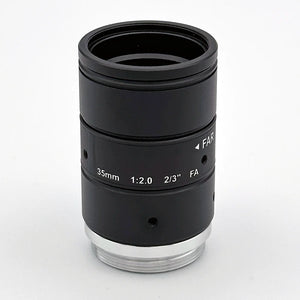
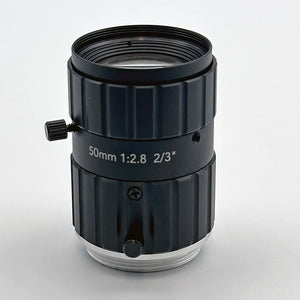
Die 5 besten Bildverarbeitungsobjektive für die Inspektion von Lebensmittel- und Pharmaverpackungen
| Rang | Objektiv | Montage | EFL | F# | Hinweis zur Versiegelung | Am besten geeignet für |
|---|---|---|---|---|---|---|
| 1 | CIL052 | M12 | 5,2 mm | F/3,4 | Keine IP-Schutzart; trockene oder leicht abgedichtete Stationen | Etiketten- und Barcode-Prüfung (−0,1 % Verzerrung) |
| 2 | CIL544 | C-Mount | 25 mm | F/1.8 (adjustable iris) | Keine IP-Schutzart; für Nassbereiche ein abgedichtetes Gehäuse hinzufügen | OCR-Erkennung von Datumscodes und Chargennummern bei größerem Abstand |
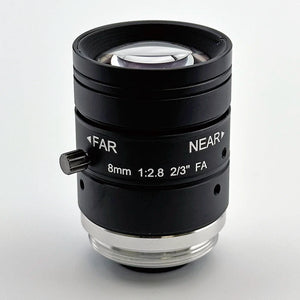
| 3 | CIL083 | M12 | 8 mm | F/2,8 | Keine IP-Schutzklasse; Einsatz in standardmäßig abgedichteten Leitungen | Füllstand-Pass/Fail, Mehrkamera-Arrays |
| 4 | CIL512 | C-Mount | 12 mm | F/2,8 | Keine IP-Schutzart; abgedichtetes Gehäuse für die Nassreinigung | Fremdkörper und NIR-Verunreinigungen (NIR-Variante erhältlich) |
| 5 | CIL042 | M12 | 4,2 mm | F/1,9 | Keine Schutzart; Trockensortiergehäuse | Hochgeschwindigkeitssortierung und -klassifizierung (großes Sichtfeld) |
Where a bare Commonlands lens is the wrong call: large-format C-mount stations that need factory-automation glass rated for continuous line duty are better served by a Fujinon or Kowa FA lens with longer published shock and MTF data. For a direct washdown zone, a full IP69K camera housing protects the whole optical stack, which a per-lens rating cannot.


Häufig gestellte Fragen
Welche Brennweite benötige ich für ein 600 mm breites Förderband?
Working distance and sensor size set it through the far-conjugate approximation EFL = (WD × sensor width) / FOV width, close when WD is much longer than the EFL. For a 600mm belt at 300mm working distance on a 2/3″ sensor (8.8mm width), EFL = (300 × 8.8) / 600 = 4.4mm. At equal framing and F#, depth of field depends on magnification and the blur criterion, not focal length. The real tradeoffs at 4.4mm are distortion, height parallax near the belt edges, and corner performance.
At 500mm the EFL rises to 7.3mm, reducing perspective variation for a given object height. A 1″ sensor (12.8mm) at 400mm gives about 8.5mm. Iterate with the FOV calculator before committing.
Was ist das beste kostengünstige Objektiv für eine Mehrkamera-Lebensmittelkontrolllinie?
The CIL083 at $19 is the practical answer for cost-sensitive multi-camera lines. It covers 1/1.8″ sensors at F/2.8 with −0.5% TV distortion, adequate for pass/fail inspection. For label stations, the CIL052 at $79 gives −0.1% distortion and better off-axis performance. Running 14 fill-level stations on CIL083 and 6 label stations on CIL052 across a 20-camera line saves about $840 without compromising where optics matter.
Kann eine einzige Linse sowohl das Auslesen von Etiketten als auch die Fehlererkennung übernehmen?
Usually not with a single station. Label reading needs the frame filled with the label for maximum pixel density per character, while defect detection may need to cover the whole product including edges. These fields of view conflict, and a lens optimized for one leaves the other underserved.
If a single camera must serve both, choose the field of view for the more demanding task and verify the other still meets acceptance criteria at the resulting resolution.
Ist C-Mount für pharmazeutische Verpackungsanlagen besser geeignet als M12?
C-mount is the better default for most fixed-station packaging inspection: adjustable iris, larger sensor support, and more tuning margin. A 2/3-inch or 1.1-inch sensor covers a wider packaging zone at the same working distance, and it preserves pixel density only if its pixel count scales with the larger area.
M12 is right when the inspection head has a hard size constraint and the surface is flat and consistent. It also works when a modest sensor is enough. Many embedded code readers and compact label heads use M12 for this reason.
Wie schütze ich die Linse in einer Umgebung, in der mit Wasser gereinigt wird?
The direct option is a lens rated to IP6K9K: the CIL190 (19mm M12) carries that ISO 20653 rating for a high-pressure, high-temperature water jet, and the shorter CIL337 (3.6mm), CIL384 (3.34mm), and CIL355 (5.5mm) carry it too for wider fields. Confirm your line's jet pressure and temperature against that test, then size the field of view and pick the lens that fits.
For lenses without an IP rating, a sealed housing with an AR-coated optical window is the standard approach. An IP6K9K lens is not a hygienic-design claim: under ISO 20653 the rating covers water and dust on the tested variant, not detergents, sanitation cycles, or the camera behind it. See the IP rating guide for what each rating covers and what it does not.
Benötigen Sie Hilfe bei der Auswahl einer Linse für eine Verpackungsanlage?
Entdecken Sie M12-Objektive und C-Mount-Objektive für die Inspektion von Lebensmittel-, Getränke- und Pharmaverpackungen.
Size focal length with the FOV calculator, or contact Commonlands engineering with your sensor format, working distance, and inspection task.