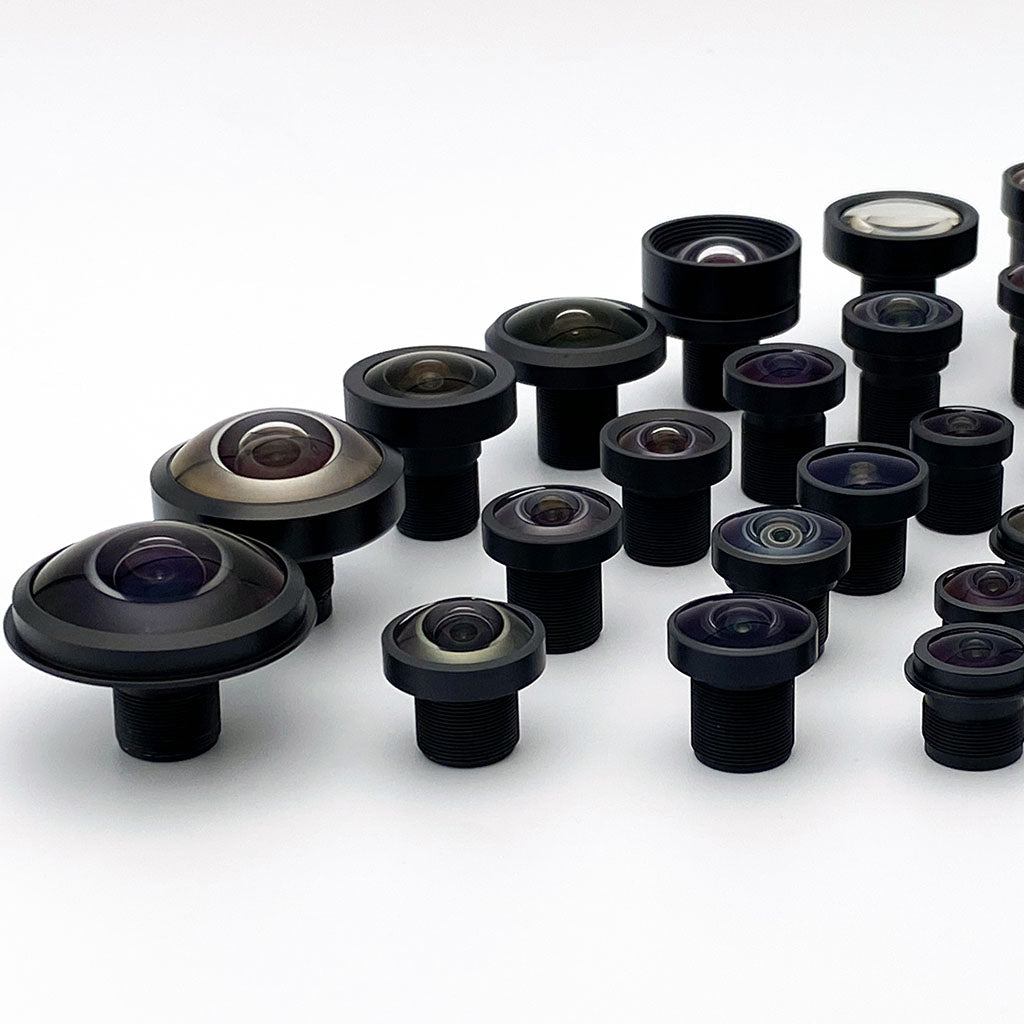

Die Auflösung von Linsen und Bildern.
Was ist die Definition von Auflösung? Und warum ist sie wichtig?
Resolution is the level of detail an image or optical system can distinguish. It is related to sharpness but not identical to it: sharpening raises edge contrast and apparent sharpness without adding resolved detail.
Five different things get called resolution:
- Pixel count resolution, the number of photosites, display elements, or image pixels
- System resolution, the SFR of a whole camera
- Optical resolution, the MTF of the lens on its own
- Angular resolution, the instantaneous field of view one pixel covers
- Effective resolution, a supplier rating that pairs a lens with a sensor class
Alle Arten der Auflösung hängen miteinander zusammen und beeinflussen gemeinsam die Bildverarbeitung.
Warum kann die Auflösung so verwirrend sein?
You're not alone! Even the experts interchangeably use the term "Resolution" when it actually refers to five different quantities, four of them measured and the fifth a rating derived from them. We ran across this misunderstanding between Optical Engineers, Image Quality Engineers, Sensor Engineering, and Computer Vision Engineers during a 2018 conversation within the IEEE P2020 working group.
Die Auflösung eines Sensors hängt zudem eng mit dem Format des CMOS-Sensors zusammen (z. B. 1/3", 1/2" usw.), worauf wir in einem separaten Artikel näher eingehen.
Megapixel als Auflösung
Pixelanzahl Auflösung
Die Angabe der Pixelauflösung wurde von der Mobilfunkbranche populär gemacht, ist jedoch bei Kameras mit 50 MP und mehr häufig irreführend, da das endgültige Ausgabebild bzw. das angezeigte Bild selten eine Auflösung von 50 MP und mehr aufweist.
Definition:- Die Gesamtzahl der lichtempfindlichen Photodioden-Wells in einem Sensor.
- Die Gesamtzahl der Leuchtelemente für Displays und Projektoren.
- Die Gesamtzahl der Pixel in einem digitalen Bild.

Die Kamera verfügt über 64 Megapixel und liefert ein Bild mit einer Auflösung von 12 bis 16 Megapixeln.
Die Kamera hat 64 MP.
SFR als Lösung
Was ist die Systemauflösung und warum ist sie wichtig?
The system resolution can characterize the quality of any digital image. It is frequently used in digital camera production lines to ensure the lens, lens-to-sensor alignment, and image processing pipeline meet a minimum quality threshold. It can also be used to benchmark different cameras and image processing/compression methods. This metric includes inputs from the Lens, the Lens-to-sensor alignment, the Sensor, the ADC, and the Analog+Digital Image Processing Pipeline.
Definition:- The Spatial Frequency Response (SFR) measures contrast as a function of spatial frequency, derived from the edge-spread function of a slanted edge (ISO 12233).
Follow ISO 12233 or read Imatest's website.
How to Express System Resolution:State the response threshold the number is read at (MTF50 is common), then the line widths per picture height at that threshold, the field position, and the illumination. SFR is a response curve across spatial frequency, so a single LW/PH figure only has meaning at a stated threshold.
The MTF50 is 2000 LW/PH at 25° field angle under 1000lux 5000K illumination.
Die MTF des Bildes beträgt 2000 LW/PH.
Welche Auswirkungen hat SFR auf die Bildverarbeitung?

From: Vasiljevic et al. "Examining the Impact of Blur on Recognition by Convolutional Networks"
MTF als Auflösung
Der Begriff „optische Auflösung“ wird von Ingenieuren für Bildgebungsoptik verwendet und fließt in die Systemauflösung ein.
The optical resolution characterizes how much contrast an optical system preserves as detail becomes finer, the measurable basis of perceived sharpness. The MTF applies to both focal and afocal optical systems, including microscopes, imaging lenses, binoculars, and projection optics.
Definition:- The Modulation Transfer Function (MTF): the contrast a lens preserves at a stated spatial frequency and field position.
- Two-point criteria such as the Rayleigh criterion answer a different question, the closest separation at which two point sources stay distinguishable, and they do not convert into an MTF percentage.
Geben Sie die MTF als Prozentsatz, die Frequenz, den Bildwinkel und die Wellenlänge an.
Die photopische MTF des Objektivs beträgt 20 % bei 200 LP/mm und einem Bildwinkel von 50°.
Der MTF-Wert des Objektivs beträgt 20 %.
Momentanes Sichtfeld als Auflösung
Der Begriff „Winkelauflösung“ wird in der Luft- und Raumfahrt sowie in der Verteidigungsindustrie und von Ingenieuren im Bereich Computer Vision verwendet.
The Instantaneous Field of View (IFOV) is the angle one pixel covers in object space, so it is quoted per pixel. Pixels per degree is its reciprocal, a sampling density, and on a lens with distortion both figures change with field angle. Neither one is the resolving power of the optics, which is an MTF or Rayleigh question. Pixels per unit distance across an object is a related spatial-sampling figure that only follows once the object range and geometry are fixed.
Definition:- IFOV: the angle in object space subtended by one pixel, in degrees, arcminutes, or milliradians per pixel.
- Pixels per degree: the reciprocal of the IFOV expressed in degrees. It is a sampling density, not an angle.
Nutzen Sie unseren fortschrittlichen Sichtfeldrechner, der auch die Winkelauflösung für Verzerrungsprofile berücksichtigt.
Wie man die Winkelauflösung angibt:State which quantity you mean, degrees per pixel or pixels per degree, and give the field angle where it was measured.
The IFOV is 0.083° per pixel at 25° field angle, a sampling density of 12 pixels per degree.
The IFOV is 12 pixels per degree.
Welchen Einfluss hat die Winkelauflösung auf die Bildverarbeitung?
Angular resolution limits the smallest object a network can reliably detect, not the largest. The impact on performance is direct. Dollár et al. show the result on the average miss rate of pedestrian detectors. With less than 50 pixels, even state of the art detectors can have a 50% miss rate on detection. This increases rapidly as scale decreases.

From: Dollár et al. "Pedestrian Detection: An Evaluation of the State of the Art"
Megapixel und MTF als Auflösungswert
Der Begriff „Effective Resolution“ wird von den Marketingteams der Objektivhersteller verwendet
The effective resolution is a quick method to filter down a lens selection when you are creating a new camera. The optical resolution (MTF) of lenses can be challenging to understand without extensive experience in camera hardware. Many experienced camera engineers do not even know the tricks which manufacturers can play with MTF charts/testing, so effective resolution can be a shortcut directly to system-level resolution.
Definition:- Die Auflösung in Sensorpixeln, für die die optische Auflösung eines Objektivs geeignet sein soll.
Geben Sie sowohl die Pixelanzahl als auch die Größe des Bildsensorformats an.
Das Objektiv ist für einen 12-MP-Sensor mit einer Größe von 1/2,3" geeignet.
The lens is rated for 12MP so its optical resolution is suitable for any 12MP sensor.
Diese irreführende Kennzahl wird von Objektivherstellern auch weiterhin genutzt und missbraucht werden. Wenn Sie ein Objektivkäufer sind: Sie sind nun gewarnt.
Quellenangaben und weiterführende Links
- Dollár et al. "Pedestrian Detection: An Evaluation of the State of the Art"
- Vasiljevic et al. "Examining the Impact of Blur on Recognition by Convolutional Networks"
Wie gehen wir bei Commonlands also mit dem Begriff „Auflösung“ um, wenn wir über unsere Objektive sprechen?
As a lens supplier, we base Effective Resolution ratings on empirical System Resolution measurements.
What matters for performance is the final image quality. An ISO 12233 measurement is a whole-camera result: it depends on the sensor's pixel pitch and sampling, the processing pipeline, aperture, focus, field position, and the chart and analysis. We repeat the measurement across sensors with different pixel pitch and state the pairing conditions, so the rating describes the lens on a sensor class rather than a standalone lens constant.
- First, we run through-focus ISO 12233:2014 measurements on a set of sensors whose pixel pitch differs.
- Those measurements also fix the pixel pitch the rating is based on.
- Then we find the maximum image circle diameter the lens delivers.
- Finally, we apply the maximum sensor size and aspect ratio that fits inside that diameter, then calculate the total number of pixels at the limiting pitch.
- We carry that pitch over from the run above rather than measuring anything a second time.
- Then we calculate how many pixels of that pitch fit on a 4:3 sensor of that format type.
M12-Objektive mit hoher effektiver Auflösung
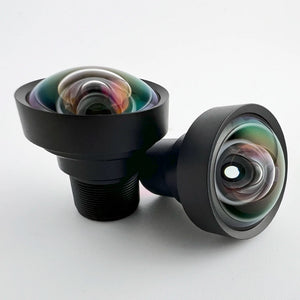
Four M12 lenses from the Commonlands catalog. Each is rated for effective resolution using the through-focus ISO 12233:2014 process described above.
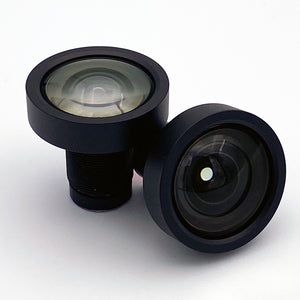
Möchten Sie herausfinden, welche Anforderungen Ihre Kamera erfüllen muss?
Nutzen Sie unseren kostenlosen, webbasierten AoV-Rechner, um die Anforderungen an das Sichtfeld Ihres Systems zu ermitteln. Verwenden Sie anschließend den M12-Objektivrechner, um Ihre Anforderungen mit den verfügbaren Objektiven abzugleichen. Unser Schärfentieferechner liefert zudem die Hyperfokaldistanz und die Schärfentiefe für jede Sensor-Objektiv-Kombination.


Außerdem bieten wir noch einige weitere Rechner an, die für viele Ingenieure interessant sind.


A Few M12 Lenses From the Catalog. Search All 80+ Optical Designs in the M12 Lens Calculator.
-
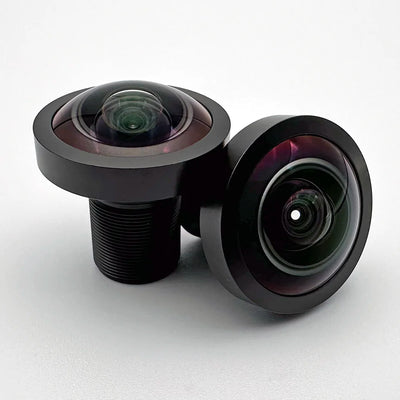
191°@6,4 mm-Fisheye-Objektiv
CIL281-F1,8-M12A650
Details anzeigen -
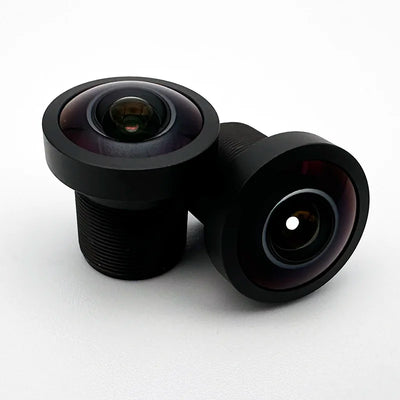
190°@6,8 mm Fisheye-Objektiv M12
CIL282-F1.8-M12B660
Details anzeigen -
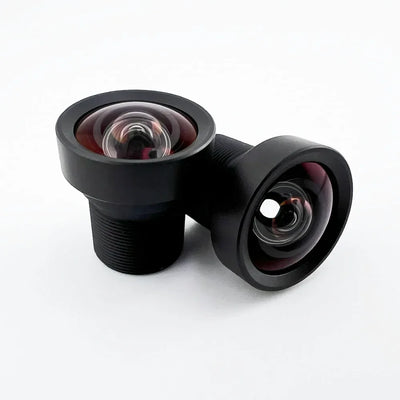
Low Distortion 3.2mm M12 Lens
CIL034-F2.3-M12A660
Details anzeigen -
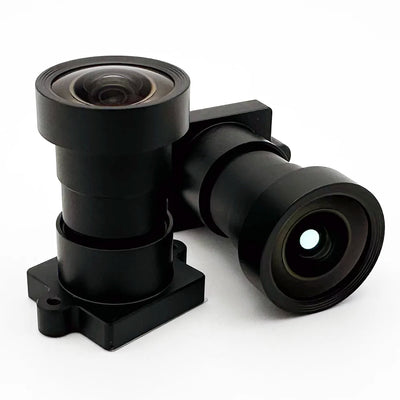
4-mm-Weitwinkelobjektiv mit M12-Anschluss
CIL339-F1.6-M12BNIR
Details anzeigen -
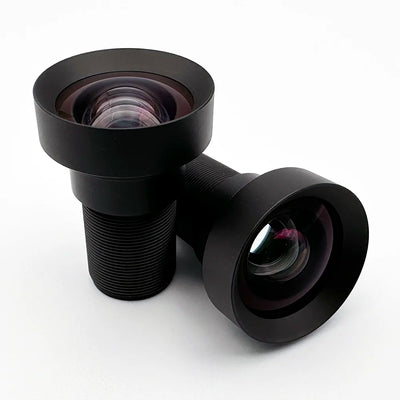
6-mm-M12-Objektiv mit geringer Verzerrung
CIL059-F1.7-M12B650
Details anzeigen
