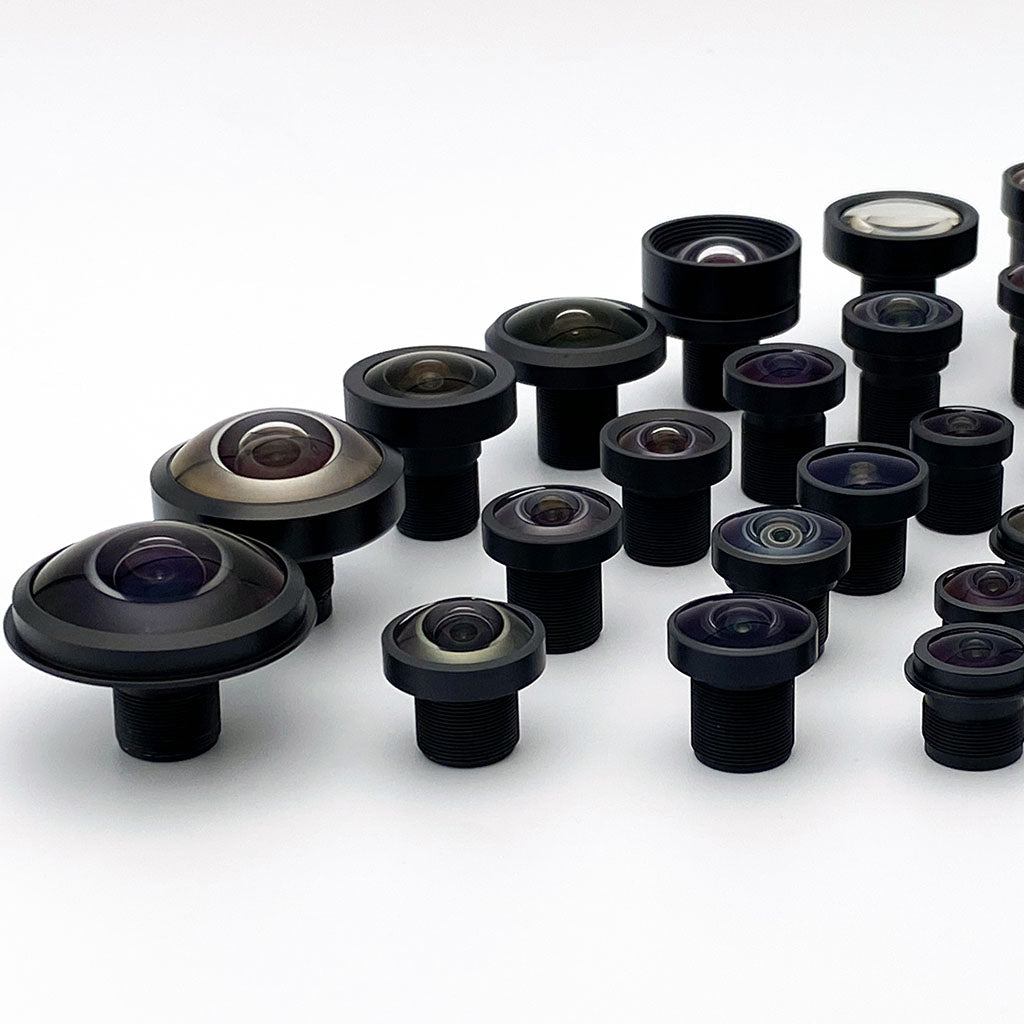

Automotive Machine Vision Optics Guide

Lenses for Autonomous Vehicles: Choosing ADAS, Surround-View, and Driver Monitoring Optics by Camera Position

Camera position determines the optical job. Front, surround, rear, and in-cabin cameras each need a different lens spec, not one automotive lens for the whole vehicle.

By the Commonlands engineering team · Updated July 2026 · 19 min read

A small ADAS camera module with a fixed M12 lens mounted behind a car windshield

There is no single lens for autonomous vehicle cameras. Front-view ADAS cameras need range, thermal stability, and low ghosting at 6-19mm. Surround-view and parking cameras need 1.8-4mm wide-angle or fisheye coverage with controlled distortion for stitching. In-cabin driver-monitoring cameras need fixed focus at 300-700mm, NIR compatibility at 850nm or 940nm, and enough face scale on the sensor for landmark detection.

Compact automotive-rated M12 lenses with IP69K sealing and athermalized designs cover most of these positions, but each camera still needs independent verification of focal length, image circle, and chief ray angle against its own sensor.

Why autonomous vehicles use different lenses by camera position

An ADAS-equipped or autonomous vehicle carries several cameras, each assigned a different optical job: forward object detection, perimeter coverage, blind-spot monitoring, and driver state monitoring. A lens optimized for one position is often the wrong tool for another. Front cameras need range and low distortion. Surround cameras need wide coverage and stitching-friendly distortion. Cabin cameras need close working distance and NIR transmission.

Camera position Primary optical job Typical focal length Key requirements
Front-view ADAS Object detection at range 6-19mm Low ghost, thermal stability, low distortion
Surround-view / parking 360-degree scene stitching 1.8-4mm Controlled distortion, IP69K, uniform response
Rear / reverse Wide proximity coverage 1.8-4mm IP69K, wide FoV, distortion tolerance
Blind-spot / side Lane-adjacent detection 3-7mm Moderate FoV, low ghosting, IP69K
Cabin / driver monitoring Face, eye, and head-pose tracking 4-8mm NIR pass, fixed focus, distortion tolerance

Each position has a different priority order for optical parameters, and getting it right at the component level matters: detection range, false-positive rate, and perception latency all trace back to image quality at the sensor, which starts with the lens. Use the field of view calculator to check coverage for any of these positions against your actual sensor dimensions.

A coin-sized fisheye M12 camera built into a car side mirror facing down
Surround-view cameras use wide fisheye lenses for close ground coverage.

Front-view ADAS lens requirements

Front cameras carry the highest detection burden. Depending on the system and sensor, design targets commonly fall in the range of pedestrian recognition around a few tens of meters, vehicle following out past 100m, and sign reading at intermediate distance. The lens must put enough pixels on target at those distances, with enough contrast that the detection model can decide confidently.

Pairing detection range with coverage

Focal length sets how many pixels fall on a given object at a given distance. A 19mm lens puts more pixels on a pedestrian at 100m than a 6mm lens does; the tradeoff is a narrower field of view that misses close-range objects in its blind zone. Many front-camera systems pair a narrow lens for range with a wider lens for proximity on the same axis, rather than asking one focal length to do both jobs. Front cameras commonly land at 6-12mm on 1/3" to 1/2" sensors as a working balance.

Thermische Stabilität

A front camera behind the windshield sees direct sun in summer and cold starts in winter, typically -40C to +85C, with some module specs extending further. Lens elements, barrel materials, and cements expand and contract at different rates with temperature, and the refractive index of the glass and any plastic elements also shifts with temperature (dn/dT), which often contributes as much to thermal defocus as the mechanical expansion mismatch. In a design without thermal compensation, focus shifts and MTF degrades at the extremes. Athermalized designs choose element spacing and materials so thermal focus shift stays within the depth of focus across the operating range. That is the only mechanism available on a fixed-focus lens, since there is no runtime adjustment.

Low-ghost coatings and stray-light control

Oncoming headlights, streetlamps, and direct sun are routine inputs for a forward-facing camera. Ghost images are secondary reflections off lens element surfaces that appear as bright, displaced artifacts and can trigger false positives or mask real objects in a detection pipeline. Multi-layer anti-reflective coatings and controlled element designs reduce ghost intensity more effectively than single-layer coatings: a single quarter-wave layer already cuts reflectance across the visible band, but multi-layer stacks push residual reflectance substantially lower with a flatter spectral response, which is what actually suppresses ghosting. When comparing front-view lenses, ask for ghost and flare test data under point-source conditions representative of the use case.

Low-light aperture tradeoffs

A wider aperture (lower F-number) gathers more light and improves signal-to-noise in the dark, at the cost of shallower depth of field. On a fixed-focus lens, focus must be set and locked at a distance that keeps depth of field deep enough for the full detection range. Depth of field at a given focus distance depends on focal length as well as aperture: hyperfocal distance scales with f², so a short front-view focal length (roughly 8mm and under) at F/1.6 focused at or beyond its hyperfocal distance, on the order of 10m depending on the circle of confusion criterion, typically holds adequate depth of field from a few meters out to infinity on 1/3" and 1/2" sensors, while longer front-view focal lengths in this article's 6-19mm range (12mm, 19mm) reach hyperfocal distances well beyond 10m and no longer cover to infinity at that same focus point. The general condition is that the focus distance must be at or beyond the hyperfocal distance H = f²/(N×c) for the far limit to extend to infinity. Very fast apertures (F/1.2 and below) narrow the near-field margin further and increase sensitivity to thermal focus shift, so they demand tighter mechanical tolerances.

Dynamic range and headlight glare at night

A front camera faces oncoming headlights directly at night while still needing to resolve dim, unlit pedestrians in the same frame. This dynamic range problem sits partly with the sensor's HDR mode and partly with the lens: a lens with poor stray-light control lets a bright point source bloom across a wider area of the frame, which reduces local contrast around the object the detection model actually needs. Combining a well-corrected, low-ghost lens with a sensor HDR mode gives the perception stack the best chance of resolving both the headlight and the pedestrian standing near it in the same exposure.

Technical note

Sensor fit still needs verification even on an automotive-rated lens. Confirm the image circle covers the sensor diagonal and that the lens chief ray angle profile matches the sensor's microlens design. A mismatch causes color shading and corner signal loss the detection model cannot recover. See lens chief ray angle and mismatch.

Surround-view, parking, and rear camera requirements

Surround, parking, and rear cameras mount at the corners or sides of the vehicle with wide-angle or fisheye optics. Their job is coverage, not range: capture as much of the area around the vehicle as possible with enough image quality for the stitching or proximity pipeline downstream.

Wide field of view and fisheye tradeoffs

Covering 130-190 degrees horizontal typically requires focal lengths under 4mm and fisheye or strongly curved optical designs. Below roughly 3mm on a 1/3" sensor, most lenses show significant barrel distortion, which is expected and accepted here because the rendering pipeline geometrically corrects it during bird's-eye view synthesis. The practical limit of a fisheye lens for surround view is set by image circle at the required field angle, not by the headline angle alone. Confirm the datasheet's image circle spec applies at the widest listed angle, not just at center field. Background on projection models and distortion behavior is in the fisheye and wide-angle lens distortion guide.

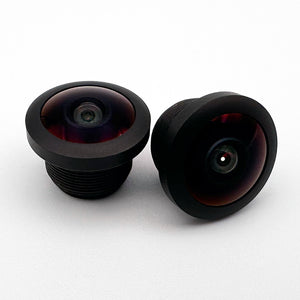
The 186° IR corrected fisheye M12 lens (CIL239) covers full hemispherical fields and is IR corrected for mixed illumination environments.

Distortion and stitching concerns

Stitching pipelines typically apply a per-lens calibration that maps pixels to ground-plane coordinates. That calibration depends on the distortion profile staying stable over temperature and consistent unit-to-unit. Defocus (an axial image-plane shift) and distortion (the field mapping) are distinct effects, and one does not determine the magnitude of the other, but thermal swings can perturb both the focus position and the effective focal length/distortion coefficients, so a fixed calibration model needs the distortion profile and focal length verified stable over the operating temperature range, not just the focus. Predictable fisheye projections (equidistant, equisolid, stereographic) work well with standard calibration libraries; irregular, non-monotonic distortion profiles need more complex per-pixel correction.

Environmental exposure

Rear and corner cameras face road spray, pressure washing, ice, and temperature cycling. IP69K covers high-pressure, high-temperature washdown and is the relevant standard for most exterior automotive mounting. It addresses a more severe washdown condition than IP67 or IP68, but the IP scale is not a single ladder: IPX9K (hot high-pressure jets) and IPX7/IPX8 (immersion) test different failure modes, and IP69K compliance does not by itself imply immersion protection, so verify immersion resistance separately if the mount is exposed to standing water. Sealing on an M12 lens sits at the barrel and front element; the camera housing still needs a matching seal integration for that protection to hold at the system level. See IP rating for machine vision lenses and ruggedized machine vision lenses for the broader picture. Note that ruggedized sealing is a property of select lenses, not a default across every C-mount or M12 product.

Proximity accuracy for rear and parking cameras

A reverse or parking camera has a different priority than a side surround camera: close-range proximity accuracy matters more than wide angular coverage alone. Objects a few tens of centimeters from the bumper occupy a large fraction of the frame, and lens distortion in that near field directly affects any distance-estimation overlay drawn on top of the video feed. If the system draws parking guidelines or proximity zones on the display, the distortion calibration used to generate those overlays has to be validated at the actual working distances the camera will see in a parking maneuver, not just at the wider distances used for stitching calibration.

Driver monitoring and in-cabin lens requirements

Driver monitoring (DMS) and occupant monitoring (OMS) cameras face the driver, not the road, from an A-pillar housing, overhead console, rearview mirror assembly, or steering column pod. That geometry sets three optical requirements that differ from every exterior position on the vehicle: short working distance, controlled NIR illumination, and sunlight rejection.

Working distance and face scale

Single-driver monitoring typically resolves the driver's face, eyes, and head pose from 300-700mm working distance. Multi-occupant OMS covering rear seats extends to 900-1200mm and needs a wider field of view. A 4mm M12 lens near 133 degrees covers the full cabin but compresses the driver's face to a smaller fraction of the sensor than a 6mm or 8mm lens at the same distance; if the face fills only a small share of frame height, landmark-detection confidence drops. A 6mm lens (66-78 degrees) is the common starting point for single-driver monitoring at 400-700mm, typically placing the head across a large fraction of frame height at those working distances, usually enough for reliable landmark detection without firmware cropping; the exact framing depends on the sensor's active dimensions. Confirm the target with the field of view calculator before committing to a mount design.

NIR illumination at 850nm or 940nm

Most DMS systems illuminate the driver with NIR LEDs rather than visible light, which would be distracting. 940nm illumination is effectively invisible to the eye, while 850nm shows a faint red glow; the tradeoff between the two wavelengths is covered in the 850nm vs. 940nm NIR guide. A standard lens with an IR-cut filter blocks most signal at both wavelengths and leaves the system blind at night, so 24-hour DMS designs need a lens variant without an IR-cut filter, or one confirmed for NIR transmission. Some camera modules place the IR-cut filter in the sensor package instead of the lens; confirm the filter stack location before selecting a lens.

Sunlight rejection and bandpass filtering

Interior cameras still see direct sunlight through the windshield and side glass, which can wash out NIR contrast from the illumination LEDs at exactly the moment the system needs it most. A narrow bandpass filter tuned to the illumination wavelength blocks out-of-band sunlight while passing the LED signal, improving contrast in bright cabin conditions. See the bandpass filter guide for CWL and FWHM selection.

Distortion tolerance depends on the algorithm

Gaze estimation and head-pose analysis that measure angles or distances between facial landmarks are sensitive to barrel distortion at the frame edges. A lens near -13% F-theta distortion (CIL337, 3.6mm) needs more software correction before geometry-dependent inference than a lens near -3% TV distortion (CIL079). Note that F-theta and TV distortion are computed against different reference mappings (r = f·θ versus a corner-height TV metric), so the two percentages are not numerically comparable; the point is the relative correction burden, not the raw numbers. Presence detection and basic eye-closure scoring do not depend on precise geometry, so higher distortion is acceptable when coverage or low-light performance matters more.

Why M12 is the default for cabin cameras

DMS and OMS modules pack a lens, sensor, and NIR LED ring into an A-pillar pocket or mirror surround, where a C-mount lens is impractically large. A typical M12 lens for this application runs 4-6g and mounts directly on the M12×0.5 thread without adapter hardware. Once cabin/mount geometry is committed, working distance is effectively fixed for that camera position (earlier in a vehicle program, the A-pillar or mirror-surround mount point is itself a design variable that can still move), and NIR illumination handles low-light response, so the adjustable iris that makes C-mount attractive for variable-working-distance industrial setups adds little here. See what is an M12 lens for mount mechanics and sensor-matching parameters.

Sensor format and thermal integration for cabin modules

Most embedded DMS modules use 1/2.5" or 1/2.7" sensors, smaller than the 1/2" to 1/1.7" formats common on front-view ADAS cameras, which keeps the module compact for A-pillar or mirror-surround mounting. Interior temperatures still swing widely, from -40C cold starts to +70C or higher in a closed, parked vehicle in direct sun, so the same athermalized design principles used on exterior lenses apply here, even though the enclosure offers some insulation from peak exterior extremes. Mechanical integration matters as much as the optical design: a lens threaded into a holder and locked with adhesive will drift out of focus if the adhesive creeps under sustained heat, so the lens-to-holder interface in the mechanical design needs its own verification against thermal cycling, separate from the lens's own athermalization.

Choosing focal length, sensor format, and mount family

Focal length selection workflow

Focal length selection for an automotive camera follows the same logic as any machine vision application: define the required field of view, identify the sensor dimensions, and calculate the focal length that produces that coverage at the working distance.

  1. Define the angular coverage needed for the position: roughly 50° HFOV for front-view, 130° HFOV for surround-view, and for single-driver cabin monitoring a lens in the 66-78° diagonal FoV class (the catalog spec measured at full image circle, not the true HFOV on your specific sensor).
  2. Identify sensor width and diagonal from the image sensors database.
  3. Use the field of view calculator to find the focal length matching that coverage on the actual sensor.
  4. Confirm the lens image circle covers the sensor diagonal, and check chief ray angle compatibility against the sensor datasheet.

For sensor size conventions used across automotive datasheets, see the CMOS sensor size guide.

Common automotive sensor formats

Automotive sensors typically run 1/4" to 1/2", with 1/1.7" to 1/1.8" formats appearing in higher-resolution forward cameras. Sensor width directly sets the focal length needed for a given field of view.

Sensor format Approx. width Typical application Notes
1/4" 3.6mm Interior / DMS Compact, cost-effective
1/3" 4.8mm Surround-view, rear Common in automotive modules
1/2.5" 5.7mm ADAS, surround-view Wider FoV at the same focal length
1/2" 6,4 mm Front-view ADAS Balanced size and sensitivity
1/1.7" 7.5mm High-res front camera Larger image circle required

M12 vs. C-mount for automotive packaging

M12 lenses are the practical choice for most automotive integrations: compact, lightweight, and sized for board-level mounting in housings often under 30mm in any dimension. C-mount lenses use a 1"-32 UN threaded interface with a 17.526mm flange distance and suit larger-format industrial cameras that are not practical for in-vehicle packaging.

M12 has no standardized flange distance, so focus is set during manufacturing and locked; there is no customer-adjustable focus ring in the finished assembly, unlike C-mount's cam-based refocus system. For the full mount comparison, see M12 vs. C-mount vs. CS-mount.

Image circle and CRA are not just mechanical checks

Sensor fit is not simply a thread check. The lens must project a usable image across the full sensor diagonal: a lens with a 6.0mm image circle (1/3" class) is insufficient for a 1/2.5" sensor at roughly 7.2mm diagonal, and vignetting from an undersized image circle shows up as dark corners a detection pipeline cannot correct. Chief ray angle (CRA) must also match: modern CMOS sensors tilt their microlenses toward the optical axis, and a lens with a mismatched CRA profile at a given image height causes color shading and reduced corner signal. See lens chief ray angle and mismatch and sensor size and lens compatibility.

Resolution and pixel budget across positions

Higher-resolution sensors do not automatically improve detection range; they only help if the lens can resolve detail at the pixel pitch the sensor demands. A 3MP sensor with small pixels needs a lens with correspondingly higher MTF at the relevant spatial frequency, or the extra resolution goes to waste on a soft image. Front-view cameras moving toward 8MP sensors for longer detection range should verify the lens is specified for that resolution class, not simply reused from a lower-megapixel design. See the spatial resolution guide and how to read MTF curves for how to evaluate a lens against a specific sensor's pixel pitch.

Thermal range and IP sealing across camera positions

Thermal stability and ingress protection apply differently depending on where the camera sits on the vehicle, and neither should be specified by default at the highest available rating.

Thermal range by position

Exterior-facing cameras (front, surround, rear, blind-spot) see the full automotive range, often -40C to +85C or beyond at the module. Interior cabin cameras behind trim see some insulation from peak exterior swings but still experience significant thermal cycling, commonly -40C cold starts to +70C or higher in a parked vehicle. Both need an athermalized optical design so focus stays within the depth of focus across the operating range on a fixed-focus lens; see ruggedized machine vision lenses for how thermal compensation is built into select lens designs, not assumed across every product.

IP sealing by position

Exterior cameras exposed to road spray and wash cycles typically need IP69K, the standard for high-pressure, high-temperature washdown resistance. Interior DMS and OMS cameras usually sit in a sealed passenger compartment with no direct moisture exposure, so IP67 or an unrated lens is often sufficient. IP69K becomes relevant for commercial cab interiors, convertibles, or mounts near HVAC condensation sources. Evaluate the actual mount environment for each position rather than defaulting every camera to the highest available rating. See IP rating for machine vision lenses for the full rating breakdown.

Qualification note

Automotive qualification claims (AEC-Q, specific temperature grades) vary by product and are not blanket claims across the Commonlands automotive M12 line. Confirm the specific qualification and temperature spec on the product page or datasheet for the exact lens under consideration before locking in a design.

Treat thermal grade and IP rating as independent specification inputs rather than a single combined "automotive-grade" checkbox. A front camera and a cabin camera on the same vehicle can land on different points of both scales once the actual mount location and exposure are worked out, and pricing a lens above its actual requirement usually adds cost without adding reliability where it matters.

Top automotive M12 lenses by camera position

For a Commonlands-only automotive M12 build, four lenses cover the main camera positions: the 19mm CIL190 for long-range front ADAS, the 5.2mm F/2.0 CIL239 fisheye for surround and parking, the 6mm F/1.9 CIL061 (Without Filter option) for NIR driver monitoring, and the 3.6mm F/1.6 CIL337 for wide rear and proximity views. All four sit in the automotive M12 lens collection and ship same day from San Diego on orders placed before 12 PM PST.

Camera position Lens EFL F# Why it fits
Front ADAS, long range CIL190 19mm See datasheet Narrow field of view puts more pixels on distant objects; IP69K, all-glass all-metal barrel
Surround / parking CIL239 fisheye 5,2 mm F/2,0 186° hemispherical coverage, IR corrected for mixed daylight and NIR lighting
Driver monitoring (NIR) CIL061 6mm F/1,9 Without Filter option passes 850nm and 940nm NIR; 66° frames a single driver at 400-700mm
Rear / proximity CIL337 3.6mm F/1,6 133° near-field coverage with IP69K washdown sealing
How we picked

Each row maps a camera position from the sections above to the shortest Commonlands automotive M12 lens that meets its field of view and sealing need, using the EFL and F-number published on each product page. We did not compute sensor-specific field of view here, so verify angular coverage against your sensor with the field of view calculator before committing a mount. CIL190 does not publish an F-number on its product page; confirm it on the datasheet before you size the aperture.

Automotive qualification

Commonlands automotive M12 lenses are select-ruggedized: IP sealing and athermalization are specified per SKU, not applied as a blanket automotive grade across the line. If your program requires AEC-Q100 or AEC-Q200 qualification or a named automotive temperature grade, a purpose-built automotive lens such as the Sunex DSL239 fisheye, or a custom automotive-qualified design, is the right call. Confirm the qualification and temperature spec on the datasheet for the exact SKU.

1 mm M12-Objektiv, stereografisches Fischaugenobjektiv

CIL207-F1.9-M12ANIR

220°@4.0mm Stereographisches M12 Fischauge

$39.00

View details
IP69 AR0234 Linse CIl329

CIL329-F2.0-M12ANIR

Weitwinkelobjektiv 2,8 mm, M12-Anschluss

$39.00

View details
4 mm IP6K9K M12-Objektive

CIL336-F1.9-M12A650

Weitwinkel-Objektiv 3,6 mm M12

$39.00

View details
6-mm-M12-Objektiv für Blackfly-Kameras mit S-Mount

CIL061-F1.9-M12B650

Lichtstarkes 6 mm M12

$39.00

View details
Advanced Driver Assistance System Kameraobjektiv 6mm M12 Objektiv S-Mount Objektiv

CIL359-F1.6-M12A650

5,9-mm-M12-Objektiv für die Automobilindustrie

$39.00

View details
IMX462 M12-Objektiv CIL079

CIL079-F2.0-M12A650

7,8-mm-M12-Objektiv mit Schutzart IP67

$39.00

View details
4-mm-Weitwinkelobjektiv mit M12-Anschluss

CIL339-F1.6-M12B640

4-mm-Weitwinkelobjektiv mit M12-Anschluss

$99.00

View details
M12-Objektiv für AR0234

CIL948-F2.0-M12B650

Weitwinkelobjektiv 4,8 mm, M12-Anschluss

$39.00

View details
AR0822 M12-Linse CIL358

CIL358-F1.9-M12A650

Weitwinkelobjektiv 5,8 mm M12

$49.00

View details
M12-Weitwinkelobjektiv von Sunex

CIL332-F1.8-M12BNIR

Weitwinkelobjektiv 3,2 mm, M12-Anschluss

$39.00

View details
Stereografisches, maßgeschneidertes Fisheye-Objektiv M12 mit Verzerrung

CIL273-F2.0-M12A650

200°@5.8mm Fisheye-Objektiv

$39.00

View details
5,5-mm-M12-Objektiv

CIL355-F1.8-M12A650

5,5-mm-M12-Objektiv, 1/2,5", 2 MP

$39.00

View details

Common mistakes when selecting automotive camera lenses

Using a standard embedded M12 lens instead of an automotive-rated one

Standard embedded M12 lenses target factory environments at room temperature. They lack the athermalized design, high-pressure sealing, and stray-light coatings automotive use requires. A generic 6mm M12 lens and an automotive-rated 6mm M12 lens can look similar in a datasheet summary and still perform very differently across -40C to +85C and under washdown.

Assuming one focal length covers every camera position

No single focal length covers both front-view range and surround-view coverage. Standardizing on one lens across positions leaves the system missing detection range at the front or missing coverage at the sides. Specify each position independently.

Not checking image circle at full field angle

Some datasheets quote image circle at a limited field angle rather than at the widest stated angle. A lens listed as covering 1/3" may fall short of full image quality at its maximum FoV. Request full-field MTF data and confirm image circle at the edge of the stated coverage, not just at center.

Locking cabin camera focus at infinity

A DMS or OMS lens focused at infinity will be soft at 300-700mm working distance. Interior cameras need focus set and locked at the actual working distance during assembly (a manufacturing process step, not a field-adjustable setting). Document the target focus distance and acceptable MTF threshold for the production line to verify.

Ignoring back focal stack-up when adding a filter

M12 lenses have no standard flange distance; each lens has its own back focal length, and the housing must accommodate the sensor-to-lens distance. Inserting a filter in the optical path, such as an IR-cut or bandpass filter, changes the optical path length and shifts the focus point. Plan the full optical stack before finalizing the mechanical housing.

Defaulting every lens to the highest IP and thermal rating available

It is tempting to spec every camera position at IP69K and the widest available thermal grade so one line item covers the whole vehicle, but that approach usually adds cost without adding reliability where it matters. An interior DMS lens sitting behind trim in a sealed cabin rarely needs the same washdown resistance as a rear camera exposed to a pressure washer, and a lens qualified well beyond the actual mount environment's thermal swing is paying for margin the application will never use. Work out the actual exposure and temperature range for each camera position first, then match the rating to that position rather than rounding every spec up to the highest number on the datasheet.

A driver-monitoring M12 camera on the steering column with a faint 940nm infrared glow
Driver monitoring uses near-infrared light so it works in the dark.

Häufig gestellte Fragen

What lens is used in autonomous vehicle cameras?

There is no single lens used across all autonomous vehicle cameras. Each position uses a lens matched to its optical job. Front-view cameras typically use 6-19mm lenses with low ghosting and thermal stability. Surround-view cameras use 1.8-4mm wide-angle or fisheye lenses. Driver-monitoring cameras use 4-8mm lenses with NIR compatibility and fixed focus set for 300-700mm working distances.

How do front-view and surround-view automotive lenses differ?

Front-view lenses prioritize detection range, low distortion, stray-light control, and thermal stability, typically at 6-12mm and 30-60 degrees horizontal field of view; longer front-view options up to 19mm narrow to roughly 15-20 degrees for extended-range detection, outside that 30-60 degree band. Surround-view lenses prioritize wide coverage (100-190 degrees) at 1.8-4mm, controlled distortion for stitching, and IP69K sealing for exterior mounting.

Why do automotive lenses need thermal stability?

Automotive cameras operate from -40C cold starts to +85C or higher in parked vehicles. Without an athermalized design, focus shifts and MTF degrades at temperature extremes, which can cause a detection model to miss objects it would resolve at room temperature. Athermalized lenses use element spacing and material choices that keep focus within the depth of focus across the operating range.

What lens should I use for driver monitoring?

For most single-driver monitoring, a 6mm M12 lens in the F/1.6-F/1.9 range is a practical starting point, such as the CIL359 (78 degree FoV, IP6K9K) or CIL061 (66 degree FoV, Without Filter option for NIR). If the camera needs to cover multiple occupants, the 3.6mm CIL337 (133 degrees) extends coverage but compresses subject scale and increases distortion. For tighter framing and gaze-tracking accuracy, the 8mm CIL079 (44 degrees, -3% TV distortion) is the better choice.

Does driver monitoring need NIR compatibility?

Yes, if the system illuminates the driver at night. Most DMS cameras use 850nm or 940nm NIR LEDs so illumination stays unobtrusive. A standard lens with an IR-cut filter blocks most signal at both wavelengths, so 24-hour operation needs a lens variant without an IR-cut filter or one confirmed for NIR transmission, such as the CIL061 Without Filter option.

What does IP69K mean for an automotive lens?

IP69K covers high-pressure, high-temperature washdown resistance: 80C water at 80-100 bar, sprayed at close range from multiple angles. For exterior automotive lenses, it means the assembly can survive commercial wash cycles without water ingress. It addresses a more severe washdown condition than IP67 or IP68, but the ratings test different threats rather than forming a single ladder: IPX9K jets and IPX7/IPX8 immersion are separate tests, so IP69K compliance does not imply immersion protection and must be verified independently.

Why does low ghosting matter in vehicle cameras?

Oncoming headlights, streetlamps, and direct sun are normal inputs for a forward-facing vehicle camera. Ghost images are secondary reflections from lens element surfaces that appear as displaced bright artifacts and can trigger false positives or reduce contrast around real objects in a detection pipeline. Front-view lenses use multi-layer anti-reflective coatings to minimize this.

Is driver monitoring the same optical problem as forward ADAS?

No. Forward ADAS cameras face the road at 20-200m working distance, need high dynamic range for outdoor lighting transitions, and survive full thermal and vibration cycling at exterior mount temperatures. Driver monitoring cameras point inward at 300-700mm in a controlled cabin environment and are packaged into compact embedded modules. Both need M12 optics and low F-numbers, but field of view, distortion tolerance, and NIR strategy differ enough that each position should be specified separately.

How do I choose focal length for an ADAS camera?

Define the detection range and required field of view for the position. Longer focal lengths deliver more pixels on distant objects but narrower coverage. Front-view cameras typically use 6-12mm on 1/3" to 1/2" sensors; surround-view cameras use 1.8-4mm. Use the field of view calculator with actual sensor dimensions to match angular coverage before selecting a specific lens.

Can one lens work for every automotive camera position?

No. A front-view lens optimized for 100m detection range at a narrow field of view is a poor surround-view lens, and a fisheye lens built for parking coverage cannot resolve objects at range. Each camera position should be specified independently based on detection range, required field of view, environmental exposure, and sensor format.

Need help specifying an automotive camera lens?

Commonlands manufactures M12 and C-mount lenses for machine vision, robotics, and automotive camera systems. Lenses are tested against their published specifications before shipping. Samples ship same day from San Diego on orders placed before 12 PM PST.