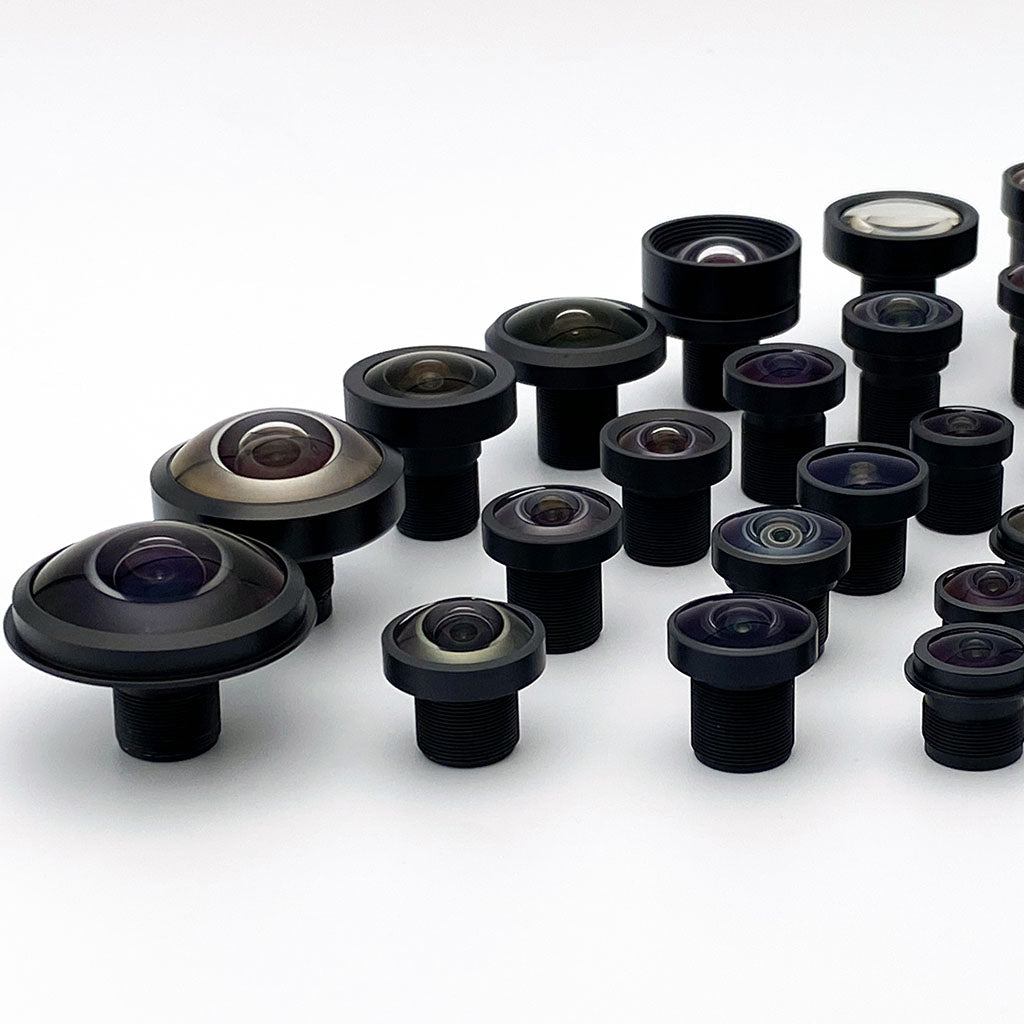

Objektive mit fester Brennweite, Variofokus-Objektive und Zoom-Objektive für die industrielle Bildverarbeitung: Fokussierverhalten, Vor- und Nachteile sowie Auswahlkriterien
Drei Objektivtypen unterscheiden sich in einer grundlegenden Frage: Was passiert mit der Schärfe, wenn sich die Brennweite ändert? Dieser Leitfaden behandelt die Definitionen, die Vor- und Nachteile, den Arbeitsablauf vom Prototyp bis zur Serienfertigung sowie die im Katalog aufgeführten Optionen.

A fixed focal length lens has one focal length and typically gives the best sharpness, distortion control, and calibration stability per dollar. Choose it once working distance and field of view are confirmed. A varifocal lens changes focal length but loses focus with every adjustment, so it must be refocused after any focal-length change. A parfocal lens, the true zoom, holds focus through the change within a specified tolerance.
Adjustable lenses earn their cost during prototyping and in systems that reframe during operation. A fixed-focal-length lens is often suitable once framing is settled. A locked varifocal can also suit production when installation flexibility, availability, or shared inventory matters.
What Is the Difference Between Fixed, Varifocal, and Zoom Lenses?
Fixed focal has one focal length. Varifocal changes it but loses focus. A parfocal zoom changes it while holding focus to a stated tracking tolerance. The deciding question is not image quality but when, and how often, the focal length has to change. The table below is the reference for every decision on this page.
| Eigenschaft | Feste Brennweite | Variofokal | Parfokales Zoomobjektiv |
|---|---|---|---|
| Brennweite | Ein EFL, werkseitig eingestellt | Einstellbereich | Einstellbereich |
| Fokussierung durch eine Fokusänderung | Not applicable. Focus is set once | Lost. Refocus after every change | Held within a stated tracking tolerance |
| Neuausrichtung zur Mitte des Zyklus | Nein | Possible if motorized, with a refocus and recalibration step in the cycle | Yes, manual or motorized, with no refocus step |
| Optische Komplexität | Niedrigste | Design-dependent. Focus changes with focal length | Am höchsten, mit koordinierten Bewegungsgruppen |
| Relative Kosten | Niedrigste | Gering bis mäßig | Höchster |
| MTF bei einer bestimmten Brennweite | Für einen Betriebspunkt optimiert | Über die gesamte Produktpalette hinweg ausgewogen | Über die gesamte Produktpalette hinweg ausgewogen |
| Verzerrung | One profile. Calibrate once | Änderungen bei der Fokuseinstellung | Änderungen je nach Zoom-Position |
| Kalibrierungsaufwand | Eine einmalige Kalibrierung reicht in der Regel aus | Nach jeder Einstellung neu kalibrieren | Kalibrierung entsprechend der verwendeten Zoomposition |
| Verpackungsgröße und -gewicht | Smallest and lightest | Größer | Größte |
| Optimale Passform | Stabile Fertigungsgeometrie | Commissioning, then locked. Motorized reframing between runs | Ein Rahmen, der sich während des Betriebs verändert |
Fixed focal designs make up the bulk of machine vision catalogs and true parfocal zooms the smallest group, because the compensating mechanics cost the most to build well. That availability pushes production toward fixed focal, which is why the Commonlands catalog runs mostly fixed focal M12 and C-mount lenses with two manual varifocal M12 lenses for bring-up.

What Is a Fixed Focal Length Lens?
A fixed focal length lens has one effective focal length (EFL) and no zoom ring. For a given sensor and focus distance, it provides a particular angle of view. Focusing can change that angle through changes in conjugate distance or internal lens geometry. It is the machine vision default because the optical design is corrected at a single operating point instead of compromised across a range, and because one calibration typically holds until the lens is disturbed or the environment shifts.
The focal length you need is a calculation from working distance, active sensor width, and required scene width, not a preference. The focal length selection guide walks the geometry. Once the number is verified on a real target, buying flexibility you will never use has no return.
Fixed Focal Does Not Mean Fixed Focus
Fixed focal refers to the focal length, not the focus setting. Most fixed focal industrial lenses keep a focus ring set at the working distance during installation and then locked. Some compact M12 lenses ship pre-focused from the factory, a separate property called fixed focus. Aperture is independent too: many fixed focal C-mount lenses carry an adjustable iris, while M12 lenses typically have a fixed aperture set at manufacture.
Photography calls a fixed focal lens a prime lens, and the optics match. Industrial lenses document sensor format coverage, distortion, resolution, and minimum working distance. Verify image circle against the sensor diagonal, corner MTF at the operating aperture, and distortion against the measurement tolerance before ordering. Commonlands documents all three on every fixed focal M12 and C-mount product page.
What Is a Varifocal Lens?
Bei einem Varioobjektiv wird die Brennweite durch die Bewegung einer internen Linsengruppe angepasst, wodurch sich auch die Fokusebene verschiebt. Der Zoomring und der Fokussierring sind voneinander entkoppelt: Nach jeder Änderung der Brennweite ist das Bild unscharf, bis der Fokussierring neu eingestellt wird. Bei Varioobjektiven wird die Entscheidung über die Brennweite vom Kaufzeitpunkt auf den Einbau verschoben.
That deferral is the value. Mount the camera, turn the zoom ring until the framing is right, restore sharpness with the focus ring, and lock both. From that point the lens behaves like a fixed focal lens. Engineers reach for varifocal lenses during proof-of-concept work at untested mounting positions and at multi-product stations where framing changes between production runs.
The optical cost is real. A designer correcting one focal length can target aberrations at that exact configuration. A varifocal designer balances correction across the whole range instead. A varifocal set to 8mm will typically show softer corners and more distortion than a fixed 8mm lens from the same price tier.
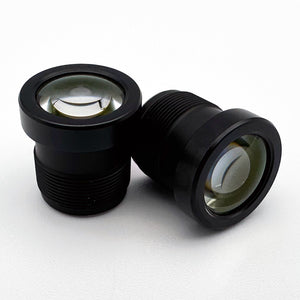
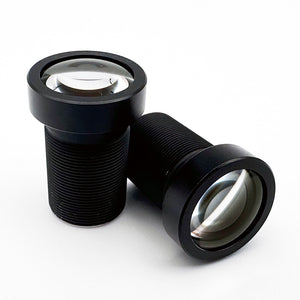
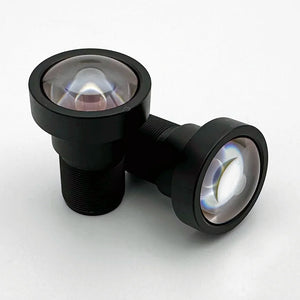
A varifocal does not solve an unstable working distance. If the target moves toward or away from the camera, the fix is sufficient depth of field, not a lens a technician has to readjust. It also does not preserve calibration: changing the focal setting shifts image scale, the distortion profile, and the principal point, so coefficients captured at one setting are invalid at another. Fix the focal length before calibrating. Commonlands stocks two manual varifocal M12 lenses, the 4mm-9mm CIL436 and the 6mm-42mm CIL461, for this commissioning role.
What Is a Zoom Machine Vision Lens?
A zoom machine vision lens changes focal length while a compensating optical group holds the image plane in place, so the picture stays sharp through the range. Holds is a tolerance, not an absolute: cam tracking error, assembly tolerances, and thermal drift leave a residual focus shift that the datasheet should bound. That stability is what separates a true zoom from a varifocal, and it is why zoom lenses carry more elements, tighter mechanical tolerances, and higher prices.
Inside the barrel, one group changes focal length while a second cancels the focus shift, coupled by a cam or driven by motors (Kingslake, Lens Design Fundamentals, 2nd ed., §18.3). Zoom ratio is the longest focal length over the shortest, so 6mm to 42mm is 7X. On many zoom designs the entrance pupil cannot grow in step with focal length once it reaches the front element clear aperture, so the F# climbs toward the telephoto end:
So any loop that commands a zoom move must also command exposure, gain, or illumination. Datasheet practice varies: some list both endpoints or a range, some publish a constant aperture, and some give one number without saying where it applies, so ask which end it describes. A motorized zoom makes runtime reframing possible without a technician, but adds failure modes: motor step accuracy, position tracking, and settling time. A system commanding moves mid-cycle must confirm the move has settled before it trusts the next frame.

What Is a Parfocal Lens?
A parfocal lens maintains focus while its focal length changes, within a specified focus tolerance rather than perfectly. The word names that behavior, nothing else. A true zoom is parfocal by design. A varifocal does not maintain focus within that tolerance as focal length changes. The term describes this behavior rather than a required internal group arrangement.
The Commonlands CIL461, sold as a 7X zoom M12 lens, is a manual varifocal, so it loses focus through a focal change: set the focal length, restore focus, lock both rings, and treat it as fixed from then on.
Varifocal vs Zoom Lenses in Machine Vision
Both change focal length. Only the parfocal zoom does it without a refocus step. A varifocal reframe has to adjust, refocus, and recalibrate, which a motorized varifocal can do under software between parts if the cycle time absorbs it. What a varifocal cannot do is reframe with focus and calibration intact. If the focal length is set once and locked, the cheaper varifocal wins. The parfocal zoom is what removes the refocus step. Pay for that behavior when the application uses it, not as insurance.
How Do You Choose Between Fixed, Varifocal, and Zoom Lenses?
Choose by when the focal length changes, then confirm against the table. Moving from an adjustable prototype lens to a fixed focal production lens should be an explicit design-review item, not an accident.
| Ihre Situation | Objektivtyp |
|---|---|
| Working distance and field of view confirmed. Geometry frozen | Objektiv mit fester Brennweite |
| Framing uncertain until installation. Adjusted once, then locked | Variofokal |
| Field of view changes during operation. No refocus step allowed | Parfokales Zoomobjektiv, motorisiert, sofern per Software gesteuert |
| Die Zielentfernung selbst variiert während des Betriebs | Festbrennweite mit ausreichender Schärfentiefe, kein Zoomobjektiv |
| Hochpräzise Messung mit enger Verzerrungstoleranz | Feste Brennweite, einmalig bei der Installation kalibriert |

Fixed and Varifocal Lens Picks Compared
Commonlands stocks two manual varifocal M12 lenses for bring-up and a set of fixed focal lenses for production, across M12 and C-mount. The table ranks them the way an integrator reaches for each: the CIL461 6mm–42mm varifocal to find a focal length, then a fixed focal lens to lock it in. The fixed picks run $39 to $149 and hold a single calibration. The varifocal trades that stability for a 7X focal-length range.
| Rang | Typ | Objektiv | Mount und EFL | Kalibrierung und Wiederholbarkeit | Optimale Passform |
|---|---|---|---|---|---|
| 1 | Manual varifocal | CIL461 | M12, 6mm–42mm, F/2.3 | Nach jeder Fokusänderung den Fokus neu einstellen und nachjustieren. Sobald der Bildausschnitt festgelegt ist, beide Ringe arretieren. | Inbetriebnahme: Durchlaufen Sie den Bereich an der tatsächlichen Einbauposition, um die Brennweite zu ermitteln. |
| 2 | Behoben | CIL059 | M12, 5,9 mm, F/1,7 | Ein Verzerrungsprofil von -4 %. Einmal kalibrieren, und die Einstellung bleibt erhalten, solange das Objektiv nicht bewegt wird. | Wide, locked production geometry on 1/1.7-inch sensors. The F/1.7 build resolves 4-6MP at 3µm pixels, and the slower F/4.0 and F/5.6 builds carry the 8-12MP ratings. |
| 3 | Behoben | CIL125 | M12, 12,5 mm, F/2,4 | The focal length is fixed, but focus rides on the M12 x 0.5 thread: tighten the lock nut against the holder after focusing, or the barrel walks under vibration. A light M12 body keeps mounting stress low. | Teleobjektiv-Bildausschnitt bei eingebetteten Systemen, Drohnen und Robotik-Konstruktionen mit Gewichtsbeschränkungen. |
| 4 | Behoben | CIL522 | C-Mount, 12 mm, F/1,4 | The iris tunes depth of field, not field of view, so a stored distortion correction usually stays close enough to reuse. Aperture, focus, and temperature can still move distortion and the principal point, so measure the shift before trusting it in a metric task. | C-Mount mit größerer Blendenöffnung für Aufnahmen bei schlechten Lichtverhältnissen mit einem Pixelabstand von 4,2 µm. |
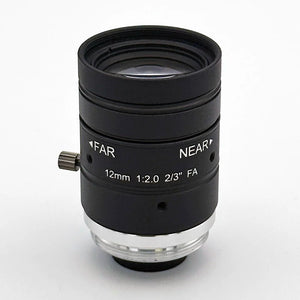
| 5 | Behoben | CIL532 | C-Mount, 12 mm, Blende F/2,0–F/16 | Stopping down buys depth of field without changing field of view, so a stored distortion correction usually carries over. Measure the shift before a metric task relies on it. On its 2.2µm pixels the Airy disk (2.44λN at 550nm) spans two pixel pitches near F/3.3, so past that marker the depth of field keeps growing with F# while contrast at fine detail falls off gradually. | 2/3-Zoll-12-MP-Produktionsauftrag, bei dem eine Blendensteuerung in der Fertigungslinie erforderlich ist. |
| 6 | Manual varifocal | CIL436 | M12, 4mm–9mm (2.25X), F/1.9–F/3.0 | Refocus and recalibrate per setting. The wide end is specified at about -65% barrel distortion, a display figure whose metric (TV, optical, or F-theta) the datasheet does not state. | Wide-angle reframing during bring-up. Correct the distortion before any metric task. |
For motorized C-mount zoom, vendors like Computar and Fujinon carry deeper catalogs. The fixed focal picks above are where Commonlands competes on published MTF, US stock, and price. Confirm image circle against your sensor before ordering.

Häufig gestellte Fragen
The Commonlands catalog runs mostly fixed focal M12 and C-mount lenses, so these distinctions decide what actually ships in a build.
Was ist der Unterschied zwischen einem Varioobjektiv und einem Zoomobjektiv?
Both adjust focal length. The difference is focus behavior. A true zoom (parfocal) lens holds focus through the focal-length change within a specified tolerance, so it can reframe mid-operation. A varifocal lens loses focus with every adjustment and needs a separate refocus step, which a motorized varifocal can run between parts when the cycle time allows. Catalogs blur the two terms, so verify focus behavior in the datasheet.
Ändert sich bei einem Zoomobjektiv die effektive Blende beim Zoomen?
Often, yes, though the amount is design-specific. On many variable-aperture zoom designs the entrance pupil cannot grow in step with focal length once it reaches the front element clear aperture, so the F# climbs toward the telephoto end, commonly by one to two stops. Constant-aperture designs hold the geometric F# across the range, which is not the same as constant light: transmission and relative illumination still vary, so check the T-stop or a measured flat field. Where the aperture drifts, exposure or illumination must compensate.
Muss ein Varioobjektiv neu kalibriert werden, wenn die Brennweite geändert wird?
Ja, in fast allen Fällen. Eine Änderung der Brennweite verändert den Bildmaßstab, das Sichtfeld und das Verzerrungsprofil und verschiebt den Fokus. Die bei der alten Einstellung gemessenen Verzerrungskoeffizienten, Maßstabsfaktoren (Pixel pro mm) und Homographien gelten nicht mehr. Führen Sie eine Neufokussierung, Neukalibrierung und erneute Validierung durch, bevor das System erneut Messungen durchführt.
Ist ein Objektiv mit fester Brennweite dasselbe wie ein Festbrennweitenobjektiv?
Optically, yes: both terms mean one focal length with no zoom. Prime lens is photography vocabulary. Fixed focal length lens is the machine vision term. Industrial fixed focal lenses are specified for sensor format coverage, distortion, and resolution across the image circle, which photography primes typically do not document.
Kann ich ein Varioobjektiv in einem industriellen Bildverarbeitungssystem einsetzen?
Yes, when field reframing is required (different part sizes at one station, for example). Lock the rings after setup and budget a refocus-plus-recalibration procedure for every adjustment. If the focal setting will never change in production, a fixed focal lens gives better repeatability with no drift-prone adjustment point.
Lock in the Right Focal Length
Send your working distance, scene size, and sensor part number to the Commonlands engineering team in San Diego. They will confirm whether a fixed focal lens covers it or a zoom earns its place, including motorized zoom requirements. Orders placed before 12 PM PT ship the same day.